Report says Trump presented with Khamenei option as envoy questions Iran’s ‘capitulation’
Axios report points to extreme US contingency planning as US intensifies pressure on Iran
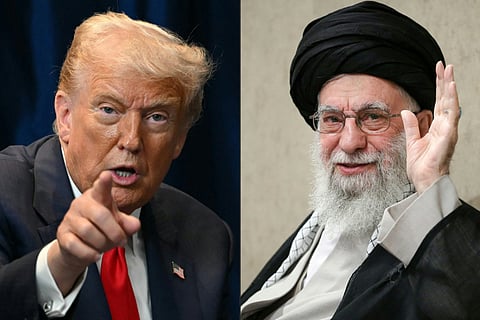
Dubai: President Donald Trump was presented with military options that include a scenario to kill Iran’s Supreme Leader Ayatollah Ali Khamenei and his son Mojtaba, according to a report by Axios, as Washington’s standoff with Tehran intensifies alongside ongoing nuclear diplomacy.
Citing US officials and advisers, the American publication said the proposal was floated in recent weeks as part of broader Pentagon contingency planning should negotiations with Iran fail.
“They have something for every scenario,” an adviser told Axios. “One scenario takes out the ayatollah and his son...”
US defence planners, according to the report, have prepared a range of contingencies as tensions persist, reflecting Washington’s strategy of coupling diplomacy with visible military leverage.
Witkoff signals pressure strategy
The broader pressure dynamics were echoed publicly by US envoy Steve Witkoff, who suggested President Donald Trump was questioning Iran’s response to Washington’s military posture in the region.
In a Fox News interview, Witkoff said Trump was “curious” why Tehran had not yielded under pressure.
“Why, under this pressure, with the amount of seapower and naval power over there, why haven’t they come to us and said, ‘We profess we don’t want a weapon, so here’s what we’re prepared to do’?” Witkoff said.
While stopping short of using the term directly, Witkoff added that the president wondered why Iran had not “capitulated.”
Diplomacy and military pressure collide
The disclosures come at a delicate moment in US–Iran relations, where diplomatic contacts over Tehran’s nuclear programme continue even as Washington reinforces its military posture in the Middle East.
Axios reported that Trump could be open to a deal allowing limited Iranian nuclear enrichment if Tehran provides assurances that its programme leaves “no possible path” to a nuclear weapon. However, officials warned that the threshold for any agreement remains exceptionally high.
“President Trump will be ready to accept a deal that would be substantive and that he can sell politically at home,” a senior US official told the publication.
At the same time, defence officials are said to be preparing for worst-case scenarios, underscoring the administration’s dual-track strategy of negotiations backed by deterrence.
Conflict fears mount across the region
Separate reporting by Reuters has pointed to growing concerns among regional governments that the standoff could slide toward military confrontation.
Gulf states and Israel are closely watching developments, with Israeli officials reportedly assessing potential joint responses if diplomacy collapses.
While speculation about possible US military action has circulated in American media, no formal decision has been announced by the White House.
“Trump is keeping his options open. He could decide on an attack at any moment,” an adviser told Axios.
Iran rejects suspension claims
Tehran has publicly insisted its nuclear programme is peaceful and denied that it has agreed to halt enrichment activities.
Iranian Foreign Minister Abbas Araghchi said discussions have focused on mechanisms to ensure the programme remains civilian in nature, including possible technical safeguards and monitoring arrangements involving the UN nuclear watchdog.
“What we are now talking about is how to make sure that Iran’s nuclear programme, including enrichment, is peaceful and would remain peaceful forever,” Araghchi said.
Iran is expected to submit a written proposal in the coming days.
Highly sensitive implications
Any suggestion of targeting Iran’s supreme leadership carries profound geopolitical implications. Analysts note that leadership decapitation scenarios are often included in military planning but remain among the most politically and strategically consequential options.
Neither the White House nor the Pentagon has publicly commented on the Axios report.
About Axios
Axios is a US-based digital news organisation covering politics, policy, and national security. Founded in 2016, the outlet is known for its Washington-focused reporting and coverage of the White House and US government.


