Breakthrough or pressure? Tehran talks split Iranian voices
Gulf security and Yemen remain key hurdles in Iran's diplomatic efforts
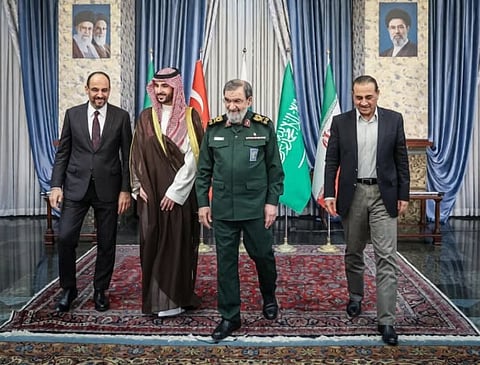
A diplomatic push in Tehran has divided Iranian commentators, with some portraying the visit by Saudi, Turkish and Pakistani officials as recognition of Iran’s influence and others warning it could bring pressure for concessions.
Monday’s four-way meeting ended with a commitment to continue dialogue on peace and security, but no announced agreement on the war, the Strait of Hormuz or Iran’s nuclear program.
Saudi Defense Minister Prince Khalid bin Salman, Pakistani army chief Asim Munir and Turkish intelligence chief Ibrahim Kalin attended the talks.
Reuters quoted a Pakistani official as saying Munir had presented a proposal intended to offer something to both Washington and Tehran, with President Donald Trump’s approval to pursue diplomacy.
Get it: Fast, verified news for FREE ... download the Gulf News app — simply click here
'Guarantor'
Authorisation to explore diplomacy does not establish that Washington approved every term of a completed agreement. Details were not disclosed.
The official said Pakistan, Turkey, Saudi Arabia and Qatar could serve as guarantors if Iran accepted the proposal.
Iran International reported that the state-run Iran newspaper welcomed the meeting under the headline “Without Iran, Never,” arguing that regional security could not be established without Tehran.
Hardline commentator Abdollah Ganji described Iran as the centre of an emerging security arrangement and suggested an “anti-Zionist bloc” was forming.
Non-aggression
Former Foreign Minister Mohammad Javad Zarif proposed a broader network emphasising non-aggression, confidence-building and prosperity.
“Regional security cannot be imported; it must be built together by the people of this region,” he wrote.
Other commentators urged caution. Mostafa Najafi said mistrust and competition had not necessarily given way to cooperation, describing regional meetings as crisis management rather than conflict resolution.
Former parliamentary security committee chairman Heshmatollah Falahatpisheh argued that Yemen was the visitors’ more immediate concern.
“As long as the Yemen issue remains unresolved, the Iran issue will not be put on the agenda,” he told Khabar Online, according to Iran International.
In a subsequent development Tuesday, Qatar said successful mediation required Iran to demonstrate good intentions by ending threats against Gulf states and opening Hormuz.
The contrasting reactions show that continued talks alone do not establish reconciliation. Concrete commitments and responses remain necessary to assess diplomatic progress.
Why it matters
The talks connect Iran’s confrontation with Washington to Gulf security and Yemen. Regional guarantees could support diplomacy, but priorities and distrust complicate any agreement. Continued dialogue is significant. However, it is not proof that military threats or shipping risks have ended.
What’s next
Watch for disclosure of the proposal, Iranian and American responses, and details of possible regional guarantees. Qatar’s concerns add pressure for concrete steps on Gulf threats and Hormuz.
Further meetings matter only if they produce verifiable commitments and practical implementation.