Riyadh airport attack: Death toll, flight disruption and US response
Attack halted airport operations and shifted Riyadh schools to remote learning for a week
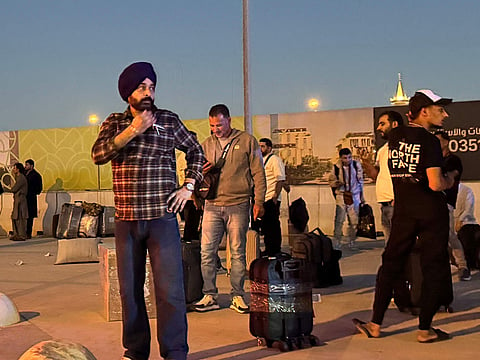
The latest attack on King Khalid International Airport in Riyadh killed 12 people and wounded 309, according to Saudi Arabia’s civil aviation authority. The Saudi-led coalition blamed Yemen’s Iran-backed Houthis and vowed a decisive response.
The attack led to the suspension of airport operations, a week of distance learning for schools in Riyadh and warnings from several foreign embassies. It also raised the prospect of US involvement in the conflict.
Get updated faster and for FREE: Download the Gulf News app now - simply click here.
Here is what we know so far.
What happened at the airport?
Four Saudi citizens were among the dead, along with two Bangladeshis and one national each from the United States, Egypt, Jordan, Syria, Palestine and Sudan, the civil aviation authority said. Some of the wounded were in serious condition.
A diplomatic source told AFP that a missile was responsible. A regional official, speaking on condition of anonymity, said it struck a complex containing terminals 3 and 4, which serve domestic flights.
One passenger told AFP they witnessed the strike near the domestic terminal.
“I was on gate 403,” the passenger said. “I saw 401 hit, I saw injured in front of my eyes. Everyone was running.”
Airport operations were suspended as authorities assessed the damage. Flight-tracking platform Flightradar24 said the closure was later extended until 9pm on Sunday.
AFP described the attack as the deadliest on Saudi soil since May 2015, when a suicide bombing claimed by the Islamic State group killed 21 worshippers at a Shia mosque in Qatif.
Who was behind the attack?
The Saudi-led coalition blamed the Houthis for the airport strike.
Coalition spokesman Major General Turki Al Malki described the attack as a “full-fledged war crime”, saying it had caused deaths and injuries among civilian passengers and airport staff.
The Houthis had not immediately claimed responsibility for Saturday’s strike. They had claimed a series of attacks on the airport on Thursday that they said killed three people and damaged a plane.
Claims by the parties to the conflict have not been independently verified in all cases, AFP reported.
Could the US join Saudi military action?
Asked on Saturday whether he had changed his mind about joining Saudi strikes on the Houthis, US President Donald Trump said: “We may.”
Trump said he would speak to Saudi Crown Prince Mohammed bin Salman and described what had happened in Saudi Arabia as “not acceptable”.
US Secretary of State Marco Rubio confirmed that an American citizen was among those killed. US media outlets have reported that previous Saudi requests for American military assistance against the Houthis were rebuffed, AFP said.
How are schools, flights and travel affected?
Schools in Riyadh switched to distance learning for the week following instructions from Saudi Arabia’s Ministry of Education.
Parents received emails on Sunday, seen by AFP, citing the ministry’s order. The email said: “All schools in Riyadh will switch to distance learning for the entire week.” It was the second time in less than a month that such an instruction had been issued.
The US, Canadian, German and Spanish embassies warned their citizens to avoid the airport. A senior Western diplomat told AFP that several embassies were banning staff from using it over the following week.
In a security alert issued on October 11, the US Mission to Saudi Arabia warned of possible flight cancellations, airspace closures and travel disruptions.
Emirates, Etihad Airways, flydubai and Air Arabia reported cancellations and schedule changes on routes between the UAE and Saudi Arabia. Passengers were advised to check their flight status directly with their airlines before travelling.
How have other countries reacted?
Several countries condemned the attack and expressed solidarity with Saudi Arabia.
Pakistan’s Prime Minister Shehbaz Sharif condemned the “heinous attack” and reaffirmed Islamabad’s commitment to Saudi Arabia’s security under their defence agreement.
India also strongly condemned the strike and expressed solidarity with Saudi Arabia in protecting its sovereignty.
Qatar described the Houthi attacks as a serious violation of Saudi Arabia’s sovereignty and a direct threat to regional security, civilians and aviation safety.
Jordan condemned the attack as a violation of Saudi sovereignty and a dangerous escalation threatening the kingdom’s security and stability. It also said the strike breached international law and the United Nations Charter.
Egypt condemned continued attacks on Saudi Arabia, including the airport strike, describing them as violations of international law and showing disregard for the safety of civilians of various nationalities.


