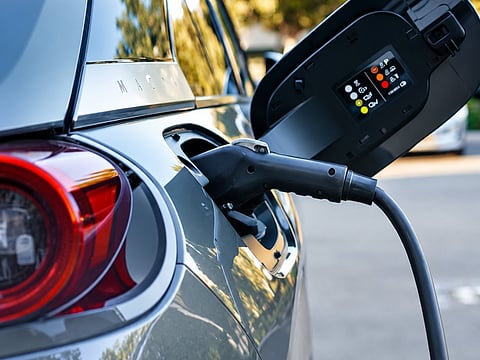
Oman sets EV charging fees from October, tariffs to reach 120 baisa per kWh

New rates will vary according to charging capacity, with three tariff categories
Last updated:
Khitam Al Amir, Chief News Editor
Under the approved rates, charging stations with a capacity of up to 90 kilowatts will charge 50 baisa per kWh. The tariff will rise to 90 baisa per kWh for chargers with capacities ranging from 91kW to 180kW, while chargers with a capacity of 181kW or more will charge 120 baisa per kWh.
Supplied

Dubai: Dubai:  Oman will introduce regulated fees for electric vehicle charging from October 1, with motorists paying between 50 and 120 baisa per kilowatt-hour depending on the capacity and speed of the charger.

The Ministry of Transport, Communications and Information Technology announced the new tariff structure in coordination with the Authority for Public Services Regulation and Oman Net Zero Centre as part of efforts to regulate the country’s growing EV charging market.

Get updated faster and for FREE: Download the Gulf News app now - simply click here.

Under the approved rates, charging stations with a capacity of up to 90 kilowatts will charge 50 baisa per kWh. The tariff will rise to 90 baisa per kWh for chargers with capacities ranging from 91kW to 180kW, while chargers with a capacity of 181kW or more will charge 120 baisa per kWh.

The new pricing framework is intended to improve transparency for EV owners and users while supporting the expansion and long-term sustainability of Oman’s charging infrastructure.

Authorities said the tariffs were set following a comprehensive study of the economic and operational aspects of EV charging stations.

The study sought to strike a balance between keeping charging affordable for motorists and ensuring that operating charging stations remains commercially viable and attractive to investors.

The move forms part of Oman’s broader efforts to develop a regulated electric mobility ecosystem as the country expands infrastructure for electric vehicles and pursues its long-term net-zero ambitions.

Khitam Al Amir
Khitam Al AmirChief News Editor
With over 30 years of journalistic experience spanning from Jordan to the UAE, Khitam has spent the past 22 years reporting on national and regional news from Dubai, with a strong focus on the UAE, GCC and broader Arab affairs. As Chief News Editor, she brings extensive expertise in delivering breaking and engaging news to readers. Beginning her tenure as a translator, she advanced through roles as Senior Translator and Chief Translator before transitioning to editorial positions, culminating in her current leadership role. Her responsibilities encompass monitoring breaking news across the UAE and the broader Arab region, ensuring timely and accurate dissemination to the public.​ Born into a family of journalists, Khitam's passion for news was ignited early in life. A defining moment in her youth occurred in September 1985 when she had the opportunity to converse with the late British Prime Minister Margaret Thatcher during her visit to a Palestinian refugee camp north of Amman. During this encounter, Khitam shared her family's experiences of displacement from their home in Palestine and their subsequent refuge in Jordan. This poignant interaction not only deepened her understanding of geopolitical issues but also solidified her commitment to pursuing a career in journalism, aiming to shed light on the stories of those affected by regional conflicts. Khitam’s commitment to accurate and timely reporting drives her to seek out news that interests readers, making her a trusted source for news on the UAE and the broader Gulf region.
Related Topics:

Get Updates on Topics You Choose

By signing up, you agree to our Privacy Policy and Terms of Use.
Up Next