Lasers, satellites and cyber tools: Inside 'Operation Epic Fury' — America’s high-tech war on Iran
Space Force sensors track missiles while lasers target drones
Dubai: As the war between the United States, Israel and Iran intensifies, Washington is deploying an array of advanced technologies — including satellite tracking systems, cyber tools and potentially laser weapons — to counter Iranian missiles and drones.
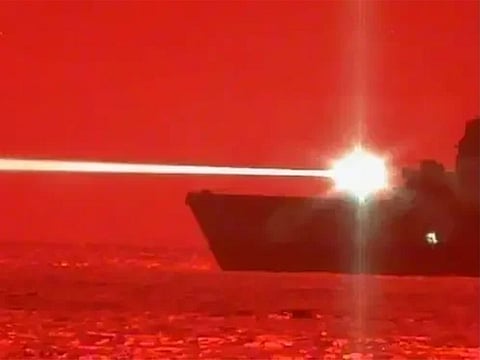
Videos released by United States Central Command appear to show a new directed-energy weapon system deployed on a US Navy destroyer operating in the Middle East.
The weapon is believed to be the High Energy Laser with Integrated Optical Dazzler and Surveillance (HELIOS), a powerful laser designed to disable or destroy drones and small aerial threats using a concentrated beam of energy.
According to a report by the New York Post, the system is part of 'Operation Epic Fury', a broader effort involving satellites, cyber tools and electronic warfare to neutralise Iranian weapons systems.
The HELIOS laser system features a steerable beam capable of focusing intense energy on incoming drones, potentially burning through their structure or disabling onboard electronics.
The technologies shaping the US war on Iran
Laser weapons (HELIOS): The High-Energy Laser with Integrated Optical Dazzler and Surveillance (HELIOS) system mounted on US Navy destroyers can fire concentrated energy beams capable of destroying drones and disabling sensors.
Space Force missile tracking: Satellites operated by the US Space Force detect missile launches using infrared sensors that identify the heat produced by rockets seconds after launch.
Patriot missile defence: Once detected, incoming missiles can be intercepted by systems such as the Patriot missile defence system, which destroys them mid-air.
Radar domes and ground control: Space Force personnel work from radar-covered facilities called radomes, analysing satellite data and calculating missile trajectories in real time.
Cyber and electronic warfare: Military-grade malware and radar-jamming tools are used to disrupt Iranian missile launchers, drones and communications networks.
However, neither the United States nor Israel has officially confirmed whether laser weapons are currently being used in combat operations against Iran.
The US Navy previously announced that the HELIOS system successfully destroyed multiple drones during a test earlier this year.
Satellites watching the battlefield
Much of the technological backbone of the campaign lies in space.
The United States Space Force, established in 2019, plays a crucial role in detecting missile launches and providing early warning to US and allied forces.
According to Brent David Ziarnick, a former professor in the Space Force programme at Johns Hopkins University, satellites equipped with infrared sensors are capable of detecting missiles almost immediately after launch.
“These satellites have infrared sensors that detect the heat signature of rockets,” Ziarnick told the New York Post.
“They can spot missiles and pinpoint where the launchers are. The missiles can then be intercepted and destroyed, often using Patriot missile systems.”
The satellite network also allows US and allied forces to receive rapid warnings of incoming missile attacks.
This gives military personnel time to take cover in bunkers or shelters and allows missile defence systems to prepare for interception.
According to reports cited by ABC News, the infrared detection systems have helped track and intercept hundreds of Iranian missiles during the conflict.
Radar domes and missile tracking
Although the Space Force operates satellites in orbit, much of its operational work is carried out on the ground.
Personnel stationed at specialised facilities inside radar domes — known as radomes — analyse incoming satellite data in real time.
These teams calculate the trajectory of missiles and relay targeting information to missile defence units.
Sam Eckhome, host of the technology programme Access Granted on YouTube, said the system is designed to ensure the United States can detect threats as early as possible.
“The system is built to ensure that if a missile is ever launched, the United States will be the first to know about it,” he said.
Missiles, drones and cyber warfare
Alongside satellite tracking and potential laser weapons, cyber tools and electronic warfare are also being used to disrupt Iranian weapons systems.
According to the New York Post, US-developed satellites, military-grade malware and radar-jamming software are being used to locate and disable missile launchers and drone networks.
US military forces have struck around 1,700 targets during the first 72 hours of the war, the report said, destroying more than 200 Iranian ballistic missile launchers while disabling dozens more.
The conflict began on February 28, when US and Israeli forces launched strikes inside Iran that reportedly killed Supreme Leader Ali Khamenei.
Since then, Tehran has fired waves of missiles and drones at Israeli territory and US military bases across the Gulf.
Human Rights Activists News Agency (Human Rights Activists News Agency) has reported that more than 1,000 civilians were killed during the first five days of the bombing campaign, including 181 children under the age of 10.
As the conflict continues to escalate, the battle is increasingly being fought not only with missiles and aircraft — but also through cutting-edge technology operating in space, cyberspace and the electromagnetic spectrum.


