Italy to send air-defence aid to Gulf countries; What are SAMP/T missile shields and anti-drone systems?
Meloni: Air defence aid not just for friends, but to protect Italians and troops
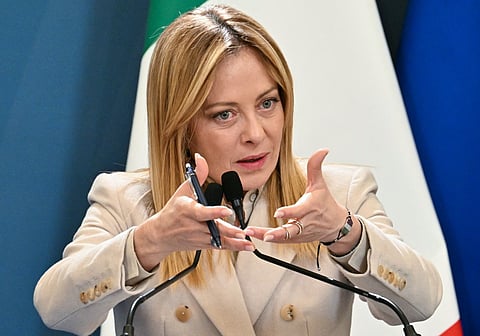
Dubai: Italy plans to send air-defence assistance to Gulf countries targeted by Iranian strikes launched in retaliation for US-Israeli attacks, Prime Minister Giorgia Meloni said on Thursday, as the widening conflict raises security concerns across the region.
“Italy, like the UK, France and Germany, intends to send aid to the Gulf countries,” Meloni told RTL 102.5 radio. She said the assistance would focus on defensive capabilities.
“We are clearly talking about defence, air defence, not just because they are friendly nations but because there are tens of thousands of Italians in that area and around 2,000 Italian soldiers that we must protect,” she said.
Meloni added that stability in the Gulf was crucial for Europe’s energy security, describing the region as “vital for energy supplies for Italy and Europe”.
What is the SAMP/T air-defence system?
European missile shield: SAMP/T (Sol-Air Moyenne Portée/Terrestre) is a Franco-Italian surface-to-air missile defence system developed by Eurosam, a joint venture between MBDA and Thales Group.
Designed to intercept missiles and aircraft: It is built to destroy ballistic missiles, cruise missiles, drones and enemy aircraft, protecting cities, military bases and key infrastructure.
Uses Aster interceptor missiles: The system fires Aster 30 missile interceptors that can strike incoming targets at ranges of up to about 120 km and at high altitude.
Mobile and rapid-deployment: Mounted on trucks with radar and launch units, SAMP/T can be quickly deployed and repositioned, making it suitable for protecting forward bases or vulnerable sites.
Europe’s answer to Patriot Often compared with the Patriot missile system, SAMP/T is one of Europe’s most advanced ground-based air-defence systems and is used by several Nato countries.
Italian officials said the government was considering sending military equipment including an air-defence system capable of intercepting ballistic missiles.
Two sources told Reuters that Rome was likely to deploy one of its SAMP/T air-defence batteries, a Franco-Italian system designed to counter missile threats. A final decision has not yet been made, and officials did not say which Gulf country might receive the system.
The sources added that Italy could also provide anti-drone systems, which could be transferred more quickly while a technical assessment of the situation continues.
What are anti-drone defence systems?
Built to stop hostile drones: Anti-drone systems are designed to detect, track and neutralise unmanned aerial vehicles (UAVs) that can be used for surveillance or attacks.
Detect threats early: They typically use radar, radio-frequency sensors and electro-optical cameras to identify incoming drones and track their flight path.
Multiple ways to neutralise drones: Once detected, systems can stop drones using electronic jamming, GPS spoofing, directed energy weapons, or interceptor missiles and guns.
Key defence against modern warfare: Cheap attack drones have become widely used in conflicts in the Middle East and elsewhere, making anti-drone systems essential to protect military bases, airports, ports and energy facilities.
Rapid and flexible deployment: Many anti-drone systems are mobile and quick to deploy, allowing countries to protect vulnerable infrastructure or respond quickly during crises.
The moves come after Iranian retaliation following strikes by US and Israeli forces on Iran, with drones and missiles targeting ports, cities and oil facilities across the Gulf — a region critical to global energy supplies.
Italy’s Defence Minister Guido Crosetto said earlier this week that Rome had received requests from Gulf countries for air-defence and anti-drone systems, including the SAMP/T battery.
As tensions spread across the wider Mediterranean, Britain, France and Greece have also said they would send air-defence forces to Cyprus after drones struck the Royal Air Force base at Akrotiri on the island.
Meloni was also asked about the possible involvement of US military bases located in Italy in operations linked to the conflict. She said the bases currently have authorisation only for “non-bombing operations” and that any change would have to be considered by the Italian government and likely approved by parliament.
“To date, we have received no requests in this regard,” she said.
Italy’s energy minister has also warned that Rome could reactivate some coal-fired power plants if the conflict disrupts energy supplies, though the country is not heavily dependent on Gulf oil and gas.


