UAE launches national initiative for climate-smart crops to boost food security
The UAE initiative aims to strengthen its leadership in climate-adaptive agriculture model
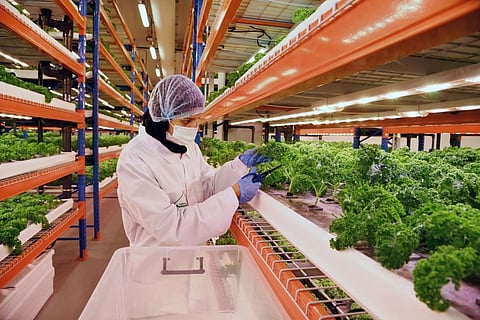
During the second edition of the UAE Conference and Exhibition in Al Ain, the official launch of the “National Agricultural Initiative for the Adoption of Climate-Smart Crops in the United Arab Emirates” was announced. This strategic step is led by the Ministry of Climate Change and Environment in collaboration with the International Center for Biosaline Agriculture (ICBA).
The initiative aims to reinforce the UAE’s position as a leading global model in climate-adaptive agriculture by transforming scientific research outcomes into practical field solutions that ensure sustainable water resource management and achieve national food sovereignty, in alignment with the objectives of the National Food Security Strategy 2051.
Get updated faster and for FREE: Download the Gulf News app now - simply click here.
Through its strategic pillars, the initiative seeks to diversify the national food basket, reduce reliance on imports, and enhance self-sufficiency in food and feed production, thereby establishing a resilient and sustainable local production system.
Features of future agricultural production
At its core, the initiative focuses on four strategic crops well-suited to the UAE’s environment. Leading this list are millet (including foxtail and pearl millet) and sorghum, which offer practical solutions to water scarcity challenges. These crops require up to 50% less water than conventional grains while maintaining high productivity under extreme temperatures exceeding 45°C.
Beyond their environmental resilience, these grains also provide significant nutritional benefits. They are rich in fiber and minerals and are naturally gluten-free, making them ideal for meeting the needs of modern consumers seeking healthy and sustainable food options.
As part of efforts to integrate these crops into the Emirati diet, a specialized “Emirati Recipe Book” will be developed, featuring climate-smart crops as key ingredients. This guide will inspire households and food enthusiasts to incorporate these products into local cuisine, blending heritage with innovation and sustainability.
Innovative solutions
In the livestock sector, “Blue Panicum Grass” emerges as an innovative solution for producing high-quality fodder with minimal freshwater consumption. This crop is highly tolerant to salinity and drought, enabling its cultivation in saline-affected soils and irrigation with non-conventional water sources. This integrated approach aims to strike a careful balance between agricultural growth and groundwater conservation.
A transformational shift in national agricultural production philosophy
Commenting on the initiative, Dr. Amna bint Abdullah Al Dahak, Minister of Climate Change and Environment, emphasized that its launch represents a fundamental shift in the philosophy of national agricultural production, placing food security at the core of the country’s strategic priorities.
Dr. Amna stated: “We are laying the foundation for a new phase of food sovereignty built on knowledge and innovation. Through this initiative, we aim to adopt climate-smart solutions specifically designed to suit the UAE’s unique environmental conditions, enabling the development of a resilient food system capable of addressing global challenges and meeting the aspirations of future generations for a secure and sustainable future.”
She added: “Investing in climate-smart crops is the most sustainable and optimal approach given our desert climate and limited water resources. This initiative enhances agricultural productivity, empowers our farmers and agricultural workforce, and promotes innovative practices that deliver maximum economic returns with minimal environmental impact. We firmly believe that investing in agricultural innovation is an investment in the nation’s sustainability. By embedding these crops into UAE soils, we are establishing a global benchmark for leveraging technology and scientific research to achieve food security goals under challenging climate conditions.”
An advanced model of integration between government vision and specialized research expertise
Dr. Tarifa Al Zaabi, Director General of the International Center for Biosaline Agriculture (ICBA), praised the launch of this national initiative, highlighting it as a leading example of integration between government vision, specialized research expertise, and practical implementation.
She stated: “This initiative represents a significant milestone in transforming scientific knowledge into applicable agricultural and food solutions. It reflects more than 25 years of ICBA’s research in developing and testing crops capable of adapting to salinity, high temperatures, and water scarcity. Through this partnership, ICBA contributes to transferring this scientific legacy from laboratories and field trials to farmers’ fields and food value chains, bringing agricultural innovation closer to the needs of producers and consumers alike, and supporting the integration of climate-smart crops into a more diverse and sustainable food system in the UAE.”


