Left hand in right hands: 10-hour surgery reattaches Pakistani expat’s arm in Abu Dhabi
Arif’s mid-forearm amputated after workplace accident on a lathe machine
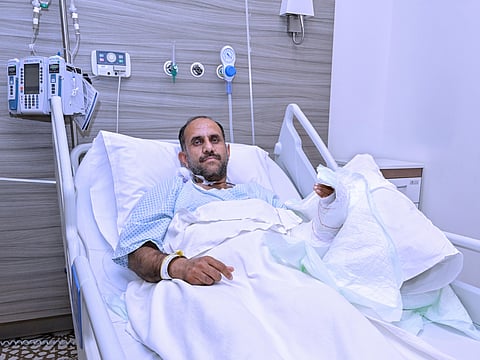
A routine workday turned into a race against time for a Pakistani expat labourer in Abu Dhabi when a workplace accident severed his left hand. In a delicate 10-hour emergency operation at Burjeel Medical City, doctors successfully replanted the limb.
Months have passed, but 50-year-old Tanveerullah Arif still can’t shake the memory of the life-altering incident on September 29.
“Everything happened so quickly. The machine was running, and I just touched it… and it happened,” said Arif, a resident of Al Dhannah City, recalling the horrifying moment while working on a lathe machine – a job he has done for the past 20 years. On that day, however, his left hand was unexpectedly caught in the machine, resulting in a complete mid-forearm amputation.
“Immediately, the company’s emergency team and firefighters took me to the hospital. I was conscious then,” noted Arif, whose wife and four children live in Pakistan.
Complex surgery
He was first rushed to the nearby Burjeel Al Dhannah Hospital for initial care, and later transferred to Burjeel Medical City (BMC) in Abu Dhabi for advanced treatment. There, a team of specialists worked in close coordination for 10 hours to replant his completely amputated mid-forearm. It was a highly complex procedure made even more challenging by a severe crush-avulsion injury.
Race against time
The accident occurred around 4:30 pm. The BMC team received a call an hour later, and emergency teams transported Arif by road, arriving to the hospital at 8:15 pm.
Dr Praveen Kumar Arumugam, Specialist in Plastic and Reconstructive Surgery at BMC, recalled that Arif was conscious but had lost a significant amount of blood.
“He was immediately shifted to the operating theatre, where anaesthetists resuscitated him and administered a nerve block to prepare for the remaining procedures,” Dr Arumugam said.
Replanting the limb
Upon arrival, the team carefully dissected both the amputated and remaining parts of the forearm to identify muscles, tendons, nerves, arteries, veins, and bones. This was followed by debridement, a procedure in which dead, damaged, or contaminated tissue is removed to promote better healing.
The next step involved stabilising the two forearm bones using plates and screws, followed by the delicate repair of blood vessels, muscles, tendons and nerves. Two arteries and four veins were restored to ensure proper blood flow, while the patient was given blood thinners to prevent clotting. Once the internal repairs were complete, the skin was sutured.
Three days later a skin graft was applied to areas where tissue had been lost. The hand was then placed in a cast to keep it elevated. In total, six units of blood were transfused during the procedure, and anaesthetists monitored the patient to prevent reperfusion injury, a complication that could affect the heart or kidneys. The surgery aimed to restore the hand’s ability to grasp and move.
The surgical team
Besides Dr Arumugam, the plastic surgery team included Dr Arivind Bhamidi, Specialist, Plastic Surgery, and Dr Michael Rebeiro, Consultant Plastic Surgeon and Director of Plastic Surgery. The orthopaedic team included Dr Ahmed Hammouda, Consultant Orthopaedic Surgeon, while anaesthesia was handled by Dr Mahmoud Mohamed, Specialist, Anaesthesia, and Dr Ahmed Omran, Consultant, Anaesthesia and Pain Management. According to the doctors, Arif’s age and healthy body with no comorbidities favoured the surgery.
Critical 6-hour window
In scenarios like this, the golden window to preserve and reattach the severed part is six hours. Luckily, the patient reached BMC within that time frame with the severed part preserved properly, and the medical team could ensure blood flow. What made it complex was the type of injury – a combination of crush, avulsion, and amputation.
“It was not a clean cut like a knife cut, but an avulsion, where the part was torn off, making it even more challenging,” said Dr Bhamidi.
During the patient’s transit, the team equipped themselves for the microsurgery, where they connect very small blood vessels under a microscope. It ensured there was no delay in surgical management.
Currently, Arif is under recovery, which includes physiotherapy for the movement of fingers, and other procedures if required after follow-up assessments.
“The surgery went well, and the doctors here are taking good care of me. I’m feeling much better now. I can even move my hand a little bit again,” Arif added.


