UAE pushes stronger women's partnerships at BRICS meetings in India
UAE highlights AI, leadership and women's empowerment initiatives during India summit
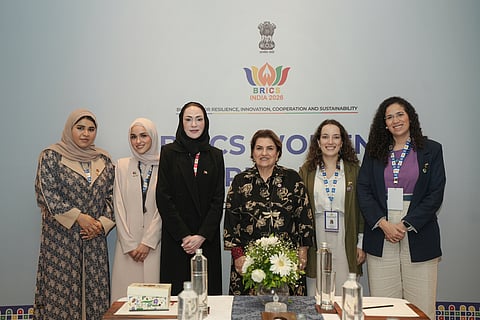
The UAE, represented by the UAE Gender Balance Council, participated in the BRICS Women Working Group Meeting and BRICS Women Ministerial Meeting held from July 6 to 9 in Kochi, Kerala, India, as part of India's 2026 BRICS presidency.
The meetings brought together ministers and officials responsible for women's affairs to discuss the draft BRICS Joint Ministerial Statement and four priority areas: leadership and governance; financial and digital inclusion; entrepreneurship and skills development; and climate action, food security and nutrition.
Vision and message
Sheikha Manal bint Mohammed bin Rashid Al Maktoum, President of the UAE Gender Balance Council and wife of His Highness Sheikh Mansour bin Zayed Al Nahyan, Vice President, Deputy Prime Minister and Chairman of the Presidential Court, said the UAE views gender balance as a key pillar of sustainable development and national competitiveness.
Get updated faster and for FREE: Download the Gulf News app now - simply click here.
She also praised India's leadership of the BRICS Women's Track for strengthening dialogue and cooperation among member states.
Sheikha Manal said: "The United Arab Emirates believes that international partnerships, constructive dialogue and the exchange of expertise are essential elements for accelerating progress and translating commitments into practical and sustainable outcomes. From this perspective, the UAE continues to work with its partners within BRICS and around the world to translate shared outcomes into policies, partnerships and practical initiatives that expand opportunities for women and strengthen their role in sustainable development."
UAE experience
At the ministerial meeting, the UAE outlined its approach to advancing gender balance through policies and legislation, including We the UAE 2031, the National Policy for Empowerment of Emirati Women 2023–2031, and the UAE Gender Balance Strategy 2027–2031.
The delegation also highlighted the country's progress in leadership, diplomacy, entrepreneurship, digital transformation, artificial intelligence and climate action. It noted that the UAE ranked first among Arab countries in the Global Gender Gap Report 2025 and first regionally in the UNDP Gender Inequality Index.
The UAE also showcased initiatives including the SDG 5 Pledge, under which 88 private-sector companies have committed to raising women's representation in middle and senior management to 30% by 2028, alongside programmes supporting families, technology, AI and climate action.
Mona Ghanem Al Marri, Vice President of the UAE Gender Balance Council, said: "The BRICS Women's Track represents a strategic platform for strengthening international dialogue, building partnerships, and exchanging expertise, thereby supporting the development of more inclusive and sustainable policies and reinforcing women's role as a key partner in achieving economic growth and sustainable development. The United Arab Emirates believes that international cooperation is a vital pillar for accelerating progress and transforming shared ambitions into initiatives that deliver tangible impact."
Outcomes and partnerships
The UAE participated in discussions on the draft BRICS Joint Ministerial Statement, the BRICS Guidelines for Building Women's Digital Capacity, and the Shared Digital Library of Best Practices, which aim to strengthen knowledge sharing and capacity building among member states.
Mouza Al Ghuwais Al Suwaidi, Secretary General of the UAE Gender Balance Council, said: "We look forward to building on the outcomes of this meeting by expanding partnerships, exchanging expertise, and working with our partners to transform our shared vision into initiatives and policies that deliver sustainable impact, strengthen women's participation across various sectors, and support the achievement of the Sustainable Development Goals."
On the sidelines of the meeting, the UAE delegation held bilateral talks with Annapurna Devi, India's Union Minister for Women and Child Development; Márcia Lopes, Brazil's Minister of Women; and Olga Batalina, First Deputy Labour and Social Protection Minister of Russia.
The meetings focused on cooperation in women's economic empowerment, entrepreneurship, the digital economy, skills development, climate action, care policies and the exchange of best practices in gender balance legislation.
Conclusion of the participation
The UAE welcomed the adoption of the Joint Ministerial Statement, saying it supports stronger international cooperation and the development of policies and initiatives that expand women's participation in sustainable economic and social development.
The country reaffirmed its commitment to work with BRICS member states and international partners to translate the outcomes into practical initiatives and partnerships that advance gender balance and women's empowerment.


