Etihad Rail's Dubai station almost ready to welcome passengers: All you need to know
New Dubai station to connect Etihad Rail with wider city transport network
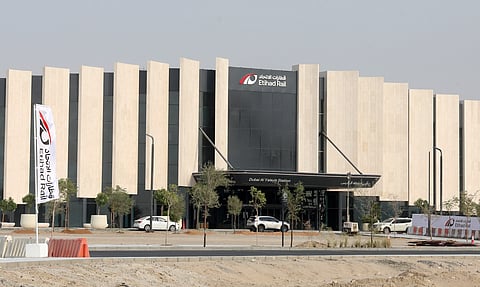
Dubai: Etihad Rail's first passenger journeys between Abu Dhabi and Fujairah have been highly popular and successful. Now, attention is turning to what comes next: Dubai's own station, and how easily people will actually be able to reach it.
With just over 75 days to go before Dubai gets on the map, the station is almost ready to welcome passengers. Opening on September 30, the station is located inside Jumeirah Golf Estates, a gated luxury community in the southern part of the city, positioned directly along Sheikh Mohammed Bin Zayed Road for easy road access. It will open alongside Al Dhaid station in Sharjah, marking the network's second major phase after the introductory Abu Dhabi-Fujairah route. But what has drawn particular interest isn't just the train itself, it's what happens the moment passengers step off it.
Get updated faster and for FREE: Download the Gulf News app now - simply click here.
A four-minute gap, and a bridge to close it
Dubai's Etihad Rail station sits remarkably close to the existing Metro station at Jumeirah Golf Estates, just four minutes apart. Rather than letting the two run as separate systems, Etihad Rail is actively building on that proximity to create one continuous journey for passengers. A footbridge is currently under construction to physically connect the two stations, already being described as a major public transport interchange for the city.
According to Adhraa Almansoori, Executive Director of Commercial and Support at Etihad Rail Mobility, authorities will follow the same approach to last-mile connectivity established at the Abu Dhabi and Fujairah stations as they roll out Dubai and Al Dhaid. In Dubai, that could mean linking to the Metro, given how close the station is, as well as connecting with existing public buses and taxis. Ultimately, she said, it's about providing seamless connectivity for passengers.
That philosophy reflects a broader view at Etihad Rail: the passenger experience doesn't begin or end at the platform, it includes everything involved in reaching and leaving the station. In Abu Dhabi, that thinking produced a dedicated Dh10 shuttle service linking Mohamed Bin Zayed City Station to ADNOC's headquarters, the ADNEC Centre, and Reem Mall, alongside integration with public buses, taxis, and top-up points for the Hafilat transport card. The passenger charter on Etihad Rail's website confirms Metro and bus services will connect to the train stations, reinforcing that Dubai's stop is designed as a transfer point rather than a standalone terminus.
Getting there: More than just the Metro
Beyond the footbridge, the station's location brings other practical advantages. Its Metro connection opens onto Dubai's wider inner-city transport network, and nearby communities including Green Community, Al Furjan, Dubai Investment Park, Dubai Production City, and Expo City Dubai all sit within reach, giving residents across southern Dubai a realistic option to leave the car at home. For air travellers, the station is roughly 30 minutes from Al Maktoum International Airport (DWC) in Dubai South, the site being developed to become the world's largest airport.
Part of a much bigger network
Dubai's station is one piece of a larger 900km rollout designed to connect 11 cities and regions nationwide, from Al Sila in the west to Fujairah in the east, passing through Ruwais, Al Mirfa, Sharjah, Al Dhaid, Abu Dhabi, and Dubai. Each train carries up to 400 passengers, with multiple daily trips planned to serve individuals, families, and groups. Jumeirah Golf Estates is also set to feature on Dubai's future Metro Gold Line, giving the station lasting relevance well beyond its opening day.
When the doors open on September 30, the real story may not be the train ride itself, it may be how effortlessly passengers can step off it and carry on with their day, whether through a quick Metro transfer, a taxi, or a connecting bus into one of the surrounding communities.


