After 18 months of effort, Abu Dhabi astronomers image the faint ‘Squid Nebula’
After 150 hours of observation, the mysterious “Squid” nebula is finally captured
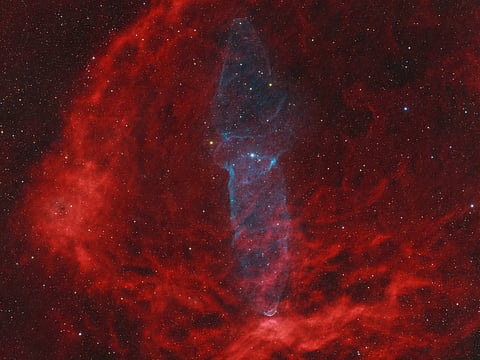
After more than a year of patient observation under the dark skies of Abu Dhabi’s desert, astronomers at Al Khatm Astronomical Observatory have succeeded in capturing an image long considered exceptionally difficult to obtain from the southern Arabian Peninsula: a faint and enigmatic nebula known as the “Squid.”
The achievement followed nearly 18 months of repeated attempts, according to the International Astronomical Centre, which said the first imaging trials began in mid-2024.
Upgrades and technical precision
Early efforts showed that existing equipment could not overcome surrounding light pollution, prompting a major upgrade, including the replacement of the observatory’s telescope.
The final image is the result of more than 1,800 individual exposures, each lasting five minutes—a total of roughly 150 hours of observation time. Only the clearest frames were selected and combined to produce the finished photograph, a process requiring technical precision and persistence.
A striking celestial duo
The Squid Nebula, named for its distinctive shape, appears in shades of blue and is composed primarily of ionised oxygen gas.
In the foreground of the image is a brighter, more easily observed nebula known as the “Flying Bat,” glowing red and providing a remarkable contrast.
A mysterious formation
Stretching across more than one degree of the sky, the Squid Nebula is extraordinarily faint and remains poorly understood. Astronomers initially believed it to be a planetary nebula formed by a star’s explosion, but later research ruled out that explanation. Its true origin remains unknown, making it a captivating subject for ongoing study.
