Abu Dhabi home to world’s largest Arabian oryx population
Decades of conservation efforts have helped restore one of Arabia’s most iconic species
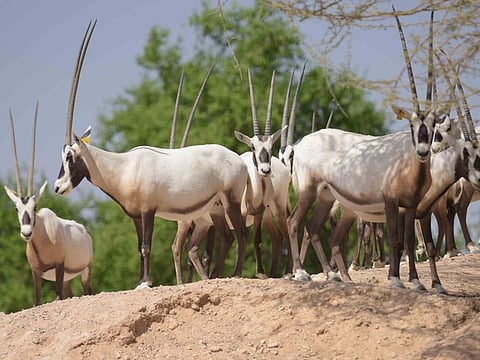
Abu Dhabi has cemented its position as a global centre for Arabian oryx conservation, with decades of breeding, protection and reintroduction programmes helping bring the species back from the brink of extinction.
According to the Environment Agency – Abu Dhabi (EAD), the UAE is home to more than 6,900 Arabian oryx, with large populations found across protected areas in Abu Dhabi.
Get updated faster and for FREE: Download the Gulf News app now - simply click here.
The Arabian Oryx Protected Area in Razeen, which covers around 5,975 square kilometres, is also home to the world’s largest concentration of the species.
From extinction to recovery
The Arabian oryx, scientifically known as Oryx leucoryx, was declared extinct in the wild in the 1970s following years of overhunting and habitat loss.
Its recovery can be traced back to conservation efforts launched by the late Sheikh Zayed bin Sultan Al Nahyan, Founding Father of the UAE, who began an Arabian oryx conservation programme in the 1970s.
The species has since been bred and returned to parts of its historic range, allowing herds to once again roam freely in their natural desert habitats.
In 2007, EAD launched the Sheikh Mohamed bin Zayed Arabian Oryx Reintroduction Programme, aimed at establishing sustainable populations in areas where the species historically lived.
The programme has supported releases in the UAE, Oman and Jordan.
26 protected areas across Abu Dhabi
The Zayed Nature Reserves Network has played a key role in providing safe habitats for the Arabian oryx and other native species.
The network now includes 26 protected areas covering 22,821 square kilometres, equivalent to around 20 per cent of Abu Dhabi.
Among them is the Qasr Al Sarab Protected Area, covering around 308 square kilometres, where Arabian oryx have been reintroduced alongside other desert wildlife.
Protected areas not only provide space for the oryx to survive and reproduce, but also help safeguard plants and other species that form part of the desert ecosystem.
More than 10,000 across the region
Surveys by the Secretariat-General for the Conservation of the Arabian Oryx recorded more than 10,000 Arabian oryx across the species’ range states in 2023.
Conservation efforts have also helped improve the Arabian oryx’s global status. After previously being classified as extinct in the wild, the species is now listed as Vulnerable on the International Union for Conservation of Nature (IUCN) Red List.
The Arabian oryx is particularly adapted to desert conditions. According to EAD, it can detect signs of rainfall and new vegetation from distances of up to 90 kilometres.
For Abu Dhabi, its recovery represents more than protecting a single species. It reflects a wider approach to restoring natural habitats, protecting biodiversity and ensuring that native wildlife remains part of the UAE’s environment for future generations.


