Dubai gold jumps Dh18 a gram this month as global risks lift prices
Dubai gold climbs fast in early January on global risk and rate-cut bets
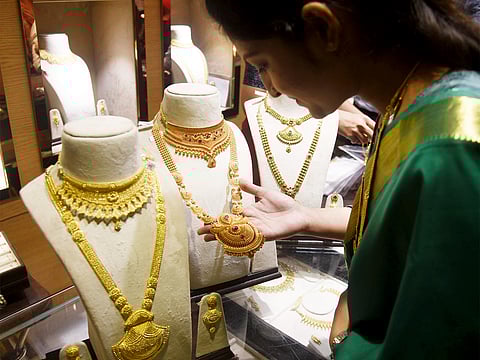
Dubai: Gold prices in Dubai have risen sharply since the start of January, tracking global rally driven by geopolitical uncertainty and shifting expectations around US interest rates. (Check latest UAE gold prices here, alongside prices in Saudi Arabia, Oman, Qatar, Bahrain, Kuwait, and India.)
By 9.30 am on Tuesday, the 24-carat price stood at Dh538.25 per gram, while 22-carat gold was trading at Dh498.25. At the beginning of the month, 24-carat gold was priced near Dh520, with 22-carat at about Dh481.74, marking a gain of roughly Dh18 per gram for higher-purity gold in less than a week.
The move caps a steady climb through the first days of January. Prices pushed higher from just above Dh520 at the start of the month, crossed Dh522 by January 3 and 4, rose again past Dh536 on January 5, before reaching current levels on January 6. The pace of gains has reinforced gold’s appeal for buyers seeking protection against global uncertainty.
Global markets steady after sharp rally
Internationally, bullion was trading near $4,440 an ounce, following a 2.7% surge in the previous session. That jump came after the capture of Venezuelan leader Nicolás Maduro, an event that injected fresh uncertainty into global markets.
Uncertainty over the future governance of Venezuela intensified after US President Donald Trump said Washington plans to “run” the country, a statement that rattled investors already wary of geopolitical risk. While tensions in Venezuela initially drove safe-haven buying, traders are now shifting focus toward a packed calendar of US economic data.
All eyes on US data and the Fed
Markets are closely watching a series of US releases this week, led by the December jobs report due on Friday. The data is expected to shape expectations for the next move by the US Federal Reserve, which has already delivered three rate cuts.
Federal Reserve Bank of Minneapolis President Neel Kashkari said on Monday that interest rates may be close to a neutral level for the US economy, leaving incoming data to determine whether further easing is needed. Lower rates tend to support gold by reducing the opportunity cost of holding non-yielding assets.
Record year sets the tone for 2026
Gold is coming off its strongest annual performance since 1979, after a year marked by repeated record highs. Central-bank buying and strong inflows into bullion-backed exchange-traded funds provided a solid base for the rally, alongside a shift in global monetary policy.
Bullion is currently trading about $100 below the all-time high of $4,549.92 reached on December 26. Some major banks continue to see room for further gains, particularly if the Fed cuts rates again and political changes reshape the US central bank’s leadership. Goldman Sachs Group Inc. said last month that its base case points to gold rising toward $4,900 an ounce, with risks tilted to the upside.
Short-term risks remain
In the near term, however, some analysts warn of technical pressures. A broad rebalancing of commodity indexes could weigh on prices if passive funds are forced to sell futures contracts to reflect new weightings. That process is expected to begin later this week and could add volatility after gold’s record-breaking run.
Prices have moved quickly at the start of the year, driven by global forces that remain fluid. With geopolitical risks still present and key economic data ahead, gold’s direction in the coming weeks is likely to be shaped as much by headlines as by hard numbers.
- With inputs from Bloomberg.