Dubai gold drops below Dh600 after volatile month and global sell-off
Profit-taking pulls Dubai gold below Dh600 while global prices consolidate near $5,000
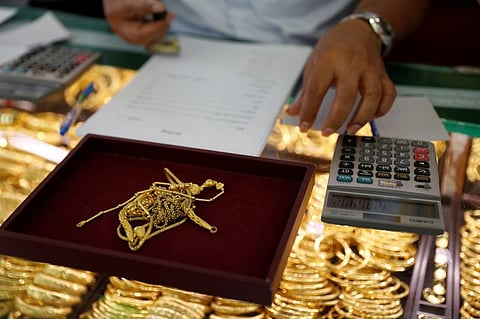
Dubai: Dubai gold prices fell sharply on Monday morning, slipping below the key Dh600 level after holding above it through much of the past week, reflecting global profit-taking and calmer trading conditions in bullion markets. (Check latest UAE gold prices here, alongside prices in Saudi Arabia, Oman, Qatar, Bahrain, Kuwait, and India.)
At 9.27 am, the price of 24-karat gold stood at Dh599.75 per gram, down from Dh607.50 on Sunday. The 22-karat variant dropped to Dh555.25 from Dh562.50 a day earlier, extending a retreat that mirrors international price movements.
The fall comes after bullion dipped below the $5,000 an ounce mark globally, as traders locked in gains following a strong rally in the previous session driven by softer US inflation data.
Pullback follows volatile global swings
Gold had climbed strongly late last week after US consumer price data showed only modest inflation growth, reinforcing expectations that the Federal Reserve could cut interest rates. Lower borrowing costs typically support non-yielding assets such as gold, which tend to attract investors when returns on bonds and cash weaken.
However, Monday’s decline reflects profit-booking after those gains, combined with thinner trading volumes in Asia due to the Lunar New Year holiday in China, one of the world’s largest gold markets.
Recent months have seen strong buying demand in China, prompting authorities in Shenzhen to warn against illegal retail gold trading activities, including leveraged online offerings.
February price swings
Dubai prices have remained volatile throughout February, showing sharp swings between peaks and pullbacks. The month began with 24-karat gold at around Dh589 per gram before dipping briefly toward the mid-Dh560 range early in the month. Prices then surged to above Dh610 in mid-February, before retreating again toward the Dh600 mark this week.
Looking further back, January saw even steeper movements, with prices climbing as high as Dh639 before easing toward the Dh590 range by month-end.
These fluctuations reflect global trends, where gold surged to a record above $5,595 in late January before experiencing a sharp correction that briefly dragged prices below $4,500. Since then, bullion has recovered roughly half of those losses amid choppy trading.
According to Ahmad Assiri, Research Strategist at Pepperstone, current price movements indicate a period of stabilisation.
“Gold is trading shy of $5,000 per ounce with further consolidation of the range, reflecting a healthy rebalancing phase following the prior high volatility,” he said.
He noted that the metal has shifted from sharp swings toward narrower price action, suggesting that markets are accepting current levels and repositioning more calmly.
“The pullback in realised volatility is a constructive signal for the broader trend, as it reflects a transition from speculative momentum-driven flows toward a more balanced accumulation phase,” Assiri added.
Long-term outlook remains positive
Analysts continue to expect higher prices over the medium term, citing ongoing geopolitical tensions, global debt concerns and central bank demand.
Assiri said the upper $4,000 range has shown resilience after the early-month correction, forming what he described as a technical base for future gains.
“Structurally, the $6,000 level remains a medium- to long-term upside objective,” he said, adding that calmer trading conditions near $5,000 provide a favourable environment for long-term investors to build exposure.
Banks such as ANZ also expect bullion to resume its upward trend, forecasting prices could reach around $5,800 an ounce in the coming months.
- With inputs from Bloomberg.