What is the US KC-135 Stratotanker ‘flying gas station’ that lost signal over Gulf?
Aircraft issued 7700 distress code as US steps up operations in Gulf and Hormuz
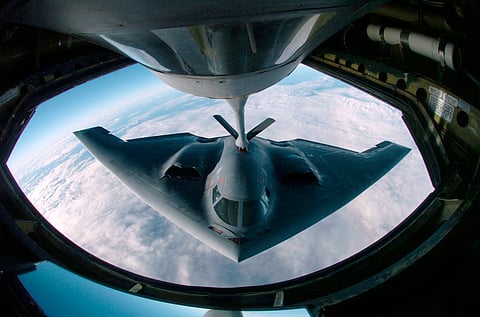
Dubai: A Boeing KC-135 Stratotanker triggered a “7700” distress signal — the universal code for an in-flight emergency — while flying over the Arabian Gulf, before its transponder signal disappeared, according to flight-tracking data.
The incident comes amid heightened regional tensions, though there has been no official confirmation linking it to hostile action, and no debris or crash site has been reported.
What is the KC-135 Stratotanker?
The US KC-135 Stratotanker, which acts as a flying gas Station for US military planes, is a military aircraft powered by four turbofan engines mounted under swept wings and used mainly for aerial refuelling.
The aircraft has a cargo deck above the refuelling system, allowing it to carry both passengers and equipment, and is used to transfer fuel to other aircraft mid-air.
It has been part of US Air Force operations for more than 60 years and plays a central role in extending the range and endurance of fighter jets, bombers and surveillance aircraft. It also supports aircraft from the US Navy, Marine Corps and allied countries.
The KC-135 is based on Boeing’s 367-80 design, which also led to the development of the commercial Boeing 707 passenger aircraft. Hundreds of KC-135 aircraft remain in service with the US Air Force, Air National Guard and Air Force Reserve.
Critical enabler in military operations
Apart from refuelling, the aircraft can carry passengers and cargo, support aeromedical evacuation missions, and transport injured or ill personnel using specialised medical pallets.
During such missions, flight nurses and technicians can be added to the crew. Depending on configuration, it can carry around 37,600 kg of cargo or several dozen passengers.
Because of this versatility, the KC-135 is considered a critical enabler in military operations, allowing sustained air missions and long-range deployments.
General emergency
A 7700 squawk is used by pilots to signal a general emergency, which can range from mechanical failure and onboard fire to medical issues or navigation problems. It is designed to immediately alert air traffic control and nearby aircraft that urgent assistance may be required.
In this case, tracking data showed the aircraft flying in a circular holding pattern before beginning descent — often a sign that crews are troubleshooting a problem, managing fuel, or preparing for an emergency landing. However, the exact cause of the alert remains unclear.
The subsequent loss of transponder signal has added to speculation, but aviation experts caution that this does not automatically indicate a crash. Military aircraft can deliberately switch off transponders for operational or security reasons, particularly in sensitive or contested airspace. In such environments, aircraft may go “dark” to avoid being tracked.
Naval blockade
That said, a distress signal followed by a disappearance from tracking systems can also point to a serious in-flight issue, even if the aircraft ultimately lands safely and out of public view.
The incident comes as the United States steps up its presence under “Project Freedom,” aimed at restoring shipping through the Strait of Hormuz after weeks of disruption.
The mission involves US naval vessels and aircraft guiding and protecting commercial ships through the key energy corridor, following Iran’s move to restrict transit.
Washington has also maintained a naval blockade targeting Iranian-linked shipping to pressure Tehran economically while keeping the waterway open. The increased patrols and escort operations have sharply raised US air and sea activity over the Gulf, heightening the risk of incidents as tensions remain high.


