US lost 42 aircraft in Iran war during Operation Epic Fury, Congressional report says
Losses include fighter jets, drones, refuelling aircraft and an F-35 stealth fighter
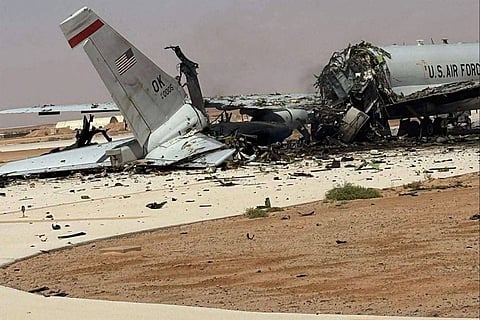
Dubai: At least 42 United States military aircraft — including fighter jets, drones, refuelling tankers and surveillance planes — were lost or damaged during the war with Iran, according to a report prepared for the US Congress, highlighting the scale and cost of a conflict that Washington initially expected to dominate from the air.
The report by the Congressional Research Service (CRS) said the toll could still rise because of classification restrictions, ongoing combat activity and unresolved attribution of losses.
The aircraft losses include some of America’s most advanced platforms: four F-15E Strike Eagle fighter jets, one F-35A Lightning II stealth fighter, an A-10 Thunderbolt II attack aircraft, seven KC-135 Stratotanker refuelling planes, an E-3 Sentry AWACS surveillance aircraft, two MC-130J Commando II special operations aircraft, a HH-60W Jolly Green II rescue helicopter, 24 MQ-9 Reaper drones and an MQ-4C Triton high-altitude surveillance drone.
The figures, according to media reports, emerged as the Pentagon revealed that the cost of military operations against Iran under “Operation Epic Fury” had already surged to nearly $29 billion.
“A lot of that increase comes from having a refined estimate on repair or replacement costs for equipment,” Pentagon finance chief Jules Hurst III told a May 12 hearing.
The conflict began on February 28 when the US and Israel launched coordinated strikes across Iran targeting military infrastructure, missile facilities and senior leadership figures. The opening phase of the war killed multiple top Iranian officials, including Supreme Leader Ali Khamenei, and triggered one of the largest US air campaigns in the Middle East in decades.
But the growing list of aircraft losses is likely to intensify debate over the true cost of the war and whether Iran managed to inflict far greater damage on American forces than initially acknowledged.
The CRS report is particularly significant because the US Department of Defence has not released a full official accounting of combat losses. Instead, congressional researchers compiled the figures using Pentagon statements, CENTCOM briefings and media reports.
US aircraft lost or damaged in Iran war
4 × F-15E Strike Eagle fighter jets
1 × F-35A Lightning II stealth fighter
1 × A-10 Thunderbolt II attack aircraft
7 × KC-135 Stratotanker refuelling aircraft
1 × E-3 Sentry AWACS surveillance aircraft
2 × MC-130J Commando II aircraft
1 × HH-60W Jolly Green II rescue helicopter
24 × MQ-9 Reaper drones
1 × MQ-4C Triton surveillance drone
Estimated operational cost so far: Nearly $29 billion
Iran quickly seized on the findings.
Foreign Minister Abbas Araghchi posted the report on X, claiming it showed that Iran had successfully challenged American air superiority and learned critical battlefield lessons during the conflict.
“Months after initiation of war on Iran, US Congress acknowledges loss of dozens of aircraft worth billions,” Araghchi wrote. “Our powerful Armed Forces are confirmed as first to strike down a touted F-35.”
He warned that if President Donald Trump resumes military action, Tehran would deliver “many more surprises.”
The loss of an F-35A — if fully confirmed — would carry major symbolic and strategic significance. The stealth fighter is regarded as one of the most advanced combat aircraft in the US arsenal and forms a central pillar of American air power.
Changing nature of modern warfare
Military analysts say the damage figures also reflect the changing nature of modern warfare, where even technologically superior militaries face mounting risks from drones, layered air-defence systems, electronic warfare and long-range missiles.
The conflict exposed how vulnerable expensive high-value assets such as refuelling aircraft, surveillance planes and drones can become in a prolonged regional war.
The reported losses come amid growing uncertainty over whether the fragile US-Iran ceasefire can hold. In recent days, Trump has repeatedly warned that Washington could launch fresh strikes if negotiations over Iran’s nuclear programme fail, while Tehran has threatened retaliation across the region.
Iranian officials have increasingly portrayed the war not as a defeat, but as proof that the Islamic Republic can survive sustained Western military pressure while imposing steep financial and operational costs on its adversaries.
For Washington, the aircraft losses and soaring costs threaten to complicate Trump’s argument that Operation Epic Fury achieved its objectives quickly and decisively.


