Silent signals, secret tool: The tiny 800g device behind the US airman rescue in Iran
Standard-issue CSEL helped locate F‑15E crew for daring US rescue
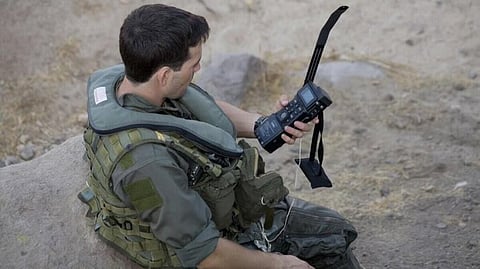
The F-15E crew member rescued from Iran relied on a standard-issue Boeing Combat Survivor Evader Locator (CSEL) to signal his location to US forces, officials said.
“They have a very sophisticated beeper-type apparatus that is on them at all times,” President Trump said Monday, praising the device for helping save the airman’s life.
Get updated faster and for FREE: Download the Gulf News app now - simply click here.
Silent, encrypted lifeline
The airman, a weapons systems officer, evaded capture for nearly 48 hours despite injuries, using the CSEL to transmit encrypted bursts with his GPS coordinates.
This allowed US rescuers to track him while remaining invisible to Iranian forces.
“He scaled cliff faces, treated his own wounds, and contacted American forces,” Trump said. “The device worked amazingly and saved his life.”
How the device works
According to Bloomberg, the CSEL—manufactured by Boeing—is a compact, rugged survival communicator weighing about 800 grams. Built to survive extreme forces during emergency ejection, it begins transmitting immediately once activated.
The device sends short, encrypted, frequency-hopping signals, appearing as random background noise to enemy systems.
Pre-loaded messages: “Injured but can move,” “Enemy nearby,” “Capture imminent.”
Satellite links: Continuous, silent communication with rescue teams.
Capabilities: Receive encrypted instructions, guide to safe zones, function as a radio when rescuers are nearby.
With a 21-day battery life, it kept the airman connected for extended evasion. Voice exists but goes silent; data takes over. No triangulation. No detection. Just a digital tether to the rescue network.
This is what finding a “needle in a mountain crevice” looks like in 2026.
A high-tech rescue
US forces deployed 155 aircraft including bombers, fighters, tankers, and helicopters in Operation Epic Fury. The CIA ran a “deception campaign” to delay Iranian forces, who even used sniffer dogs to track the downed airman.
The mission underscores the operational and geopolitical risks of modern rescues: hundreds of personnel, dozens of aircraft, and a large conventional force were on alert to extract a single airman.
Technology vs history
Past rescues, such as in Bosnia (1991) and Vietnam, relied on primitive, easily detectable signals, leaving airmen vulnerable.
The CSEL’s encrypted, burst-based communication represents a step change, enabling a fast, covert extraction while minimizing exposure to enemy fire.
Future of airman survival
The success of the Iranian rescue validates the CSEL as a critical survival tool and highlights the evolving doctrine of silent, encrypted communication in high-risk environments.
While the technology is powerful, the mission also demonstrates the high stakes involved in deploying such resources under contested conditions.


