Behind enemy lines: How the US rescued a downed airman deep inside Iran
Elite commandos, airpower and covert ops combine in high-risk rescue deep inside Iran
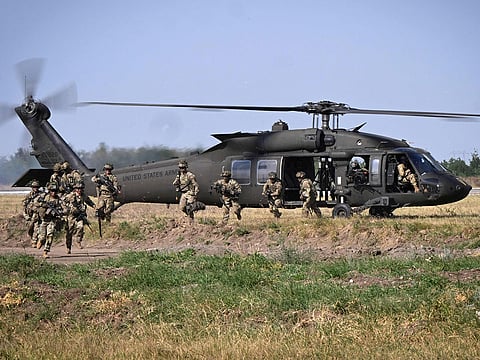
Dubai: The dramatic rescue of a US Air Force officer deep inside Iran — after his F-15E Strike Eagle was shot down — has spotlighted one of the most complex and high-risk military operations: Recovering a pilot behind enemy lines.
According to reports from The New York Times and Axios, US special operations forces carried out a massive, multi-layered mission to extract the injured weapons systems officer, who had evaded Iranian forces for more than 24 hours in mountainous terrain.
The operation unfolded as a high-stakes race between US rescue teams and Iranian forces searching for the downed airman — a scenario military planners consider among the most dangerous in modern warfare.
The operation involved dozens of aircraft and hundreds of special forces troops, with US warplanes striking Iranian convoys to keep them away from the airman, according to reports. A firefight also broke out as American forces moved in, underscoring the risks of the mission deep inside Iranian territory.
Deception tactics
US intelligence agencies also played a key role. Officials told Axios that the CIA used deception tactics, spreading misinformation inside Iran that the airman had already been found, while deploying “unique capabilities” to pinpoint his location and guide rescue teams.
Iranian media reported that authorities had offered a reward for the capture of the missing airman as search efforts intensified, highlighting how close US forces came to a confrontation before the successful extraction.
“We got him,” US President Donald Trump said, calling the mission a “daring” operation.
What happened in Iran
The F-15E, part of ongoing US-Israel operations since February 28, was shot down by Iranian forces. Both crew members ejected.
The pilot was rescued within hours
The weapons systems officer remained missing for over a day
He survived with limited supplies, carrying little more than a pistol
US officials told Axios that the airman survived in rugged terrain with little more than a pistol while Iranian forces scoured the area and even sought local assistance to capture him.
As US forces closed in, a firefight broke out. American aircraft reportedly struck Iranian convoys to keep them away, clearing a path for special forces.
In the end, hundreds of commandos, supported by warplanes, drones, and surveillance assets, successfully extracted the officer.
The injured officer was flown to Kuwait for medical treatment, US officials said.
President Donald Trump later confirmed the rescue, calling it “one of the most daring operations,” adding the officer was injured but stable.
Why rescuing a pilot is so critical
When a US aircraft goes down in hostile territory, the military activates a Personnel Recovery mission — a doctrine built on two urgent priorities:
Save the aircrew
Protect sensitive military technology
As outlined in US military doctrine cited by NYT reporting, captured personnel can be exploited for intelligence, propaganda, or leverage in negotiations — making rapid recovery essential.
How pilots survive behind enemy lines
Before deployment, US aircrew undergo SERE training — Survival, Evasion, Resistance, and Escape.
This prepares them to:
Stay hidden and avoid detection
Move carefully through hostile terrain
Communicate securely with rescue teams
Withstand capture if necessary
In this case, the downed officer used a beacon and secure communications device to coordinate with rescuers — a key factor in his survival.
Night conditions also worked in his favour. US forces typically dominate night operations using advanced infrared and surveillance systems, improving both evasion and rescue chances.
How rescue missions unfold
Such operations are highly coordinated and can involve:
Special operations forces (SEALs, Pararescue, Army units)
Fighter jets and attack aircraft providing cover
Helicopters for extraction
Satellites, drones, and cyber intelligence tracking the target
According to Axios, the CIA also played a role — using “unique capabilities” and even deception tactics to mislead Iranian forces about the airman’s location.
One official described it as “finding a needle in a haystack.”
The final twist
Even after locating and rescuing the officer, the mission faced a last-minute complication.
Two transport aircraft meant for extraction became unusable at a remote base inside Iran, forcing commanders to fly in additional planes. The stranded aircraft were later destroyed to prevent them from falling into Iranian hands, officials told The New York Times.
Why this mission stands out
US officials described the operation as one of the most complex in recent history:
Conducted deep inside hostile territory
Involved hundreds of troops and multiple assets
Took place under active threat from Iranian forces
Required real-time intelligence, deception, and firepower
Despite the risks, all US personnel were extracted safely — with no reported American casualties.
The bigger picture
The rescue underscores both the risks of the expanding conflict and the lengths to which the US military will go to recover its personnel.
It also highlights a key reality of modern warfare:
When a pilot goes down, the battle doesn’t end — it shifts into a race against time, terrain, and the enemy.


