US-Iran war: What UAE residents need to know today (July 10, 2026)
Ceasefire crumbles as fresh strikes, missile interceptions raise regional risks
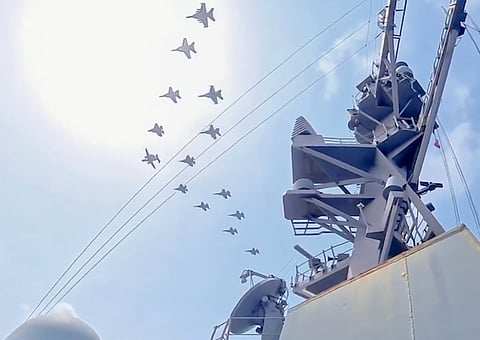
The fragile ceasefire between the United States and Iran appeared to be collapsing Friday after both sides accused each other of violating the truce.
New military strikes were reported across Iran, with Jordan intercepting missiles crossing its airspace and tens of thousands of mourners gathering for the funeral of Iran's supreme leader.
Get updated faster and for FREE: Download the Gulf News app now - simply click here
The renewed fighting has reignited concerns that weeks of diplomacy could give way to a broader regional conflict, even as mediators continue efforts to restore the ceasefire.
Following are the latest updates:
Fresh US strikes: Iranian state media reported that U.S. forces carried out fresh strikes overnight, targeting sites in southern Iran, including areas near the port city of Asaluyeh on the Arabian Gulf, home to critical energy infrastructure linked to the South Pars gas field, one of the world's largest natural gas reserves.
Infrastructure hit: Photographs published by the semi-official Fars News Agency showed damage near the fishing harbour at Bonod in Asaluyeh, where officials said projectiles struck the area. Iranian authorities said civilian infrastructure was damaged, although the extent of casualties was not immediately clear.
The US military had not publicly confirmed the reported strikes, consistent with Washington's recent practice of declining to discuss ongoing operations in detail.
Conflicting accounts: The reports followed an earlier wave of confirmed US strikes and an Iranian missile attack on a US military base in Jordan. Later Thursday, Iranian media reported additional explosions in two cities, but a US defense official said American forces were not conducting operations at that time. Israeli officials likewise said they were unaware of any new Israeli strikes.
Jordan intercepts missiles: Jordan's Armed Forces said its air defences intercepted "several missiles and drones" that entered the kingdom's airspace Thursday, marking another instance of the conflict spilling beyond Iran and the Gulf. Military officials said the interceptions were carried out to protect civilians and prevent debris from falling into populated areas. Jordan has repeatedly emphasised that it will not allow its territory or airspace to be used by either side in the conflict. The kingdom has previously intercepted Iranian missiles and drones launched toward Israel during earlier phases of regional hostilities, underscoring its increasingly delicate balancing act between security cooperation with Western allies and maintaining regional stability.
Diplomatic push: Regional and international mediators are intensifying efforts to bring Washington and Tehran back to the negotiating table as renewed violence threatens to unravel an already fragile ceasefire.
Khamenei funeral ends: Iran concluded days of funeral ceremonies for slain Supreme Leader Ali Khamenei with a final public procession and private burial. Mojtaba Khamenei, who succeeded his father as Iran's supreme leader, has yet to make a public appearance since assuming the country's highest political and religious office.
The conclusion of Ali Khamenei's funeral marks a symbolic transition in Iran's leadership, although the continued absence of Mojtaba Khamenei from public view has fueled speculation about the timing and manner of his formal assumption of power. Analysts say his first public appearance will be closely watched for clues about Tehran's military and diplomatic strategy amid the ongoing crisis.
The latest attacks came after US officials accused Iran of supporting renewed attacks on commercial shipping and coalition naval forces in and around the Strait of Hormuz, the narrow waterway through which roughly one-fifth of global oil consumption and nearly a third of the world's seaborne crude exports pass.
Uncertainty
The latest reported explosions underscore the uncertainty surrounding the ceasefire, with conflicting claims from Tehran, Washington and Israel making it difficult to independently verify responsibility for each incident.
The renewed reports of violence come as diplomats race to prevent a broader regional escalation after weeks of conflict that has drawn in US forces, Iran and its network of regional allies.


