Trump’s Hormuz plan: How the US will guide ships and why it risks escalation with Iran
US bid to reopen key oil route meets Iran threats as experts warn ships may remain at risk
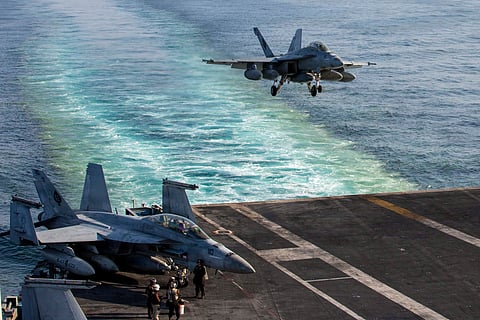
Dubai: The US Navy will begin guiding foreign commercial vessels through the Strait of Hormuz from Monday under a new initiative announced by Donald Trump — a high-stakes move that could test the fragile ceasefire and risk direct confrontation with Iran.
Dubbed “Project Freedom,” the plan is Washington’s boldest attempt yet to break Iran’s grip on the strait after it was effectively shut earlier in the war. While Trump has framed the effort as humanitarian, it marks a clear US challenge to Tehran’s attempt to control one of the world’s most critical energy chokepoints.
The strait carries roughly a fifth of global oil supplies, meaning any disruption — or escalation — can ripple instantly through energy markets worldwide.
According to Axios, Trump said the US would help ships from countries “that have done absolutely nothing wrong” to safely exit the waterway, warning that any Iranian interference “will, unfortunately, have to be dealt with forcefully.”
Questions remain
But the operation stops short of a traditional naval escort mission. US officials told Axios that American warships will remain “in the vicinity” rather than accompany vessels directly, focusing instead on guiding ships through safer maritime lanes — particularly those believed to be free of Iranian sea mines.
That distinction is key — and raises questions about how much protection ships will actually have.
A statement from US Central Command cited by CNN said the operation will involve guided-missile destroyers, more than 100 aircraft, and unmanned platforms. But how those assets translate into real-time protection for commercial vessels remains unclear.
Jennifer Parker, a former naval officer and analyst, said the plan appears designed less as a shield and more as a signal.
“This appears to be an operation … which is less about providing direct protection to a vessel … and more about trying to change the situation in the strait so ships feel safe,” she told CNN.
Rather than convoy-style escorts, Parker said the US is likely betting on presence — warships nearby, aircraft overhead — to deter Iranian action, including the use of small attack boats or drones.
The strategy, she added, raises the stakes for Tehran.
What we know / What’s unclear
What we know
US to begin guiding ships through Hormuz from Monday
Warships will be nearby, not full convoy escorts
Operation includes destroyers, aircraft, and drones
Trump warns interference will be met with force
What’s unclear
Whether Iran was consulted or will tolerate the move
How ships will be protected without direct escorts
Whether enough US naval assets are available
If shipping companies will actually resume transit
“In some ways [Trump] is forcing Iran’s hand,” Parker told CNN. “They would need to escalate and fire at US warships, which is a different level of escalation.”
Iran’s early reaction suggests it sees the move as precisely that.
Ebrahim Azizi, a senior Iranian lawmaker, warned the plan would violate the ceasefire in place since April 8, while a military commander quoted by Iranian media said “any foreign military force … will be attacked” if it enters the strait.
Doubts persist
Trump, however, paired the warning with a diplomatic note. He said US representatives were engaged in “very positive discussions” with Iran and suggested talks could still lead to “something very positive for all,” according to Axios.
Still, operational doubts persist.
Shipping executives are unconvinced the plan will materially reduce risks. “It takes both sides to unblock — not just one,” Bjørn Højgaard, CEO of Anglo-Eastern, told CNN, underscoring industry concerns that without Iranian cooperation, safe passage cannot be guaranteed.
Experts also highlight the geography of the strait itself. At just 24 miles wide at its narrowest — with shipping lanes far tighter — vessels have little room to manoeuvre. Iranian threats are dispersed and mobile, ranging from truck-mounted missiles and drones to sea mines that can be deployed from small civilian craft.
“Are you going to be able to destroy all those vessels to eradicate the threats? To me, it’s not very feasible,” security analyst Collin Koh told CNN.
There are also questions about capacity. Analysts say the US may not have enough naval assets in the region to sustain escort-style operations while also enforcing its blockade of Iranian ports.
All of which suggests “Project Freedom” is less about physically securing every vessel and more about breaking what analysts describe as Iran’s de facto control of the strait.
Whether that gamble reopens the world’s most critical oil artery — or triggers a direct US-Iran confrontation — now depends on Tehran’s next move.


