Iran not to hit neighbours unless attacks originate there: What we know so far
President apologises to the neighbouring countries that were attacked by Iran
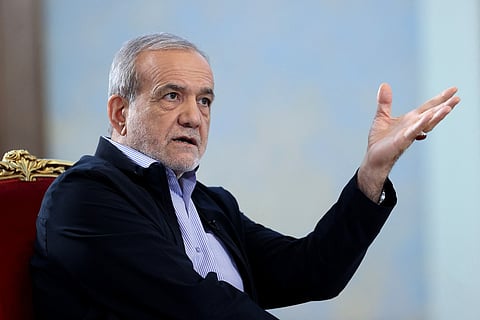
Dubai: Iranian President Masoud Pezeshkian said Tehran would not capitulate to Israel or the United States despite a week of heavy strikes on Iranian territory.
In a speech broadcast on state television, he declared that those hoping for the surrender of the Iranian people would “take that wish to their graves.”
At the same time, Pezeshkian apologised to neighbouring countries affected by Iranian retaliatory attacks, signalling Tehran’s awareness that the conflict is spreading across the wider region.
"I must apologise on my own behalf and on behalf of Iran to the neighbouring countries that were attacked by Iran," he said.
"The interim leadership council agreed yesterday that no more attacks will be made on neighbouring countries and no missiles will be fired unless an attack on Iran originates from those countries."
However, despite the interim leadership council’s decision on Friday, Iranian missiles and drones were reported targeting Gulf states on Saturday as the conflict widened.
US President Donald Trump on Friday demanded Iran's "unconditional surrender" as the only acceptable outcome to end hostilities, while promising to help rebuild the country's economy if Tehran complied.
Here are the latest developments:
Israel strikes 16 IRGC aircraft: Israel’s military said it struck 16 aircraft belonging to the Revolutionary Guards’ Quds Force at Tehran’s Mehrabad Airport, accusing the Guards of using the airport to move cash and weapons to regional proxies including Hezbollah.
Jordan accuses Iran of attacks: Jordan said Iran fired 119 missiles and drones toward targets in the kingdom since the war began, with 108 intercepted.
Saudi intercepts missiles and drones: Saudi Arabia said it destroyed a ballistic missile targeting Prince Sultan Air Base and intercepted drones aimed at the Shaybah oil field.
Iran hits tanker in Gulf: Iran’s Revolutionary Guards said they targeted a Marshall Islands-flagged oil tanker with a drone in the Arabian Gulf.
Iran strikes Kurdish militant sites: The Revolutionary Guards said drones hit locations of Iranian Kurdish “separatist groups” in Iraq’s Kurdistan region.
Israel orders evacuation in Lebanon: The Israeli military warned residents in southern Lebanon’s Tyre district to evacuate ahead of strikes on Hezbollah infrastructure.
Turkey considers F-16 deployment: Ankara said it may deploy F-16 fighter jets to Northern Cyprus after a drone attack on a British base on the island.
Israel launches large-scale airstrikes on Tehran: Israel said more than 80 fighter jets carried out a major wave of “broad-scale” strikes on Iranian military facilities, missile launchers and Revolutionary Guard targets in Tehran and central Iran. Among the sites hit was a Revolutionary Guard academy that Israel said was being used as an emergency operational centre. Iranian officials reported casualties in the central province of Isfahan following US-Israeli strikes, underscoring the scale of the campaign against Iran’s military infrastructure.
Iran expands attacks across the Gulf and Israel: Iran responded with waves of drones and missiles aimed at Israel as well as US military installations in the Gulf region. Iranian forces said they had launched attacks targeting bases in the Gulf, while missiles fired toward Israel triggered air raid sirens across the country. Israel said its air defence systems were intercepting incoming projectiles, with residents rushing to bomb shelters as explosions were heard in several areas.
Blasts and alerts across Gulf states: Authorities in Bahrain sounded warning sirens and urged residents to move to safe locations. Saudi Arabia also reported intercepting threats linked to the conflict, highlighting the growing involvement of Gulf states as Iranian retaliation expands beyond Israel to include American and allied military sites across the region.
Saudi Arabia intercepts missiles and drones: Saudi Arabia’s defence ministry said it shot down a ballistic missile fired toward Prince Sultan Air Base, which hosts US forces, and intercepted drones targeting the vast Shaybah oil field near the UAE border. The attacks followed earlier strikes on Saudi energy infrastructure, including a drone strike that partially disrupted operations at the Ras Tanura refinery earlier in the week, raising fears about the vulnerability of Gulf oil facilities.
Oil tanker hit in Strait of Hormuz: Iran’s Revolutionary Guards said an exploding drone struck an oil tanker named Prima in the Gulf after it allegedly ignored warnings about navigation in the Strait of Hormuz. The Guards warned that shipping in the vital waterway was unsafe amid the conflict and suggested US naval forces might attempt to escort vessels through the strait. The incident heightened concerns about the security of one of the world’s most important oil transit routes.
Arab League calls emergency meeting: Foreign ministers of the Arab League will hold an emergency meeting on Sunday to discuss Iranian attacks on several Arab countries. The meeting was requested by Kuwait, Saudi Arabia, Qatar, Oman, Jordan and Egypt. Officials said the virtual gathering will focus on regional security and possible diplomatic responses as Gulf states face increasing missile and drone threats linked to the conflict.
US approves emergency arms sale to Israel: The United States approved an emergency sale of 12,000 bomb casings to Israel as fighting intensified. The State Department said the deal would strengthen Israel’s ability to confront current and future threats and reinforce its defence against regional adversaries. The move reflects Washington’s continued military backing for Israel as the joint US-Israeli campaign against Iran enters a more intense phase.
Conflict widens with regional and global stakes: The fighting has spread across multiple fronts involving Iran, Israel, the United States and several Gulf states. Iranian strikes have targeted military bases and energy infrastructure across the region, while Israel and the US continue heavy airstrikes on Iranian territory. Casualty figures have climbed sharply, with more than 1,200 reported killed in Iran, over 200 in Lebanon and several deaths in Israel and among US troops, raising fears that the conflict could escalate into a broader regional war.
Russia reportedly providing intelligence to Iran: US officials say Russia has supplied Iran with information that could help Tehran track American warships and other military assets in the region. While there is no indication Moscow is directing Iranian attacks, the intelligence sharing marks the first sign of possible Russian involvement in the conflict and adds another geopolitical dimension to the rapidly expanding war.
-- With AFP and AP inputs


