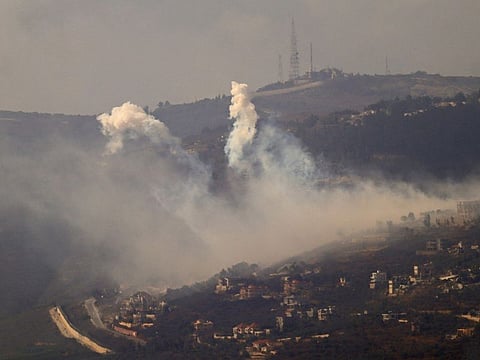
Israel strikes south Lebanon days after signing US-backed peace deal
Israel won't withdraw troops until Hezbollah disarms, officials say
Highlights
We are closing this coverage now. For the latest updates, click here.
Saudi delegation joins Khamenei's funeral in Tehran
The funeral of Iran’s Supreme Leader Ali Khamenei on Friday was attended by senior Iranian officials and foreign delegations, including representatives from Saudi Arabia, Qatar and Oman. Officials paid respects before his coffin at Tehran’s Grand Mosalla, four months after he was assassinated in US-Israeli strikes that triggered a wider Middle East war.
The six-day funeral procession began with an official Iranian delegation led by President Masoud Pezeshkian, Parliament Speaker Mohammad Bagher Ghalibaf and judiciary chief Gholamhossein Mohseni Ejei.
Military commanders also paid tribute, including Ahmad Vahidi, the commander of the Revolutionary Guards, who had not appeared publicly since the start of the US-Israeli war in February, according to footage carried by Iranian media. A Saudi Foreign Ministry delegation joined representatives from Qatar, Egypt and Oman in paying respects.
Omani delegation attends Khamenei's funeral in Tehran
Omani delegation attends Khamenei's funeral in Tehran, sent by the Sultan to convey his condolences to Iran's leadership, Oman News Agency shared on X.
Over 600,000 displaced Lebanese return home amid ceasefire
More than 640,000 displaced people in Lebanon have returned home, according to the International Organization for Migration (IOM), as clashes between Hezbollah and Israel have wound down following a deal to end the Middle East war.
Lebanon was drawn into the regional war on March 2 when Tehran-backed militant group Hezbollah fired rockets at Israel to avenge the killing of Iran's supreme leader in US-Israeli strikes.
Israel responded with heavy airstrikes and an invasion of southern Lebanon, where its troops still occupy swathes of territory.
Lebanese authorities say Israeli attacks have killed around 4,300 people and displaced over one million, particularly from southern Lebanon and Beirut's southern suburbs.
Hundreds gather at Khamenei funeral site
Several hundred people were already waiting on Friday evening outside the venue for the funeral of Iran's slain supreme leader Ali Khamenei ahead of its opening to the public the next morning, according to AFP journalists.
Khamenei will lie in state at the Grand Mosalla religious complex in Tehran until Monday, with doors scheduled to open at 6:00 am local time (0230 GMT). AFP journalists at the scene also saw a significant security presence and roadblocks on surrounding streets.
Netanyahu, Trump agree to meet in US 'soon'
Israeli Prime Minister Benjamin Netanyahu and US President Donald Trump spoke on Friday and agreed to meet "soon" in the United States, the premier's office said.
The conversation comes after the United States and Israel fought alongside each other in their military campaign against Iran, and also follows reports of tensions between the two leaders over efforts to end the war.
"The Prime Minister said in their conversation that the US is a guarantor of global freedom, and Israel greatly appreciates the close ties between nations," a statement from Netanyahu's office said.
India pays respects at Khamenei's funeral
Minister of State (MoS) for External Affairs Pabitra Margherita and Bihar Governor Lieutenant General Syed Ata Hasnain (retired), paid their tributes representing India at the funeral ceremony of former Iranian Supreme Leader Ayatollah Seyyed Ali Khamenei in Tehran.
"Governor of Bihar Lieutenant General Syed Ata Hasnain and I represented India at the funeral ceremony for Ayatollah Seyyed Ali Khamenei, former Supreme Leader of Iran, in Tehran. Conveyed our respects on behalf of the government and the people of India," MoS Margherita wrote on social media platform X.
Yemen's Houthis threaten Saudi after alleged airspace intrusion: spokesman
Yemen's Iran-backed Houthis on Friday threatened Saudi Arabia's airports and vital assets should Riyadh violate its airspace or attempt to attack it, as the rebels accused the kingdom of an earlier airspace intrusion.
"We warn the criminal Saudi enemy against repeating any attempt to violate our airspace or any aggression targeting our country," military spokesman Yahya Saree said in a video statement.
"Such actions will be met with a comprehensive response targeting its airports and vital interests on land and sea."
Saree said the rebels had thwarted an attempt by Saudi warplanes to infiltrate their airspace at 5:20 am (0220 GMT) in a bid "to prevent an Iranian civilian aircraft carrying more than 200 stranded, wounded, and sick citizens from landing at Sanaa International Airport".
Israel military says struck Hezbollah positions in south Lebanon
Israel's military said Friday it had struck several Hezbollah sites in southern Lebanon a day earlier in response to attacks on its troops in the area.
Israel and Lebanon signed a US-sponsored framework agreement last week to pave the way for peace between the two countries and disarm Iran-backed militant group Hezbollah.
Israeli officials have repeatedly ruled out withdrawing troops from southern Lebanon, maintaining that any withdrawal would happen only after Hezbollah has been disarmed across Lebanon.
"The IDF struck approximately 10 Hezbollah infrastructure sites and a truck used to transfer weapons in southern Lebanon," the military said in a statement.
Iran leaders pay last respects to Khamenei as mourners gather
Top Iranian officials on Friday paid their final respects to the country's slain supreme leader Ali Khamenei at the start of a week of funeral ceremonies, with allies and mourners converging on Tehran where his body is lying in state.
Authorities expect public mourning and grand processions to attract millions before Khamenei's burial next week, four months after he was killed aged 86 at his compound in the opening US-Israeli salvo of the Middle East war.
AFP images showed mourners carrying his coffin aloft at the vast Grand Mosalla religious complex in the Iranian capital, with the casket draped in the colours of the Islamic republic that he led for more than three decades.
State TV broadcast footage of Iranian President Masoud Pezeshkian paying his respects at Khamenei's coffin on Friday afternoon, alongside parliament speaker and chief negotiator Mohammad Bagher Ghalibaf.
Ahmad Vahidi, head of the Revolutionary Guards, the ideological arm of the military, also made his first appearance since the start of the war in February.
In Photos
Afghan FM pays respects to Khamenei
Afghanistan's foreign minister in the Taliban government paid his respects on Friday at the coffin of Iran's slain supreme leader Ali Khamenei in Tehran, Iranian state television showed.
Amir Khan Muttaqi's tribute came just hours after that of Ahmad Massoud, the head of a key anti-Taliban group, whose father was backed by Iran in the 1990s.
Pakistani PM pays respects at Khamenei coffin
Pakistani Prime Minister Shehbaz Sharif paid his respects at the coffin of late Iranian supreme leader Ali Khamenei on Friday, state TV footage showed.
Sharif, whose country has been mediating US-Iran talks to permanently end their conflict, was accompanied by army chief Asim Munir and a delegation as they visited the coffin.
Iranian leaders pay respects ahead of funeral
Iranian leaders began paying their respects on Friday before the coffin of the country's late supreme leader Ali Khamenei, killed in the US-Israeli strikes that triggered the Middle East war, as Tehran prepared for a vast funeral.
Khamenei's body arrived at Tehran's Grand Mosalla on Friday ahead of ceremonies which are expected to draw millions.
A coterie of foreign dignitaries is also due to attend Saturday's official ceremony, with Tehran's chief negotiator calling for a massive turnout to avenge his death.
Iran president pays respects at Khamenei's remains
Iranian President Masoud Pezeshkian on Friday paid his respects at the remains of slain supreme leader Ali Khamenei, alongside other officials including the country's top negotiator Mohammad Bagher Ghalibaf.
State television showed Pezeshkian praying at Khamenei's coffin, where a black turban had been placed, which is worn by clerics to signify descent from the Prophet Mohammed.
Get updated faster and for FREE: Download the Gulf News app now - simply click here.
Pakistan Army chief Asim Munir arrives in Tehran
Pakistan’s Chief of Army Staff, Field Marshal Asim Munir, has arrived in Iran’s capital Tehran to attend the funeral of late Supreme Leader Ayatollah Ali Khamenei.
He was received by Iran’s Defence Minister Majid Ibn Reza and Interior Minister Eskander Momeni, according to reports.
Pakistan’s Interior Minister Mohsin Naqvi also travelled to Tehran directly after an official visit to Saudi Arabia to join the funeral proceedings.
Earlier, Prime Minister Shehbaz Sharif departed for Tehran on a one-day visit, leading a high-level delegation that includes senior government officials to attend the ceremony.
Iran warns US and Israel over deal compliance: Speaker
Iran’s parliament speaker Mohammad Bagher Ghalibaf has warned that Tehran will respond if the United States and Israel fail to meet their commitments under an interim agreement aimed at ending the conflict.
“We strongly demand full implementation of the agreements, and if the US and the Zionist regime fail to fulfil their commitments, Iran will resume proportionate actions,” Ghalibaf was quoted as saying by ISNA.
He said Washington cannot confront Iran militarily and dismissed Israeli threats as “baseless propaganda”.
Ghalibaf also claimed that the US and Israel failed to achieve their objectives in the conflict, adding that they ultimately sought a ceasefire after realising military action had not succeeded.
Tight security in Tehran ahead of Khamenei’s funeral
Security has been tightened across Tehran ahead of the funeral processions for slain Iranian Supreme Leader Ayatollah Ali Khamenei. Security personnel are patrolling key areas as authorities enforce sweeping restrictions, including closures of public and private offices from Saturday to Monday, traffic curbs in central districts, and partial airspace closure from Friday followed by a full shutdown on Monday.
Coffins of Khamenei and family members were placed at the Imam Khomeini Grand Mosalla on Friday. Funeral ceremonies are expected across Iran and Iraq from July 4 to 9, drawing an estimated 15–20 million mourners.
Tehran, Qom and Mashhad will observe public holidays during the events. Following Tehran ceremonies, the body will be taken to Najaf and Karbala before burial at the Imam Reza shrine in Mashhad on July 9. Representatives from around 30 countries are expected to attend.
Get updated faster and for FREE: Download the Gulf News app now - simply click here.
Khamenei’s coffin arrives at Tehran mosque ahead of funeral
The coffin carrying the body of former Iranian Supreme Leader Ayatollah Ali Khamenei has arrived at Tehran’s Imam Khomeini Grand Mosalla ahead of the funeral, state-affiliated Fars News Agency reported on Friday.
Footage shared by Fars shows the flag-draped coffin being carried through a large crowd into the mosque, as mourners gathered for the upcoming ceremonies.
Trump says 'ridiculous' for US to maintain current support for NATO
Trump said it is "ridiculous" for the United States to continue its "one sided" relationship to NATO, less than a week before a NATO summit in Ankara.
Trump wrote on his Truth Social platform: "They were not there for us!!!" and Washington's relationship with NATO "is not reciprocal."
Trump has repeatedly lashed out at European allies over their response to the war in Iran.
Powerful general in Iran emerges from hiding
A powerful general who leads Iran's paramilitary Revolutionary Guard emerged from hiding as Tehran prepared Friday for the dayslong funeral for the late Supreme Leader Ayatollah Ali Khamenei.
Photos published online by Iranian state media showed Gen. Ahmad Vahidi attending a meeting about the funeral of Khamenei, 86, then sitting alongside his casket as Iran's theocracy held a smaller service for him Thursday night near the supreme leader's former home in downtown Tehran.
Vahidi has become a major player in formulating Iran's tough stance in negotiating a possible permanent end to the war with the United States, experts say. He is believed to be part of a small clique in direct contact with Iran's new Supreme Leader Ayatollah Mojtaba Khamenei, who remains in hiding after being reportedly wounded in the Feb. 28 Israeli strikes that killed his father, the elder Khamenei.
Vahidi himself hasn't been seen publicly since Feb. 8, weeks before the Iran war began.
Get updated faster and for FREE: Download the Gulf News app now - simply click here.
Supreme leader's body arrives at Tehran religious complex for funeral
The body of Iran's supreme leader Ali Khamenei, who was killed in US-Israeli strikes, arrived at Tehran's Grand Mosalla religious complex ahead of his funeral, state media reported Friday.
"The body of the martyred Leader of the Islamic Revolution has arrived at the Imam Khomeini Grand Mosalla," IRNA wrote on Telegram, using the complex's official name.
US deploys second Marine Expeditionary Unit to Middle East
US Central Command (CENTCOM) has confirmed that ships carrying a second Marine Expeditionary Unit (MEU), typically comprising more than 2,000 Marines, are currently operating in the Middle East.
In a post on X, CENTCOM said the Boxer Amphibious Ready Group (ARG) and the embarked 11th MEU are deployed in the region as part of a scheduled mission.
The ARG includes the amphibious assault ship USS Boxer, the amphibious transport dock USS Portland—which has recently arrived in the region—and the dock landing ship USS Comstock, which has been operating in the area since May.
The deployment joins the amphibious assault ship USS Tripoli, along with its escorts and embarked Marines, which have been stationed in the Middle East since late March, further strengthening US naval posture in the region.
Pakistani interior minister arrives in Iran ahead of funeral
Pakistan’s Interior Minister Seyyed Mohsin Naqvi has arrived in Iran ahead of the funeral of Supreme Leader Ali Khamenei, calling the country Pakistan’s “second home”.
Iran says representatives from over 100 countries will attend the ceremony, which begins on Saturday.
Pakistan’s Prime Minister Shehbaz Sharif is also expected to attend the proceedings.
Images show casket holding Khamenei’s body
The first images have emerged of the casket carrying the body of Iran’s former Supreme Leader Ayatollah Ali Khamenei.
Posted on his official X account, the image shows the coffin placed in a small room decorated with Iranian flags.
A red flag with white script — described as the sacred banner of the shrine of Imam Hussein — is draped over the casket, according to the post.
Get updated faster and for FREE: Download the Gulf News app now - simply click here.
Iran attacks ‘not incidental’: Bahrain to UN Security Council
Bahraini officials told the UN Security Council on Thursday that Iranian missile and drone strikes on Gulf states are deliberate and part of a systematic pattern of aggression, not random or isolated incidents.
Bahrain's representative made the remarks during an emergency Security Council session convened at its request to address recent Iranian attacks on Bahrain and other countries in the region amid escalating tensions involving Iran, the United States and broader Middle East conflicts.
"Iranian attacks [are] never random nor incidental," the Bahraini delegation stated, according to reports from the meeting.
Officials described the strikes as "meticulously pre-planned" and evidence of Tehran's "aggressive intentions" toward its neighbours.
Hormuz oil traffic climbs above 10 million barrels per day
Oil traffic through the Strait of Hormuz has climbed above 10 million barrels per day, as Bloomberg reported.
According to TankerTrackers, Iran has exported around 50 million barrels of crude oil since the US-imposed blockade was lifted two weeks ago, averaging 1.66 million barrels per day in June 2026. However, most regional producers still remain well below their pre-war export levels.
Crude oil prices went down in early morning trade on Friday, with WTI easing further to $68.41, down $0.28 or 0.41%; Brent slid to $71.54 or $0.26 (0.36%) lower, while Murban Crude lost $0.42 to $65.22.
Tehran denounces US-led Bahrain security summit
The US Central Command (CentCom) has convened a landmark regional security conference in Bahrain, bringing together military leaders from 12 nations, including unprecedented participation from Syria and Lebanon.
The high-level summit, hosted by the Bahrain Defence Force, aimed to fortify the Middle East's unified air defence umbrella and secure vital maritime shipping lanes.
However, the American-led initiative immediately drew fierce condemnation from Tehran, exposing deep geopolitical fault lines over who should police the volatile region.
Responding sharply to the military gathering in Manama, Iranian Foreign Minister Seyed Abbas Araghchi firmly rejected the notion that Western intervention brings stability to the Middle East.
Get updated faster and for FREE: Download the Gulf News app now - simply click here
India, Japan, China back free navigation in Hormuz
India, Japan and China have renewed calls to safeguard freedom of navigation through the Strait of Hormuz, underscoring growing international concern over the security of one of the world's most important energy chokepoints.
Officials from the three trading heavyweights, speaking separately, stressed that safe and uninterrupted passage through the strategic waterway is essential to global trade, energy security and the stability of international supply chains.
In a joint statement released on Thursday following the 16th India-Japan Annual Summit, Indian Prime Minister Narendra Modi and Japanese Prime Minister Sanae Takaichi highlighted the strategic necessity of keeping the Strait of Hormuz open to guarantee uninterrupted global commerce and resilient energy corridors.
As two of the world's premier energy-consuming economies, India and Japan are acutely vulnerable to supply disruptions in the Middle East.
The prime ministers explicitly warned against any geopolitical manoeuvres that could restrict maritime trade.
Chinese Foreign Minister Wang Yi echoed that message during talks with Pakistan's foreign minister, saying normal shipping through the strait should resume quickly to protect global industrial and supply chains following months of conflict in the Gulf.
Japan has reiterated that freedom of navigation is a fundamental principle of international law.
In statements issued through its Foreign Ministry and at the United Nations, Tokyo said commercial shipping through the Strait of Hormuz must remain safe and open in accordance with the United Nations Convention on the Law of the Sea (UNCLOS). Japanese officials also welcomed international efforts to establish protected maritime corridors and urged all parties to respect international law.
Iran announces multi-day funeral ceremonies to honour Khamenei
Iranian authorities have announced an extensive series of funeral ceremonies to honour Khamenei, with commemorations scheduled from July 4 through July 9 across both Iran and Iraq.
The multi-day procession is expected to pass through Tehran, Qom and Mashhad in Iran before continuing to the Shiite holy cities of Najaf and Karbala in neighboring Iraq, underscoring Khamenei's religious and political influence across the Shiite Muslim world.
The ceremonies are expected to draw senior Iranian officials, religious leaders and supporters from across the region, with heightened security anticipated throughout the events.
Khamenei, who led Iran for more than three decades, shaped the country's domestic politics, nuclear policy and regional alliances, including its backing of armed groups across the Middle East. His death has added uncertainty to an already volatile region following months of conflict between Iran, Israel and the United States.
Get updated faster and for FREE: Download the Gulf News app now - simply click here.
Pezeshkian urges mass turnout for Khamenei funeral
Iran’s President Masoud Pezeshkian called on Iranians to attend the Supreme Leader Ayatollah Ali Khamene’s funeral in “large numbers.”
Iranian army general then warned the US and Israel against launching attacks during the procession.
Iran president: Supreme Leader’s ‘martyrdom’ unites grieving nation
Iranian President Masoud Pezeshkian paid tribute to Supreme Leader Ayatollah Ali Khamenei, describing his death as a "martyrdom" that has plunged the nation into grief while vowing that the Islamic Republic would remain steadfast in the face of adversity.
In a post on X, Pezeshkian said Khamenei's killing had deeply saddened the Iranian people but insisted it would strengthen national unity rather than weaken the country.
"His martyrdom is not the end of the road, but the beginning of a new chapter of unity, resilience," Pezeshkian wrote.
Khamenei was killed in an airstrike on February 28, the opening day of the US-Israeli war against Iran, dealing the Islamic Republic its most significant leadership loss since the 1979 Islamic Revolution.
Get updated faster and for FREE: Download the Gulf News app now - simply click here
US‑Israel war on Iran: Recent developments
Day 125: Iran denounces US-led security summit of 12 nations
Day 124: Iran says Qatar talks with US on war MoU concluded
Day 123: Iran says US blockade stopped oil exports completely
Day 122: IRGC Navy spokesperson Akbarzadeh dies in car 'mishap'
Day 121: Iran warns against attacks from regional territory
Day 120: US–Iran ceasefire under strain as drones target Bahrain
Day 119: Lebanon, Israel, US sign trilateral deal in Washington
Day 118: Oil price spikes after IRGC strike on ship in Hormuz
Day 117: Iran-Gulf reconciliation talks expected in Saudi Arabia


