Inside Iran’s calculus: Why Tehran sees concessions as riskier than war
Tehran views nuclear and missile limits as threats to regime survival, analysts say
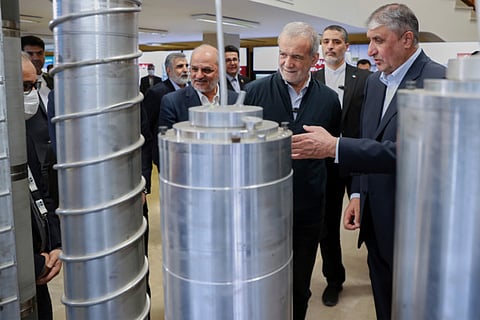
Dubai: Iran’s leadership appears to be making a stark strategic calculation as tensions with the United States intensify — that yielding to Washington’s demands could pose a greater threat to regime survival than the dangers of military confrontation.
The New York Times, citing analysts and officials familiar with Iranian decision-making, has reported that Tehran’s resistance reflects not miscalculation but a deeply entrenched belief that core elements of its deterrence posture are non-negotiable.
At the heart of the standoff lies a widening gap in threat perception.
While Washington has framed its demands — including “zero enrichment” of nuclear material and constraints on ballistic missiles — as non-proliferation safeguards, Tehran views such concessions as existential risks.
“For Iran’s leadership, enrichment and missile capability are not bargaining chips; they are pillars of regime security,” said Ali Vaez, Iran director at the International Crisis Group, reflecting a view widely echoed in Western policy circles.
Iranian officials have long argued that uranium enrichment represents a sovereign right. Analysts note that beyond legal considerations, enrichment capability carries deep strategic significance.
“Even without weaponisation, threshold nuclear capacity alters the balance of power,” said a regional security analyst familiar with Iranian doctrine. “It creates deterrence through ambiguity.”
Tehran’s ballistic missile programme plays a similarly central role.
Missile development
With an ageing air force and decades of restricted access to advanced platforms, Iran has relied heavily on missile development as a substitute for conventional air power — an assessment frequently highlighted in international security discussions, according to the BBC.
“Missiles are Iran’s most credible deterrent tool,” said Farzin Nadimi, a defence analyst specialising in Iran’s military capabilities. “They compensate for structural weaknesses in air power.”
The nuclear programme, though officially civilian, is also widely seen as carrying deterrent value.
“Mastery of the enrichment cycle gives Tehran latent leverage,” noted a European diplomat tracking the negotiations. “That latent capacity itself shapes adversary calculations.”
From Tehran’s perspective, dismantling these capabilities would strip away critical layers of defence.
Analysts cited by the New York Times suggest Iran’s leadership fears that accepting US demands would not guarantee sanctions relief but could invite further pressure.
“They don’t believe capitulation ends the confrontation,” Vaez has argued in past assessments. “They believe it deepens vulnerability.”
This strategic mindset helps explain why visible economic strain and domestic unrest have not translated into greater flexibility.
Despite internal pressures, Tehran’s leadership appears convinced that retreating on enrichment and missile policy could destabilise elite cohesion and undermine ideological legitimacy.
“A regime built on resistance cannot easily justify strategic surrender,” a Gulf-based political risk consultant told The New York Times.
Uncertain prospects
Diplomatic efforts continue against this volatile backdrop.
US and Iranian negotiators are expected to meet in Geneva on Thursday amid reports of a narrowly tailored proposal permitting highly restricted nuclear activity for medical purposes — a framework widely seen as a potential face-saving mechanism.
Yet prospects for compromise remain uncertain.
The New York Times has noted that regime survival concerns dominate Tehran’s calculations, while US officials insist enrichment limits are central to any agreement.
Military realities further complicate the equation.
American carrier groups, combat aircraft and missile defences remain positioned across the region, underscoring Washington’s readiness to escalate if diplomacy fails.
But analysts caution that coercive pressure does not always produce predictable political outcomes.
“For Iran’s leadership, the logic is deterrence preservation,” Nadimi said. “In that framework, endurance may appear less risky than concession.”


