Trump weighs wider Iran strike as nuclear talks enter critical phase
Thursday’s talks seen as critical as Trump weighs options beyond limited strikes
Dubai: President Donald Trump is considering a wider range of military options against Iran as diplomatic efforts enter what officials describe as a critical phase, the New York Times reported, citing sources familiar with internal administration deliberations.
According to the report, Trump has told advisers that if negotiations — or even a limited initial US strike — fail to push Tehran to abandon its nuclear ambitions, he would keep open the possibility of a far larger military response in the coming months, leaving open the possibility of a military assault later this year intended to help topple Ayatollah Ali Khamenei, the supreme leader.
US and Iranian negotiators are scheduled to meet in Geneva on Thursday in what the Times characterised as last-ditch talks aimed at avoiding direct military conflict. Even as diplomacy continues, Trump has been reviewing contingency plans, including potential strikes on Iranian nuclear facilities, ballistic missile assets and sites linked to the Islamic Revolutionary Guard Corps (IRGC).
While no final decisions have been announced, the newspaper said discussions inside the administration reflect growing concern over both the strategic consequences and operational complexities of targeting Iran.
The White House declined to comment directly on the president’s thinking.
Key developments
Netanyahu warns of ‘challenging days’ – Israel’s prime minister says the country is prepared for any scenario amid rising Iran-US tensions
Iran signals harsh retaliation – Tehran warns any US attack would trigger a “ferocious” response under its right to self-defence
Escalation risks flagged in Geneva – Iran’s deputy foreign minister says consequences of renewed aggression would not remain contained
US reduces Beirut embassy footprint – Washington orders non-emergency staff departures citing regional security concerns
Military pressure backdrop intensifies – Diplomatic efforts continue as US forces remain massed within operational range of Iran
Iran unrest adds volatility – University protests resume with anti-government slogans as tensions mount externally
Diplomatic window narrows – Indirect US-Iran talks expected to resume in Switzerland later this week
‘Zero enrichment’ divide persists – Washington and Tehran remain publicly at odds over uranium enrichment limits
Medical enrichment proposal debated – IAEA-linked framework seen as potential face-saving compromise
Foreign governments issue advisories – India and several European states urge citizens to leave Iran
“The media may continue to speculate on the President’s thinking all they want, but only President Trump knows what he may or may not do,” Anna Kelly, a White House spokeswoman, said in a statement.
Positions harden ahead of talks
Diplomatic signals from both sides suggest narrowing room for compromise.
The New York Times reported that Steve Witkoff, the president’s special envoy, said Trump’s “clear direction” was that any agreement must deliver “zero enrichment” of nuclear material by Iran — a longstanding US demand aimed at preventing Tehran from retaining weapons-grade capability.
However, Iran’s Foreign Minister Abbas Araghchi pushed back on that position. In an interview with CBS’s Face the Nation, Araghchi insisted Iran would not relinquish what it describes as its “right” under the Nuclear Nonproliferation Treaty to produce nuclear fuel for peaceful purposes.
The divergence underscores the central dilemma facing negotiators: whether Washington and Tehran can craft a face-saving formula on nuclear production that both sides can portray domestically as a victory.
Medical enrichment proposal emerges
Amid the deadlock, a potential diplomatic off-ramp has surfaced.
According to the Times, officials are discussing a proposal associated with Rafael Grossi, director general of the International Atomic Energy Agency (IAEA), which inspects Iran’s nuclear facilities.
Under the reported framework, Iran would be permitted to conduct a highly restricted enrichment programme limited to producing nuclear fuel for medical research and treatment applications.
Iran has long produced medical isotopes at the Tehran Research Reactor, a facility dating back nearly six decades. In a historical irony frequently cited by analysts, the reactor was originally supplied by the United States under the “Atoms for Peace” initiative during the rule of the pro-American shah.
Supporters of the proposal argue it could allow Iran to claim continuity of civilian nuclear activity while enabling Trump to assert that Tehran’s broader enrichment infrastructure — particularly pathways to weaponisation — had been effectively dismantled.
It remains unclear whether either side would accept such an arrangement, especially given Trump’s repeated public insistence on “zero enrichment.”
The diplomatic uncertainty coincides with a substantial US military build-up in the region.
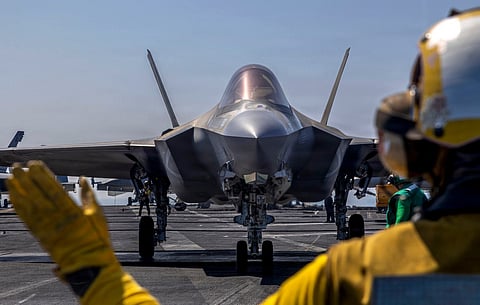
The New York Times reported that two aircraft carrier groups, along with fighter jets, bombers and refuelling aircraft, are now positioned within operational range of Iran, signalling Washington’s readiness to escalate if negotiations fail.


