How Iran's claim that mines struck a crude oil tanker fell apart — is the regime losing control of Hormuz?
US strikes, failed mine claim raise doubts over Tehran’s control of key waterway
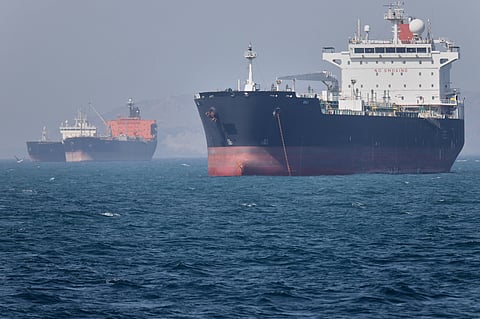
The reported tanker attack in the Strait of Hormuz has become a key test of Iran’s ability to control the waterway — and of the "infowar" surrounding the conflict.
Here's the rough timeline:
In the early hours of Monday (August 31, 2026), Iran’s Islamic Revolutionary Guard Corps (IRGC) claimed that a supertanker using the southern route near Oman struck two naval mines, caught fire and was forced to stop.
The report appeared shortly after US forces struck Iranian mine-laying capabilities from Larak and nearby areas (see list below).
Notably, the IRGC did not identify the vessel, its flag, the precise location or provide independently verifiable evidence.
Get it: Fast, verified news for FREE ... download the Gulf News app — simply click here
By about mid-day on Monday, the US Central Command rejected the claim, saying no ship had hit a mine in the Strait of Hormuz and accusing the IRGC of spreading disinformation to intimidate commercial shipping.
What ISW says
The Institute for the Study of War (ISW) said Iran appeared to be trying to restore its control over Hormuz by deploying mines and reinforcing the perception that ships faced danger in the waterway.
ISW also said repeated Iranian claims about tanker mine strikes were likely intended to make the southern route appear unsafe.
In a separate assessment, ISW said US strikes on Iranian radar systems would likely constrain Iran’s ability to disrupt shipping.
Increased commercial traffic suggested Tehran was having difficulty preventing some vessels from using the southern route, the institute said.
The assessment supports a narrower conclusion: Iran’s maritime coercion appears to have been weakened. It does not, by itself, prove that the Iranian government is close to collapse.
Is Iran panicking?
Iran’s behaviour is consistent with a regime under severe pressure. “Panic” has been used by some observers.
Tehran has faced losses to its military infrastructure, economic disruption and growing difficulty in keeping Hormuz closed.
Moreover, there's a possible surge in anti-missile hardware production by the US, as demonstrated by the US military's respond to Iran's multiple missile launches in Jordan.
On Tuesday (September 1), the drone-and-missile attacks launched by the Iranian regime against commercial ships in the Strait of Hormuz that were then shot down also indicate better coordination within the Central Command structure on countering such attacks.
Its tanker claim — issued without the details normally accompanying a verified maritime incident — could be viewed as an attempt to preserve deterrence after US forces cleared mines and escorted commercial vessels.
The ability of the CentCom to clear mines, strike and degrade Iran military capabilities at will even while enabling more commercial vessels to transit the Strait of Hormuz under American "escort" suggests a significant development.
Targets identified by CENTCOM
In the latest strikes, US forces said they hit Islamic Revolutionary Guard Corps (IRGC) facilities linked to attacks on commercial shipping and US personnel.
The targets included:
Air-defense sites.
Radar systems.
Maritime assets and facilities.
Mine-laying capabilities.
Communications sites.
Reports identified explosions or strikes around:
Chabahar and Konarak, which contain maritime, commercial and military infrastructure.
Bandar Abbas and Qeshm Island.
Sirik, Jask and Asaluyeh, according to Iranian media reports.
Larak Island, where the US previously struck two rocket launchers that it said were being prepared to deploy sea mines into the Strait of Hormuz.
Iranian state media also reported damage to a fishmeal factory, a fishing pier, a maritime organisation tower and Jiroft Airport.
Those claims have not been independently verified, and the United States has not confirmed that those civilian sites were intended targets.
Still, Iran has also demonstrated its ability to retaliate.
It launched attacks against US-linked facilities in Jordan, Bahrain, Iraq and Kuwait, while threatening countries that assist Washington.
Iranian officials also blacklisted additional ships attempting to transit Hormuz.
Those actions suggest a regime trying to preserve leverage. However, a state can be militarily weakened and economically strained while retaining a strong grip of its domestic security forces and population.
What Trump said
President Donald Trump has increasingly framed the conflict in terms of Iranian collapse and possible internal revolt.
In a Truth Social post, he said he was not trying to force Tehran back to negotiations and claimed the United States had “almost total control” of Hormuz while Iran’s economy was “totally collapsing.”
“They are just playing out the inevitable,” Trump wrote, before asking: “When are the Iranian people going to rise up and fight?”
He also declined to rule out US support for Iranian protesters, telling reporters that it would not "inappropriate" to say whether the CIA might arm them.
Trump later said Iranians face deadly repression when they protest but argued that the regime was “getting weaker by the day.”
The statements mark a shift from presenting negotiations as a possible off-ramp toward openly encouraging regime opposition.
'Death spiral?'
Treasury Secretary Scott Bessent described Iran as being in a “death spiral” and said pressure could lead to one of three outcomes: divisions within the IRGC, a popular backlash or a return to negotiations.
But he also said regime collapse was not necessarily the administration’s formal objective.
Other analysts are more cautious. Iran experts cited by public media said the regime remained entrenched despite the economic damage and military losses.
One assessment said there were no clear signs that economic hardship had yet produced protests capable of threatening the government’s stability.
A separate analysis argued that regime collapse was unlikely within six months and that economic pressure alone would more probably create a long-term crisis than an immediate political breakdown.
Reuters also reported that Trump’s aides were trying to keep the war limited ahead of November’s congressional elections.
Sources told the news agency that the United States had significantly weakened Iran’s conventional forces but had not achieved all four objectives publicly associated with the campaign: dismantling Iran’s nuclear program, degrading its ballistic-missile capability, destroying its navy and cutting support for regional proxy groups.
The stronger reading
The evidence points to a regime under mounting strain, not one demonstrably on the verge of collapse.
Iran appears to be losing freedom of action in Hormuz, while using military retaliation, threats and information operations to preserve the appearance of leverage.
The disputed tanker claim may reveal desperation — but it may also be a calculated attempt to deter shipping without risking another direct confrontation.
The most important indicators of imminent collapse would be sustained mass protests, defections from the IRGC or security forces, elite fragmentation, failure to pay state employees and visible loss of control in major cities.
None of those conditions has been independently established at the level needed to conclude that the end of the Islamic Republic is near.
For now, the tanker story shows that Iran’s control of Hormuz is contested. It does not yet show that Tehran has lost control of Iran.


