Iran has no control over Hormuz, in a 'death spiral': US Treasury Sec. Bessent
Washington targets Iran’s ‘tinker toy’ radar in bid to secure global oil chokepoint
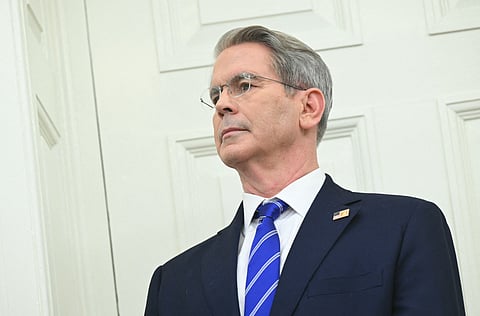
US Treasury Secretary Scott Bessent said Iran was attempting to rebuild a network of radar installations along the Strait of Hormuz before the US military struck and destroyed the emerging system, as Washington sought to demonstrate that Tehran does not control the strategic waterway.
Bessent described Iran's effort in unusually dismissive terms, referring to what he called a “patchwork tinker toy erector set radar” that Iranian forces were trying to reconstruct along the shores of the Strait.
“Iran does not have control of the Strait. And they are in a death spiral,” Bessent said.
Get it: Fast, verified news for FREE ... download the Gulf News app — simply click here
He said Iran had been rebuilding “some patchwork of tinker toy erector set radar” along the Strait before US forces targeted the installations.
The comments came after the US military launched a new wave of strikes against Iranian targets on Tuesday, including air-defense systems, radar sites, maritime assets, mine-laying capabilities and communications facilities, according to US Central Command.
Why the radar matters
Radar is critical to Iran's ability to monitor shipping and military activity through the Strait, detect aircraft and ships, and support anti-ship and air-defense operations.
The US campaign appears aimed at preventing Iran from reconstituting those capabilities after earlier strikes degraded its military infrastructure.
Washington said Iranian forces there were preparing rocket launchers for operations involving sea mines in the Strait. Iran subsequently launched missiles at US positions in Jordan.
The US then carried out the larger Tuesday strike package.
President Donald Trump has said the latest attacks also targeted Iranian radar systems that Tehran was attempting to repair, but snapped at a reported who asked about nuking Iran.
The renewed attacks followed US strikes on Larak Island.
A battle over Hormuz
The dispute goes far beyond radar.
The Strait of Hormuz carries roughly one-fifth of global oil consumption, making it one of the world's most consequential energy chokepoints.
Shipping through the waterway has fallen dramatically during the conflict, although some traffic has resumed.
Two tankers were struck near the Strait on Monday, further raising concerns over the safety of commercial shipping.
Bessent's comments form part of a broader US effort to convince markets and shipping companies that Iran cannot permanently shut the waterway.
Bessent also said Washington is imposing additional sanctions on Iranian financial institutions, potentially on a weekly basis, as part of its campaign to economically isolate Tehran.
Iran rejects the US narrative
Iran has continued to assert its ability to disrupt shipping and has warned that if it cannot export oil, other countries should not expect to export oil through the Gulf either.
The IRGC said the latest US attacks would tighten the effective closure of Hormuz.
Iranian forces also retaliated after Tuesday's strikes with missile and drone attacks against US positions in the region, according to Iranian state-linked media.
That leaves the central question unresolved: Who actually controls Hormuz?
Washington says Iran has failed to establish control and that US military operations are restoring freedom of navigation.
Tehran argues that its ability to threaten shipping, deploy mines and attack vessels gives it enormous leverage over the waterway.
The active US naval blockade against Iran, meanwhile, is severely stalling Iranian oil exports, keeping at least 1.5 million barrels per day of Iranian oil off the market, and deepening economic hardship inside the country.
For global energy markets, the distinction is less theoretical.
The Strait may remain physically open.
However, commercial shipping still cannot move through it at pre-war levels, even as overland pipelines moving oil from the Gulf to world markets could render Iranian over the chokepoint less disruptive to oil markets.


