850 missiles in 4 weeks: What the Iran war is costing the US
Pentagon faces pressure as Tomahawk use surges raising concern over future readiness
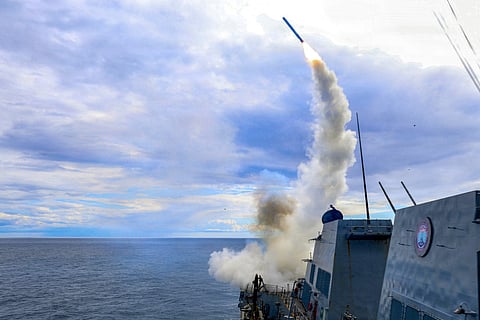
The United States has fired more than 850 Tomahawk cruise missiles in just four weeks of war with Iran, a pace that has raised concerns inside the Pentagon about dwindling stockpiles and the ability to sustain future military operations, according to a report by The Washington Post.
The heavy reliance on the long-range precision weapons — a cornerstone of US strike capability — has prompted urgent internal discussions on boosting supply, relocating missiles from other regions, and ramping up production. The issue comes as Washington weighs further escalation in the conflict even while exploring diplomatic options to end hostilities.
What are Tomahawk missiles and why are they key?
Tomahawk cruise missiles have been a staple of US military operations since the Gulf War in 1991. Capable of travelling more than 1,600km, they allow strikes on heavily defended targets without putting pilots at risk.
Modern versions, in service since 2004, can be guided via satellite, strike pre-programmed targets, or locate moving threats using GPS. They can also loiter over battlefields and relay real-time imagery to commanders.
Why is the current usage raising concern?
Only a few hundred Tomahawks are manufactured each year, making supply inherently limited. The Pentagon does not disclose its total inventory, but the current burn rate has drawn scrutiny.
One official described the number of missiles left in the Middle East as “alarmingly low,” while another warned the Pentagon could be approaching “Winchester” — military slang for running out of ammunition — without intervention.
The issue is not just about the Iran campaign. Officials are also concerned about maintaining readiness for potential conflicts elsewhere, particularly in the Indo-Pacific.
Tomahawk missiles: At a glance
Type: Long-range cruise missile used by US Navy
Range: Over 1,600 km
Launch platforms: Surface warships and submarines
Role: Precision strikes on high-value or heavily defended targets
First used in combat: 1991 Gulf War
Guidance: GPS and satellite-linked targeting; can adjust mid-flight
Capabilities:
Strike pre-programmed targets
Track and hit moving targets
Loiter over target areas before striking
Relay battle-damage imagery via onboard camera
Size: Around 20 feet long; weighs about 1,580kg
Cost: Up to $3.6 million per missile
Production time: Up to two years per unit
Annual production capacity: About 600 missiles
Recent procurement: 57 missiles in last US defence budget
Total produced historically: Nearly 9,000 (many older versions retired)
Key advantage: Reduces need to send pilots into high-risk airspace
How many missiles does the US have?
Estimates vary. Before the conflict began, the US Navy likely had between 4,000 and 4,500 Tomahawks, according to analysts. Others suggest the number could have been closer to 3,000 after previous operations.
Mark Cancian, a senior adviser at the Centre for Strategic and International Studies, said firing more than 800 missiles would amount to roughly a quarter of the total inventory.
“That would be about a quarter of the total inventory and would leave a large gap for a conflict in the Western Pacific,” he said.
“It would take several years to replenish.”
What about production and cost?
Tomahawks are expensive and slow to produce. The latest versions can cost up to $3.6 million each and take as long as two years to build.
The US defence industry currently has the capacity to produce about 600 missiles per year. However, recent procurement has been limited — with just 57 missiles included in last year’s defence budget.
Over the lifetime of the programme, nearly 9,000 Tomahawks have been produced, though many older variants are now obsolete and retired.
How is the war affecting usage?
A significant number of the missiles were fired during the opening phase of the conflict, known as Operation Epic Fury.
At least one strike hit near an elementary school in Minab, prompting a US investigation after Iranian officials said the attack killed scores of children.
As Iranian air defences were degraded, US forces increasingly shifted to airstrikes using other munitions that are more readily available.
What other weapons are being used?
The US military has also fired more than 1,000 air-defence interceptor missiles — including those from Patriot and THAAD systems — to counter Iranian attacks.
Like Tomahawks, these systems are costly and produced in limited numbers, raising additional concerns about sustainability.
What is the Pentagon saying?
US officials have pushed back strongly on suggestions of shortages.
Pentagon spokesman Sean Parnell said the military “has everything it needs to execute any mission at the time and place of the President’s choosing and on any timeline.”
He added that coverage suggesting otherwise was “biased and obsessed with portraying the world’s strongest military as weak.”
White House press secretary Karoline Leavitt also said the US military “has more than enough munitions, ammo and weapons stockpiles to achieve the goals of Operation Epic Fury laid out by President Trump — and beyond.”
Defence Secretary Pete Hegseth echoed that position, saying: “we’ve got no shortage of munitions.”
What happens next?
Despite public reassurances, the administration has already begun engaging defence contractors to boost production.
Trump said companies had agreed to “quadruple Production of the ‘Exquisite Class’ Weaponry,” with further meetings planned.
The Pentagon is also seeking more than $200 billion from Congress to fund the war, though the request has faced resistance from lawmakers.


