Who runs an impeachment trial? Are 16 votes required for conviction? Constitutional debate shapes fate of the Philippines' highest-profile case
VP Sara Duterte impeachment trial sparks clash over limits of Supreme Court intervention
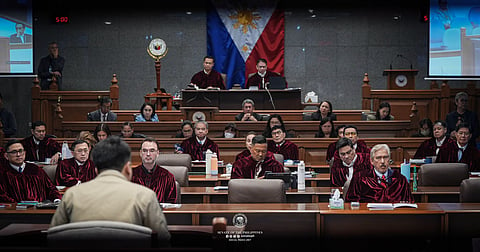
Manila: A constitutional law expert has pushed back against claims that only the Senate President may preside over an impeachment trial and that 16 votes are needed as an absolute number to convict an official being impeached.
The remarks came from legal scholar, Atty. Domingo Cayosa, who argued that the Philippine Constitution gives the Senate broad authority to determine its own impeachment procedures and that courts should avoid intervening in what is fundamentally a legislative function.
Cayosa, former president of the Integrated Bar of the Philippines (IBP) explained contentious points amid the ongoing debate over the Senate's impeachment rules, including who may preside over impeachment proceedings and how many votes are required for conviction.
Constitution first, legislative history second
The lawyer challenged arguments raised by some senators, including Sen. Alan Peter Cayetano, who cited the deliberations of the 1986 Constitutional Commission — the body that drafted the 1987 Constitution — to support the position that no officer other than the Senate President should preside over an impeachment court.
According to the Cayosa, constitutional interpretation begins with the text itself — not with the records of the Constitutional Commission.
"When interpreting the Constitution, the first thing you examine is what is actually written because that is what the Filipino people approved in the plebiscite," he told Facts First, a political blog run by Filipino journalist Christian Esguerra.
He explained that legislative history, including the Constitutional Commission debates, is merely a secondary source that courts consult only when constitutional language is ambiguous.
"If the constitutional text is clear, there is no need to resort to the Commission's deliberations," he said, describing this as a well-established doctrine in statutory and constitutional interpretation.
What the Constitution actually says
The expert argued that the Constitution explicitly identifies only one instance in which it specifies who must preside over an impeachment trial:
When the President of the Philippines is on trial, the Chief Justice presides.
Outside that situation, he noted, the Constitution simply provides that senators sit as judges during impeachment proceedings and does not expressly require the Senate President to preside.
"The Constitution does not say that the Senate President must always be the presiding officer," he said.
Senate can set its own rules of impeachment proceedings
Instead, he pointed to another constitutional provision giving the Senate authority to determine its own rules of proceedings.
According to him, the designation of the Senate President as presiding officer comes not from the Constitution itself but from the Senate Rules on Impeachment, making it a procedural matter that senators are free to amend through their rule-making powers.
Can the Senate change its own impeachment rules?
Cayosa's answer was unequivocal: Yes.
He said the Senate has constitutional authority to amend its procedural rules, including provisions governing who presides over impeachment proceedings.
He noted that senators voted earlier this month to amend portions of the impeachment rules to provide greater procedural flexibility.
The amendments, he said, were approved by majority vote, published, and became part of the Senate's official rules.
"Once adopted through the Senate's procedures, it is too late to argue that the amendment is invalid," he said.
Should the Supreme Court intervene?
The lawyer also criticised recurring efforts to challenge impeachment proceedings before the Supreme Court.
He argued that impeachment is constitutionally entrusted to the Senate and warned against judicial interference in what he described as an internal legislative function.
"The Senate and the Supreme Court are separate constitutional bodies," he said.
Referring to a previous Supreme Court ruling that drew criticism for intervening in impeachment-related proceedings, he said the Court should exercise greater restraint if new petitions are filed.
"I hope the Supreme Court has learned its lesson and avoids interfering in matters that belong exclusively to the Senate," he said.
The next legal battle: 16 votes needed to convict?
Another issue generating debate concerns the constitutional requirement that conviction in an impeachment trial requires a two-thirds vote of all the Members of the Senate.
During the opening day of the proceedings, Senate President Francis "Chiz" Escudero reportedly stated that 16 votes would be needed for conviction.
Impeachment presiding officer Escudero said the Charter is clear on the voting thresholds in an impeachment trial: 24 senators constitute the impeachment court, while 16 votes are needed to convict.
Senator Escudero cited the 2000 Supreme Court ruling in Bayan v. Zamora, which held that despite only 23 incumbent senators at the time, the constitutional requirement of a two-thirds vote still meant at least 16 affirmative votes.
Escudero stressed that the same constitutional standard must be observed in Duterte’s impeachment trial, saying it protects both the respondent’s rights and the sovereign will of the people.
“This is the prevailing law today. And whether we agree with it or not, we must abide by it,” he said.
Escudero made the statement following the arrest earlier Monday of Sen. Rodante Marcoleta on plunder charges.
Sen. Jinggoy Estrada had also been arrested on plunder charges weeks earlier and is currently under a 90-day suspension.
The following day, Sen. Alan Peter Cayetano clarified the matter, prompting questions over whether the issue could ultimately reach the Supreme Court.
Atty. Cayuso said Escudero's statement reflected only his "personal interpretation" and was not a formal ruling adopted by the Senate.
"That was his opinion. It was not voted upon by the senators," he said.
He suggested the statement may have been intended as a "tactical move" to prevent procedural delays while leaving open the possibility of future judicial review if necessary.
Is the issue ripe for Supreme Court review?
According to the lawyer, not yet. He argued that no actual legal controversy exists because the Senate has not yet conducted a vote requiring the disputed threshold.
"There is nothing final to review because no conviction vote has occurred," he said.
Only after the Senate applies the constitutional voting requirement, he said, would a genuine legal controversy potentially arise.
Does 'all members' always mean 24 senators?
Cayuso disputed the assumption that two-thirds must always be computed from the Senate's full 24-member membership.
The Constitution clearly requires a two-thirds vote of "all the Members of the Senate," but he argued that this phrase should be interpreted in light of practical realities.
He noted that some senators may be unable to participate because of vacancies, suspension, detention or legal disqualification.
Drawing comparisons with appellate courts and even the Supreme Court, he said judges or justices who do not participate in a case are generally not counted in determining the number of votes needed for a decision.
"The Constitution is a living document," he said.
"It should be interpreted in a way that makes it effective rather than impossible to implement."
He maintained that the constitutional intent was to require a supermajority — not necessarily a fixed numerical threshold based on a full Senate, regardless of participation.
Under that interpretation, only senators actually participating in the impeachment proceedings should be counted when determining the two-thirds requirement.
Why the debate matters
The dispute could have significant implications beyond the current impeachment proceedings.
If challenged before the Supreme Court, the Court may eventually be asked to define:
whether the Senate has exclusive authority to determine who presides over impeachment trials;
how far courts may review impeachment procedures; and
whether "all the Members of the Senate" refers to the Senate's total constitutional membership or only senators legally participating in the trial.
Those questions could shape the constitutional boundaries between the judiciary and the legislature — and establish precedents for future impeachment proceedings in the Philippines.
Also In This Package


