Day 1: What Sen. Escudero can — and cannot — do as Philippine Senate presiding officer in Sara Duterte impeachment trial
Senate picks Escudero to preside over Duterte impeachment despite objections
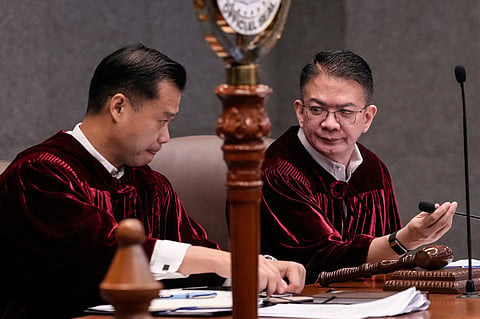
Manila: Senator Chiz Escudero was elected as the presiding officer on Day 1 of the Philippine Senate, now assembled as an impeachment court, that will try Vice President Sara Duterte.
Escudero received 12 votes after being nominated by Senator Ping Lacson, despite objections from Senator Alan Peter Cayetano, who argued that the Senate president should preside over the trial.
According to Senate President Win Gatchalian, the Senate amended its impeachment rules in June to allow the election of a presiding officer other than the Senate president.
Following the vote, Escudero — a lawyer — formally took the chair to preside over the impeachment proceedings.
A FIRST: The Philippines' first-ever impeachment trial of a sitting Vice President opened on Monday (July 6, 2026). Sara Duterte faces four charges: misusing ₱612.5 million in "confidential funds" (₱500M from her own office, ₱112.5M from the Department of Education), amassing unexplained wealth and failing to disclose assets from 2022-2024, bribery and cash payments to officials, and threatening to assassinate President Marcos and the First Lady.
Cayetano's objections
Before the election, senators debated for more than half an hour over the selection of the presiding officer at the start of the trial proper, after Cayetano challenged the rules approved under Gatchalian's leadership last month.
Cayetano, aligned with the Duterte bloc, and a former foreign minister under former President Rodrigo Duterte, maintained that the Constitution provides that the Senate president should preside over an impeachment trial.
Senators aligned with the Gatchalian bloc disagreed.
Gatchalian — a businessman with a degree in Finance and Operations Management — has not objected to Lacson's motion.
Gatchalian pointed out that on June 3, the Senate unanimously voted to amend its rules to permit the election of a presiding officer other than the Senate president.
The amended rules were published and circulated in newspapers, as required by law, on June 9, he said.
Under the 1987 Philippine Constitution and the Rules of Procedure on Impeachment Trials adopted by the Senate, the presiding officer plays a significant but generally limited and procedural role.
The presiding officer manages the proceedings but does not have the same authority as a judge in an ordinary court, because the Senate sitting as an impeachment court is the ultimate decision-maker.
Here's a breakdown of the presiding officer's powers:
Constitutional basis
Article XI, Section 3(6) of the 1987 Constitution provides:
"The Senate shall have the sole power to try and decide all cases of impeachment. When sitting for that purpose, the Senators shall be on oath or affirmation. When the President of the Philippines is on trial, the Chief Justice of the Supreme Court shall preside, but shall not vote."
For impeachment trials involving officials other than the President (such as the Vice President, constitutional commissioners, or Supreme Court justices), the Senate elects its own presiding officer under its impeachment rules.
Powers of the presiding officer
1. Presides over the proceedings
The presiding officer:
Opens and adjourns sessions.
Maintains order and decorum.
Ensures the orderly presentation of evidence.
Recognizes speakers.
This is similar to a trial judge's administrative role.
2. Rules on questions of evidence and procedure
The presiding officer may initially rule on:
objections;
admissibility of evidence;
motions;
procedural issues; and
requests made by either the prosecution or defense.
However, unlike an ordinary judge, these rulings are not necessarily final.
3. Senate may overrule the presiding officer
One of the defining features of Philippine impeachment trials is that the Senate retains ultimate authority.
If a senator challenges the presiding officer's ruling, the Senate may vote to:
affirm,
modify, or
overturn the ruling.
Thus, the presiding officer's authority exists subject to the will of the impeachment court.
4. Issues orders necessary to conduct the trial
The presiding officer may:
administer oaths;
issue subpoenas if authorized under the rules;
direct witnesses;
regulate examination and cross-examination;
implement schedules and hearing procedures.
5. Signs official orders and processes
The presiding officer signs:
summons,
subpoenas,
writs,
official notices, and
procedural orders issued by the impeachment court.
6. Enforces decorum
The presiding officer may:
call parties to order;
direct counsel to comply with the rules;
maintain dignity during the proceedings.
7. Does not determine guilt or innocence alone
Unlike a trial judge:
the presiding officer cannot convict or acquit;
cannot dismiss the impeachment case unilaterally;
cannot decide factual issues by himself or herself.
Only the Senate, voting as an impeachment court, may convict.
What the presiding officer cannot do
Generally, the presiding officer cannot:
dismiss the Articles of Impeachment on their own;
prevent the Senate from voting on motions;
refuse to submit questions to the Senate when required by the rules;
render a final judgment without Senate concurrence.
The Senate possesses the "sole power to try and decide" impeachment cases.
If the Chief Justice presides
When the President is the respondent, the Chief Justice presides.
Even then, the Chief Justice:
cannot vote on conviction;
serves mainly as the presiding officer;
makes procedural rulings subject to review by the Senate.
This arrangement was seen during the 2012 impeachment trial of Renato Corona, where then-Senate President Juan Ponce Enrile presided because the respondent was the Chief Justice rather than the President.
Practical implication
In practice, the presiding officer acts as the manager of the trial, while the Senate collectively functions as both the judge of law and the judge of facts.
This means the presiding officer can make initial procedural and evidentiary rulings to keep the trial moving efficiently, but any senator may seek a vote of the impeachment court to reverse those rulings.
The Senate's decision on such matters is controlling, reflecting the Constitution's grant to the Senate of the sole power to try and decide all impeachment cases.


