How high-stakes impeachment case could reshape Philippines: Democracy on trial
Televised proceedings turn legal battle into a national political reckoning
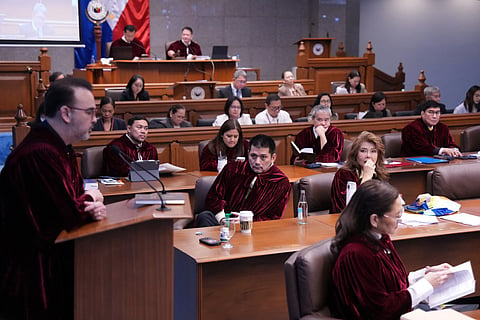
As the impeachment trial of Vice President Sara Duterte enters its next phase, the proceedings have evolved into something larger than a legal contest over alleged misconduct.
They have become a test of the Philippines' constitutional system — its checks and balances, the resilience of its democratic institutions, and the willingness of its political leaders to submit to the rule of law.
The opening days of the Senate trial suggest that the battle ahead will be fought on two fronts.
One will unfold inside the impeachment court, where prosecutors and defence lawyers argue over evidence and constitutional interpretation.
The other will play out before the Filipino public, where every testimony and procedural ruling could influence the country's political future.
More than a legal proceeding
Former Supreme Court Justice Adolf Azcuna, one of the principal framers of the 1987 Constitution, described the impeachment as a constitutional "test" of the country's accountability mechanisms.
Impeachment, unlike an ordinary criminal case, is a sui generis proceeding — a unique constitutional process.
Why? It is both legal and political.
Senators sit not only as legislators but as judges sworn to render an impartial verdict, while ultimately making decisions that carry enormous political weight.
The outcome will determine not only whether Vice President Sara Duterte, who remains extremely popular especially in the South, remains in office, but also how future generations view the strength of Philippine democratic institutions.
The Philippine Senate has earmarked ₱26 million to cover the operational costs of the ongoing impeachment trial of Vice President Sara Duterte, including approximately 60 traditional judicial robes (reportedly priced at ₱7,000 each). During the 2012 impeachment trial of Chief Justice Renato Corona, the House spent a total of ₱5.8 million on food, logistics, and administrative assistance over a five-month span, as per published data.
Constitutional questions at the heart of the trial
Several unprecedented constitutional issues have already emerged.
One concerns the Senate's internal procedures. Because the current Senate President (Win Gatchalian) is not a lawyer, another senator (Francis Escudero) with legal training has been designated to assist in presiding over portions of the trial.
While "unusual", retired SC Justice Azcuna argues the arrangement is not unconstitutional.
He explained that the Constitution gives the Senate broad authority to organise its own impeachment proceedings.
Another issue involves "due process".
The Supreme Court's earlier rulings on impeachment clarified that constitutional due process applies throughout the impeachment process, although differently from ordinary criminal proceedings.
The SC ultimately emphasised that lawmakers considering impeachment articles must have access to the complaint and supporting evidence, while allowing the House considerable flexibility in conducting its own proceedings.
These rulings have become central to both the prosecution's and defence's legal strategies.
Battle over the numbers
The most closely watched question is whether prosecutors can secure the two-thirds vote of all Senate members for conviction.
Under the Constitution, conviction requires the votes of two-thirds of the Senate — not merely two-thirds of senators present during voting.
That distinction has become increasingly significant amid ongoing legal cases involving several senators.
Azcuna argues that unless a senator has formally ceased to be a member of the Senate, every senator must still be counted in determining the constitutional threshold for conviction, regardless of detention, absence or pending legal issues.
This interpretation means prosecutors face an exceptionally high hurdle to get a conviction.
Azcuna, elected delegate to the 1971 Constitutional Convention and appointed a member of the 1986 Constitutional Commission that drafted the 1987 Charter, explained that senators who are unable to attend the impeachment trial may ultimately be unable to vote because the Senate's current rules require physical presence to participate in the proceedings.
However, he emphasised that even if they are absent, they are still counted as members of the Senate when computing the constitutional threshold required for conviction.
"This is different from the rules governing the election of the Senate President," Azcuna said. "There, there has been debate over whether a simple majority should be based on those present and voting. But impeachment is governed by a different constitutional standard," Justice Azcuna explained to Richard Heydarian in an interview.
He explained that the Constitution specifically requires the concurrence of two-thirds of all Senate members, not merely two-thirds of those present.
"The reason for this strict computation is that the Constitution does not want the removal of a high-ranking public official to be taken lightly," he said.
While the impeachment threshold was lowered from previous constitutional provisions, Azcuna noted that it remains intentionally difficult to meet.
"A supermajority is still a high hurdle because the removal of a constitutional officer should never be easy," he said.
"The Constitution requires two-thirds of all members — not just those present — so the required number cannot be manipulated simply because some senators are absent, arrested or detained."
Which impeachment article appears strongest?
Among the articles of impeachment, constitutional observers believe one allegation may prove easier to litigate than the others.
The charge involving the Vice President's alleged public threat against President Ferdinand Marcos Jr., First Lady Liza Araneta-Marcos and ex-House Speaker Martin Romualdez is widely viewed as the most straightforward because it relies largely on publicly available statements whose authenticity is not in dispute.
Financial allegations — including questions surrounding confidential funds, alleged unexplained wealth and bribery — are expected to require far more extensive documentary evidence, accounting records and witness testimony.
Legal experts note that these financial allegations could become significantly more complex, allowing greater room for factual disputes.
Meanwhile, the constitutional ground of betrayal of public trust remains the broadest impeachment standard.
Because the Constitution does not precisely define the term, senators will have considerable discretion in determining whether the Vice President's conduct renders her unfit to remain in office.
A political trial as much as a legal one
Even if conviction proves difficult, few observers believe the trial will be politically inconsequential.
Months of televised hearings will expose evidence, witness testimony and competing narratives before a national audience fed by livestreamed proceedings.
The prosecution appears aware that obtaining the required supermajority may be challenging.
Instead, analysts suggest its broader objective may be to present enough evidence for voters to make their own judgment before the next presidential election.
The defence, meanwhile, is expected to seek not only acquittal but also to preserve the Vice President's political standing by challenging the credibility, admissibility and interpretation of the prosecution's evidence.
Could conviction and disqualification be separated?
One constitutional question raised during the discussion remains largely unexplored in Philippine jurisprudence.
The Constitution provides that impeachment judgments "shall not extend further than removal from office and disqualification to hold any office."
Azcuna suggested this language could theoretically allow separate votes — one on removal from office and another on permanent disqualification — although no Philippine impeachment court has ever adopted such an approach.
Whether such an interpretation would withstand constitutional scrutiny remains uncertain and would likely become the subject of intense legal debate should that scenario ever arise.
Why this trial matters beyond Sara Duterte
Regardless of its outcome, the impeachment will shape how Filipinos view constitutional accountability.
Supporters see the proceedings as an opportunity to reinforce the principle that no public official is above scrutiny.
Critics worry that impeachment could become another arena for political rivalry rather than constitutional accountability.
Both concerns can coexist.
That is why the process itself may ultimately matter as much as the verdict.
If prosecutors are allowed to present their evidence fully, the defence receives every opportunity to respond, and senator-judges follow constitutional procedures rather than partisan considerations, the trial could strengthen public confidence in democratic institutions — even if it ends in acquittal.
The impeachment of Vice President Sara Duterte is therefore more than a question of whether one official remains in office.
It is a measure of whether the constitutional safeguards established in 1987, after the fall of the dictatorship of Ferdinand Marcos Sr., continue to function under the pressures of modern Philippine politics.
Also In This Package


