When the camera never blinks: How livestreaming is changing the Sara Duterte impeachment trial
When every objection is content: The Sara Duterte case in the age of endless replay
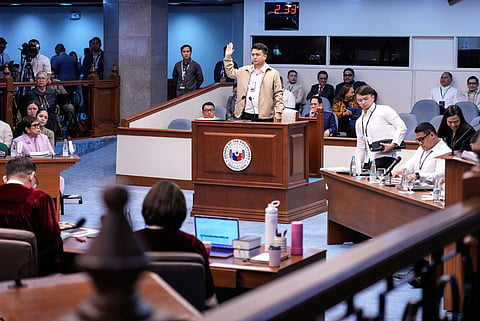
Marshall McLuhan's famous dictum that “the medium is the message” has rarely felt more relevant than during the livestreamed impeachment trial of Philippine Vice President Sara Duterte.
Millions of Filipinos are not reading transcripts.
Get updated faster and for FREE: Download the Gulf News app now - simply click here
They are not waiting for newspaper headlines or the evening news.
They are watching the trial unfold in real time — hour after hour, objection after objection, recess after recess — on YouTube, Facebook, TV and mobile phones.
In the process, the impeachment has become something larger than a constitutional proceeding.
It has become media. The distinction matters.
Impeachment was designed as a solemn legal and political mechanism.
It relies on evidence, procedure and deliberation.
But livestreaming transforms it into a continuous public performance, where every participant is conscious of an audience that extends far beyond the Senate chamber.
The senators are no longer speaking only to fellow senator-judges. They are speaking to millions of potential voters.
Irony unfolds in real-time
The prosecutors are presenting not only to the impeachment court but also to wider world in real time.
The defence, likewise, is arguing simultaneously before the Senate and before public opinion.
Every raised eyebrow becomes a meme. Every object is content.
Every stumble becomes a viral clip. Every gap in questioning, point of order, objection, rhetorical flourish becomes tomorrow's TikTok video.
Here’s the irony: in this age of livestreaming, the most forceful 30-second clip may carry more weight than three hours of documentary evidence.
Here’s the irony: in this age of livestreaming, the most forceful 30-second clip may carry more weight than three hours of documentary evidence.
The camera has democratised access to one of the country's most consequential political events.
That is unquestionably healthy for a whole-of-nation schooling.
Citizens no longer rely solely on journalists or official summaries to understand what happened.
They can watch for themselves: It's radical tranparency.
The unfolding drama of what's expected to be a multi-week trial has just started (it's just Day 5, as of today, July 10, 2026).
Radical transparency
Yet transparency brings an unexpected consequence.
The trial now unfolds at two different speeds.
Inside the chamber, impeachment remains a painstaking legal exercise governed by rules of evidence and constitutional standards.
Outside the Senate chamber, public debate unfolds under a very different set of rules.
Online platforms are designed to reward content that provokes strong emotional reactions — outrage, conflict, certainty — rather than the measured, procedural reasoning that often defines legal proceedings.
Online platforms are designed to reward content that provokes strong emotional reactions — outrage, conflict, certainty — rather than the measured, procedural reasoning that often defines legal proceedings.
In that environment, a senator or counsel raising a careful question about due process may attract little attention, while another delivering a sharp, confrontational soundbite can dominate the conversation for days.
Social media amplifies what is most engaging, not necessarily what is most informative, or is truthful.
Social media incentives
These dynamics create powerful incentives.
In today's many-to-one and one-to-many communication ecosystem, where messages can also be tailored to different audiences, political performance often travels farther than legal substance.
As a result, truth and careful deliberation can be overshadowed by the spectacle that has long been part of legislative politics.
Livestreaming simply magnifies its rewards.
Television once edited hearings into nightly highlights.
Today, every second is available instantly, searchable and endlessly remixable. The archive never disappears. Every speech can be clipped, reframed, sliced, diced, tweaked and redistributed within minutes.
Today, every second is available instantly, searchable and endlessly remixable. The archive never disappears. Every speech can be clipped, reframed, sliced, diced, tweaked and redistributed within minutes.
Simple point: The internet offers infinite information, not guaranteed understanding — just as a shelf full of books guarantees neither knowledge nor wisdom.
An eight-hour hearing is rarely consumed as a whole.
Instead, viewers experience it through fragments, usually chosen by political allies, influencers, content creators or one's own limits.
From mass media to mass customisation of content
Different audiences end up watching different trials, each assembled from selective moments that reinforce existing beliefs, or bolster biases.
The medium encourages polarisation as much as participation.
Yet there is another side to the story.
Livestreaming also imposes accountability.
Public officials know they cannot rely on closed-door trading or selective leaks.
Every question, every vote and every procedural manoeuvre is preserved in a public record — or ledger — available to anyone with a 4G/5G gear. Welcome to the era of what amounts to the Bitcoin of politics.
Partisanship vs preparation
That visibility raises the cost of obvious partisanship and rewards preparation, discipline, credibility.
It keep an easy-to-search archive of evidence and facts presented. It exposes flawed reasoning.
The senators — sitting as impeachment judges — are expected to decide the case solely on the Constitution, the law and the evidence presented in court, not on:
public outrage;
opinion polls;
social media campaigns;
political pressure; or
the fact that many people may believe Sara Duterte is guilty or not guilty.
More importantly, the trial serves as a lesson in critical, logical and creative thinking.
For one, it exposes common fallacies in argumentation, from argumentum ad populum — the appeal to popularity, where a claim is treated as true simply because many people believe it — to non sequitur, in which a conclusion does not logically follow from the premises.
Beyond its legal and political significance, the proceedings offer a public demonstration of how arguments should be evaluated on the basis of evidence and logic rather than rhetoric alone.
Constitutional justice
Even so, constitutional justice is not measured by viewer counts.
And an impeachment trial is not supposed to produce cliffhangers or viral moments.
It is supposed to establish facts, test evidence and determine whether an official has committed impeachable offenses under the Constitution.
But it can also reinforce partisanship.
Senators may ultimately vote along party lines to protect their political futures instead of standing, courageously and independently, on the side of the truth.
Senators may ultimately vote along party lines to protect their political futures instead of standing, courageously and independently, on the side of the truth.
Accountability in the age of livestreaming
The proceedings are about constitutional accountability.
But the livestream itself has become a big part of the story, reshaping perception, reinforcing biases, influencing political behaviour and turning every participant into both a constitutional actor and a media performer.
In that sense, the impeachment is no longer just a trial.
It's a real-time, full-on broadcast — and the broadcast is changing the trial.
The public is no longer merely observing democracy.
For example, VP Duterte's conditional "kill video" threat (made by Duterte against President Marcos Jr, his wife Lisa and former House Speaker Martin Romualdez) has seen prosecution and defence spar for a good part of the workweek.
This sparring is amplified by those follow it in real time, on different channels, with the red-hot comments section scrolling beneath.
Ultimately, Senator-judges will decide how much weight to give the surrounding conversation versus the precise language used.
Even if the remarks were determined not to satisfy every element of "grave threats" under the Revised Penal Code, that would not necessarily resolve the impeachment case.
And, as expected, more reactions to every part of the trial will simply roll online.
Whether VP Duterte is ultimately acquitted or convicted, the livestream has already changed Philippine politics.
McLuhan argued that technologies reshape society not simply by carrying messages but by changing how people think, behave and relate to one another.
The Duterte impeachment trial illustrates that insight with remarkable clarity.


