The cult of Rodrigo Duterte: Why one man still divides the Philippines
Strongman has inspired much devotion — and as much revulsion
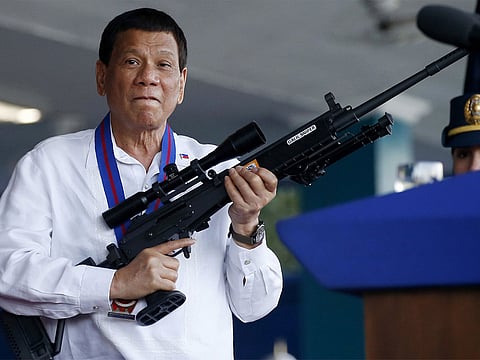
Manila: Few politicians in modern Philippine history have inspired as much devotion — or as much revulsion — as Rodrigo Duterte.
A decade after his landslide election in 2016, and even as he faces trial before the International Criminal Court (ICC) in The Hague over alleged crimes against humanity linked to his bloody anti-drug campaign, Duterte remains the country's most polarising political figure.
His daughter, Vice President Sara Duterte, has already declared her intention to seek the presidency in 2028, ensuring that "Dutertismo" will remain central to Philippine politics for years to come.
The question is no longer simply whether Duterte was a successful president.
It is why millions continue to see him as a saviour while millions of others regard him as one of the gravest threats Philippine democracy has faced since the fall of strongman Ferdinand Marcos Sr.
The making of a political cult
Duterte did not build his movement through ideology alone. He built it through storytelling.
Unlike traditional politicians who spoke in rehearsed bureaucratic language, Duterte sounded like a neighbourhood elder telling stories over San Miguel.
His speeches wandered between jokes, profanity, anecdotes and dark humour. Supporters rarely minded that many stories were exaggerated, unverifiable or contradictory.
What mattered was authenticity — or the perception of it.
His crass language broke political convention. His insults became entertainment.
His profanity became a symbol of rebellion against Manila's elite. He trashed the Malacanang, the principal workplace and residence of the president, saying it's full or rats.
For many Filipinos, particularly overseas workers frustrated by corruption, criminality and government inefficiency, Duterte appeared refreshingly genuine.
Surveys during his presidency frequently placed his approval and trust ratings above 80%, with some measures exceeding 90% at their peak.
To supporters, he said what ordinary Filipinos were thinking but previous presidents were too cautious to utter.
His political genius lay in converting personality into legitimacy.
Fear as public policy
No issue defined Duterte more than drugs.
His central promise was brutally simple: eliminate drug dealers and users, and ordinary Filipinos would once again feel safe.
The message resonated.
Many families — particularly overseas Filipino workers (OFWs) watching crime stories from abroad — felt someone was finally willing to confront problems previous administrations appeared unable to solve.
Whether crime statistics fully supported that perception became almost secondary.
Politics often rewards feelings, or perceptions, more than facts — or even the truth.
For millions, Duterte restored a sense of order. He promised that with his "war on drugs", the fish in Manila Bay would grow "fat" from the bodies of criminals.
For many others, he normalised extrajudicial violence.
Human rights organisations documented thousands of deaths during anti-drug operations and vigilante killings. The ICC alleges that the campaign constituted crimes against humanity — a charge Duterte denies and one that remains before the court.
Thus emerged the country's deepest political divide: one side saw justice; the other saw murder.
The authoritarian temptation
Political scientists have long observed that authoritarian leaders rarely begin by abolishing democracy outright.
Instead, they redefine democracy. Elections continue.
Institutions formally remain.
But independent institutions weaken, critics become "enemies", and loyalty increasingly outweighs competence.
Duterte displayed many characteristics commonly associated with authoritarian populism.
He portrayed himself as the embodiment of "the people" against corrupt elites.
He frequently attacked independent media, human rights groups, churches, political opponents. He denigrated even his own children.
His difficult relationship with son Sebastian (also known as “Baste") is well-documented. “My youngest son is a jerk. He’s not been going home to his house anymore,” Duterte was quoted by BBC as saying in a mixt of Tagalog, English and the Visayan dialect in a February 2017 speech.
Duterte also called his daughter, now-Vice President Sara Duterte, a “drama queen” in jest during an ambush interview in April 2016. The remark was made when he expressed doubt over her disclosure that she had been a rape victim.
He famously called Pope Francis a "son of a b**" (or p*** i*** in Tagalog) during a 2015 speech. He made the controversial remark to express his frustration after getting trapped in a monstrous traffic jam in Manila, made worse by the pontiff's visit.
Duterte also famously called Barack Obama a "son of a b**", warning the then-leader of the United States not to raise human rights concerns with him.
Duterte's lawyers pursued then-Senator Leila de Lima on drug-related charges that many legal scholars argued were politically motivated.
After 7 years in detention, courts eventually acquitted de Lima, further fueling criticism that criminal law had been weaponised against dissent under Duterte.
The underlying philosophy was unmistakable.
The interests of the state — and Duterte's idea of national security — were often presented as superior to individual rights.
This reflects an authoritarian worldview in which civil liberties become conditional, rather than inherent.
While it does not necessarily amount to fascism, it does share important family resemblances: the glorification of strongman rule, suspicion of liberal institutions, militarised rhetoric, and willingness to subordinate individual rights to state power.
Militarism as governance
Duterte consistently framed national problems through the language of "war".
There was a war on drugs.
A war against communists.
A war against corruption.
A war against terrorism.
Military and police institutions assumed unprecedented political prominence.
The distinction between law enforcement and warfare increasingly blurred.
Critics warned that treating citizens as enemies rather than rights-bearing individuals altered the fundamentally relationship between government and society.
Supporters countered that extraordinary problems required extraordinary measures.
The China paradox
Perhaps the greatest contradiction of Duterte's presidency lay in foreign policy.
While projecting uncompromising nationalism domestically, he pursued an unprecedented rapprochement with China despite the Philippines' landmark 2016 arbitration victory in the South China Sea.
His administration repeatedly downplayed maritime confrontations.
Economic cooperation with Beijing became a priority.
One of the most controversial decisions involved allowing a Chinese state-owned company to participate in the Reed Bank (Recto Bank) oil and gas development through a joint venture framework pursued during his administration, a move critics argued diluted Philippine sovereign rights.
Opponents viewed it as symbolic of Duterte's willingness to accommodate Beijing.
To supporters, this represented pragmatic diplomacy.
To critics, it amounted to strategic capitulation.
Cronyism and accountability
No presidency escapes allegations of patronage.
Duterte's was no exception.
His administration faced repeated allegations over pandemic procurement contracts, particularly involving Pharmally Pharmaceutical Corp., whose executives had close ties to government insiders despite limited capitalization before receiving multibillion-peso contracts.
Senate investigations exposed serious questions about pricing, procurement procedures and political connections, although legal accountability remains contested.
Critics argued that these controversies illustrated how personal networks flourished under Duterte despite his anti-corruption rhetoric.
Supporters responded that corruption long predated his administration and that investigations themselves demonstrated institutions were functioning.
Why the divide refuses to heal
The Duterte phenomenon survives because it speaks to two different Philippine realities.
One Philippines remembers insecurity, crime and governmental paralysis before 2016.
Another remembers grieving families, shrinking civic space and democratic erosion afterward.
Both experiences are real to those who lived them.
The result is not merely political disagreement.
It is competing historical memory.
The algorithm problem
Social media transformed Duterte from a politician into an ecosystem.
Facebook, YouTube and TikTok algorithms reward emotional, identity-driven content. Anger spreads faster than nuance. Loyalty spreads faster than complexity.
Supporters increasingly encountered only content reinforcing Duterte's achievements.
Critics increasingly consumed content reinforcing his abuses.
Algorithms do not invent polarisation. They monetise it.
Every viral confrontation strengthens tribal identity.
Every shared outrage deepens confirmation bias.
In such an environment, facts become less persuasive than belonging.
What happens next?
Duterte's ICC proceedings will almost certainly become a defining issue ahead of 2028.
Political scientist Cleve Arguelles (head of WR Numero Research) has argued that Sara Duterte's unusually early 2028 presidential declaration in February 2026 can be understood partly as an attempt "freeze panic" within her camp, and partly to frame legal challenges —including the impending impeachment — as political persecution rather than legal accountability.
Arguelles noted that the early declaration was aimed at stabilising her political alliance amid rising legal risks (impeachment complaints and her father's ICC trial).
It was designed to deter defections, and signal to allies that the Duterte camp could still return to power in 2028. Arguelles noted: “When legal risk rises, so does the temptation to defect early to save one’s own skin.”
In short, the early announcement raises the "perceived cost of defection."
Analysts including Ronnie Holmes of Pulse Asia and Ranjit Rye of OCTA Research have suggested that while Sara retains a formidable political base, particularly in Mindanao, her coalition remains vulnerable in Metro Manila and much of Luzon, where electoral outcomes are often decided.
Several scenarios are plausible
If Rodrigo Duterte is convicted, supporters may interpret the verdict as international injustice, strengthening the family's political narrative.
If proceedings drag on without resolution, the trial itself could remain a rallying point throughout the campaign.
If Sara wins the presidency, Philippine politics may again shift toward the brand of populist strongman governance associated with her father, although the precise direction would depend on institutions, coalition partners and the political environment at the time.
Conversely, if an opposing coalition successfully frames the election around democratic accountability, human rights and institutional reform, the Duterte era could gradually recede into history.
Beyond Duterte
Ultimately, the Philippines faces a larger question than whether one family returns to Malacañang.
The deeper challenge: whether democratic institutions can become strong enough that no leader — however charismatic, popular or entertaining — can dominate them, crush dissent, weaken accountability, drive investors and jobs away.
The lesson of the Duterte years is not simply about one man.
It is about how democracies respond when voters become willing to trade institutional restraint for a perceived "decisive" leadership.
Strong leaders can solve problems.
Strong institutions ensure that no leader becomes stronger than the law.
Whether the Philippines chooses personality or institutions in 2028 may determine not only the fate of the Duterte dynasty, but the trajectory of Philippine democracy itself.


