Trump’s Iran playbook: Apocalyptic threats deliver short-term results — but a strategic mess remains
Truce halts fighting, but Iran’s power, nuclear risk and Hormuz leverage persist
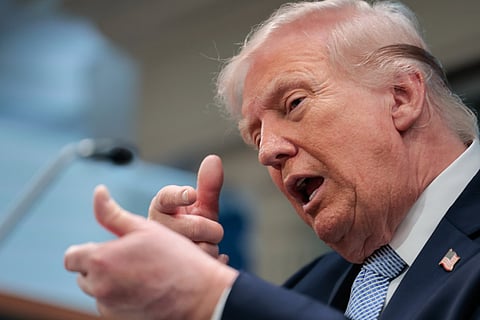
Dubai: US President Donald Trump’s strategy was simple: Escalate to the extreme, force a crisis, then step back.
Iran’s leadership remains in place, its security apparatus led by the Islamic Revolutionary Guard Corps remains intact, and its nuclear programme — including an estimated 970 pounds of near-bomb-grade material — remains untouched, the very issue that triggered the conflict in the first place.
That stark contrast between short-term gain and long-term uncertainty now sits at the centre of the fragile ceasefire that has paused weeks of escalating confrontation.
According to The New York Times, Trump’s approach reflects a familiar playbook honed long before politics — in the high-stakes world of New York real estate, where maximalist demands, brinkmanship and a willingness to defy convention were used to force concessions.
“Mr. Trump’s instinct is to escalate to the point of crisis and then look for an exit — a pattern that has defined both his business career and his foreign policy,” analysts told The New York Times.
That same instinct appeared to guide his latest moves on Iran. By raising the stakes to unprecedented levels — including warnings of catastrophic consequences if the Strait of Hormuz was not reopened — Trump created urgency that helped produce an off-ramp. Within hours of his most dramatic threat, a ceasefire framework emerged, reportedly facilitated through backchannel diplomacy.
Escalation, not restraint, delivers results
For Trump, the outcome reinforces a long-held belief: Escalation, not restraint, delivers results.
But analysts warn that what looks like a breakthrough may instead be a pause that leaves the underlying risks unresolved.
“What looks like a breakthrough may instead be a carefully staged pause, one that leaves the core issues untouched,” analysts said, according to The New York Times.
Why it matters
Tactical vs strategic gap: Ceasefire achieved, but no structural change on the ground
Nuclear risk persists: Iran retains near-bomb-grade material and capability
IRGC intact: Core power structures remain unshaken despite weeks of strikes
Hormuz vulnerability: Global energy routes still exposed to disruption
Cycle risk: Escalation may repeat without a clear long-term resolution
The ceasefire does not dismantle Iran’s nuclear capabilities, nor does it fundamentally weaken the structures of power within the country.
“The nuclear programme — the central trigger of the conflict — remains largely unaddressed despite weeks of escalation,” analysts told The Times.
The ruling system, backed by the Revolutionary Guards, continues to hold firm despite sustained military pressure.
Equally significant is Iran’s ability to endure and respond. Even after absorbing thousands of strikes, Tehran demonstrated it could wage an asymmetric campaign — targeting shipping routes, disrupting energy flows and exerting pressure far beyond its borders.
Difficult questions
That resilience raises difficult questions about what the conflict has ultimately achieved.
“The strategy relies on creating maximum pressure quickly, but it does not necessarily produce lasting solutions,” analysts warned.
If the objective was to curb Iran’s nuclear ambitions or decisively weaken its regional posture, the current pause offers little evidence of either. Instead, it risks entrenching a status quo in which Iran retains both its strategic capabilities and its leverage over key global energy routes.
Political costs
The Strait of Hormuz remains a critical fault line. While shipping may resume under the ceasefire, uncertainty lingers over who ultimately controls access and under what conditions — a concern that has already rattled markets and exposed vulnerabilities across the Gulf.
There are also political costs closer to home. Trump’s aggressive posture, followed by a rapid pivot to de-escalation, has drawn scrutiny from allies and critics alike, with questions emerging over whether the United States is being pulled into cycles of confrontation without a clear endgame.
For now, the ceasefire offers breathing space.
But it also sets the stage for a far more complex challenge: Turning a tactical pause into a durable settlement.
That will require bridging deep divides over Iran’s nuclear programme, regional role and security guarantees — issues that have eluded resolution for decades.
“The risk,” analysts say, “is that crisis-driven diplomacy can produce pauses — but not peace.”
Trump has shown he can force a moment.
Whether he can shape what comes after remains far less certain.


