Why trust in media matters most during times of crisis
Mark Thompson, Editor-in-Chief, Gulf News, on leadership, trust and crisis reporting
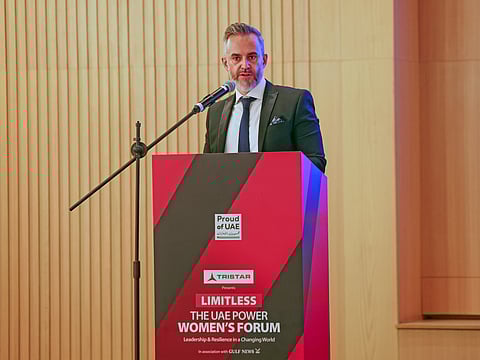
At a forum celebrating powerful women, it was a man who chose to talk about the kind of leadership that rarely makes headlines. Speaking at the session Beyond the Headlines: A Trusted Voice in Times of Crisis, Mark Thompson, Editor-in-Chief of Gulf News, traced his understanding of leadership back to a place far removed from boardrooms and newsrooms — home.
The session was part of the Tristar presents Limitless: The UAE Power Women’s Forum, held in association with Gulf News on April 21 at Taj Exotica Resort & Spa, The Palm, Dubai.
“I feel a bit out of place here,” Thompson admits early on, standing before a room of accomplished women. He calls himself the “warm-up act,” before setting the tone for his address. “My five minutes will hopefully give you some insight into how women taught me real leadership,” he says.
That lesson, he explains, did not come from degrees or professional experience. It came from watching his mother navigate life as a single parent during the upheaval of the early 1990s Gulf War. “I didn’t learn real leadership from any of those things,” he says, referring to his formal training. “I learned it at the kitchen table, in the car and before I went to bed.”
He describes a woman who ran a household with the precision of a business, managing finances under pressure, making difficult decisions without hesitation, and leading with empathy. At the same time, she worked as a critical care nurse, “saving lives in hospitals” while raising a family without a safety net.
“There was no backup plan, she was everything,” he says. "I see my wife in a similar way - she carries a mental load as a mother that I often don’t comprehend, I am often oblivious to the details."
That early exposure, Thompson argues, shaped his belief in the kind of leadership that often defines women in both personal and professional spaces. “Women often lead with a balance of strength and understanding,” he says. “They listen, they build relationships, they don’t shy away from difficult choices.”
At Gulf News, he sees those qualities reflected in a newsroom where women hold key leadership roles. “We’re only as strong as the skills that we all bring to the table,” he says, stressing the importance of diversity not as a corporate ideal, but as a practical advantage.
For Thompson, leadership is more about reliability than visibility. “It’s about being the one people can rely on, the one who keeps going when things get hard,” he says. “It’s not something we say, it’s something we do day in and day out.”
That idea becomes central as he turns to the role of media in moments of crisis. In an environment flooded with information, he draws a stark picture of what happens when trust disappears. “Imagine waking up tomorrow and every headline you read turns out to be completely made up,” he says. What begins as disbelief quickly turns into confusion, then frustration, and eventually disengagement. “By the fourth day, you stop believing anything at all.”
What follows, he warns, is already visible in parts of the media landscape. “Conspiracies, gossip, AI slop… an ocean of rumours and speculation,” he says. “That’s what a world without trust in media would look like. Chaos and anarchy.”
It is this reality, he argues, that makes journalism not just relevant but essential. “Trust in media isn’t just important, it’s essential. It shapes how we see the world, and ultimately, how the world is shaped,” he says.
In recent weeks, he notes, audiences have witnessed how coverage from different global outlets can shape perception in conflicting ways. For Thompson, the answer lies in proximity and lived experience. “You can only trust those with a lived experience on the ground,” he says, pointing to the newsroom’s focus on elevating its reporters. “They have the same problems, concerns and challenges as you, our readers.”
Trust, he adds, must be built and maintained with accountability. “We’ll make mistakes but we’ll put our hands up and apologise when we do,” he says. “When we get it right, it empowers people. When we get it wrong, people walk away unless we are human and admit our faults.”
The results, he suggests, indicate that this approach is resonating. “Last month more people visited the website than live in the UAE,” he says, adding that readership has grown significantly. "The number of stories read on our website grew by 500 per cent year on year. We became the first port of call for many looking for verified and accurate information.”
Still, he resists framing those numbers as the end goal. The responsibility, he insists, lies in maintaining credibility, especially during uncertain times. “We take that responsibility very seriously and we have been honoured to serve this country,” he says.
Thompson returned to the influence of women on his leadership approach. “I’ve learnt how to be a leader from women and with the support of women,” he says.
He adds that trust remains central to journalism, particularly in times of uncertainty. “When it matters most, trust Gulf News. Not because it’s catchy, but because we live and breathe it.”


