UAE-made jammers tackled 85% of drones launched from Iran, says EDGE Chairman
EDGE Chairman says local defence capability proved its role during the conflict
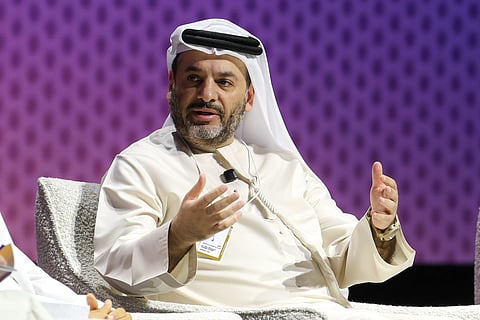
Abu Dhabi: UAE-made defence technology played a central role in protecting the country during the recent conflict, with locally developed and produced jammers tackling 85% of drones that targeted the UAE, Faisal Al Bannai, Advisor to the UAE President for Strategic Research and Advanced Technology Affairs and Chairman of EDGE Group, said at the Make it in the Emirates summit in Abu Dhabi.
Get updated faster and for FREE: Download the Gulf News app now - simply click here.
Al Bannai saying the conflict proved the value of national industrial capability at a moment when speed, scale and operational reliability mattered most.
“The UAE was targeted with missiles and drones, and a large quantity of drones, 1000 plus drones came to the country way, way more than anyone else,” Al Bannai stated during a panel discussion on supply chain disruption and industrial resilience.
“85% of these drones were tackled through the jammers developed and produced in the UAE,” he said. “So this is a significant number of the attack that came with the UAE were neutralized using UAE technology.”
The UAE’s air defence systems have intercepted 537 ballistic missiles, 26 cruise missiles and 2,256 drones launched from Iran since February 28, 2026, according to figures shared in the discussion context, with attacks continuing into April despite a declared ceasefire.
Local defence industry proved its role
Al Bannai said the UAE had already demonstrated that it was prepared to defend itself, pointing to the performance of the Armed Forces and the role of domestic technology during the conflict.
“I think UAE have defended itself,” he said. “We're so proud, not only us as nationals, but everyone who lived among us, everyone who live here in this country practicing their usual going to restaurants, going to seminars, going to work.”
He said the UAE has a long history of defending itself and protecting those who live in the country, while adding that the next phase would require the country to move faster and deepen its capabilities.
“I have no doubt of our capabilities, but those capabilities will go to the next level,” he said.
That next phase, Al Bannai explained, will be shaped by lessons from the conflict and by a stronger focus on locally developed defence systems, particularly in areas where the UAE has already shown measurable performance.
“When EDGE was created around six and a half years ago, there were some doubters outside that felt maybe this is just a cosmetic activity,” he said.
The assumption, he added, was that the UAE would continue to buy its core defence capability from abroad while local industry would remain secondary.
“I think I'm proudly saying that during the last war, like no other time, the local defense industrial capability truly proved its worth,” Al Bannai said.
UAE tech used when it mattered
Al Bannai said a critical part of the UAE’s defence network during the conflict relied on products developed and manufactured inside the country.
“During this war, a critical part of the defense of the UAE was defended using UAE national products produced in the UAE, developed in the UAE, and they played the pivotal part of the defense of the entire network here of the UAE,” he said.
The Chairman described the conflict as a live test of whether local defence systems could perform beyond trials, demonstrations or controlled environments.
“This is a clear demonstration that we are able to develop, we're able to produce, and we're able to show it's worth during the time that matters,” he said.
The transformation carries wider industrial significance for the UAE because defence manufacturing sits at the intersection of advanced technology, supply chain readiness, skilled engineering and sovereign production capability.
Al Bannai said the conflict would accelerate work that had already been taking place inside the country, with development timelines now expected to compress across several priority areas.
“Whatever work we were doing before is going to be 100x in the coming period in terms of accelerating further capability, accelerating further what we do,” he said.
From two years to 30 days
One of the strongest examples, Al Bannai said, came from products that did not exist before the conflict but became operational within 30 days.
“Day Zero, certain products did not exist. Day 30, these products entered operation,” he said.
Under normal conditions, those products would have required much longer development timelines, but the urgency of the conflict forced teams to move at a pace that showed what the UAE’s defence ecosystem can deliver under pressure.
“Normally, these products would have taken us two years of development. They took 15 days of development and another 15 days to be used operationally,” he said.
Al Bannai said that speed changes expectations across the sector because programmes previously planned over years may now face far shorter deadlines.
“My team knew that after this war, whatever two year development programs are on the table for other things are scratched now the deadline is a two week deadline for a two year program,” he stated.
The point fits into the wider Make it in the Emirates agenda, where ministers and industrial leaders have been positioning local production as a core part of national resilience, particularly when global supply chains, shipping routes and security conditions come under pressure.
Air defence will be UAE-made
Al Bannai said the UAE has reached self-sufficiency in soft-kill air defence capabilities, including the jammers that were used during the conflict.
“When it comes to air defense, the soft kill air defense, the jammers that came in play, we are now fully self sufficient as a country in that category,” he said.
He added that missile air defence is also set to become more localised, with part of that capability expected to be produced in the UAE between this year and next year.
“When it comes to the air defense area between this year next year, we'll start seeing part of the missile air defense will become local UAE air defense,” Al Bannai said.
The Chairman said the country’s longer-term target is clear, with air defence emerging as one of the strongest areas for local industrial expansion.
“Over the next few years, we definitely have a determination that anything to do with air defense will be fully a UAE capability in that regard, produced in the UAE,” he said.
Al Bannai made clear that the UAE is not seeking to produce every category of defence equipment, especially fighter aircraft, but will focus on areas where it can build meaningful capability and take a serious share.
“We don't develop fighters yet,” he said. “I think today, as a player, we take a very reasonable share.”
UAE defence products find global buyers
The Chairman said EDGE’s order book also shows that UAE-made defence and advanced technology products are gaining traction outside the domestic market.
Six and a half years ago, EDGE companies generated only 2% of annual booked orders internationally. That figure rose to 25% three years ago, 50% two years ago and 70% last year, he said.
“The product developed in the UAE in an annual booked orders that we have last year, 70% was international orders,” Al Bannai said.
That surge, he added, shows how far the UAE’s defence industry has moved from being seen as a domestic supplier to becoming a recognised player in global advanced technology and defence.
“This tells you where we sit today from a capability point of view, and how determined are we to really excel in that domain and really defend the nation and become a key player in the global advanced tech space and defense,” he said.