Why Dubai RTA taps Chinese tech giants to power next-generation Metro
Partnerships will bring AI to support Metro Blue Line and future rail projects
Dubai: Dubai’s Roads and Transport Authority (RTA) is turning to China’s technology and rail expertise to build a smarter, AI-powered metro network, signing strategic agreements with two of the country’s leading companies as it accelerates plans for the emirate’s next generation of public transport.
The agreements with Huawei Technologies and rail signalling specialist CASCO SIGNAL LTD. mark one of RTA’s most significant international technology collaborations, aimed at embedding artificial intelligence, digital infrastructure and smart transport solutions into the Dubai Metro Blue Line and future rail projects.
The partnerships were announced during an official RTA delegation visit to China led by Mattar Al Tayer, Director-General and Chairman of the Board of Executive Directors of RTA. Beyond signing two memoranda of understanding (MoUs), the delegation met government agencies and leading technology companies to study how Chinese cities are using AI, automation and digital platforms to manage transport systems serving millions of passengers every day.
The initiative reflects Dubai’s broader ambition to remain at the forefront of smart mobility by adopting proven technologies from one of the world’s fastest-growing transport markets.
AI lab for Dubai Metro
A key outcome of the visit is the agreement with CASCO SIGNAL, a company known for its expertise in signalling, communications and control systems for metro and railway networks.
Under the partnership, CASCO will establish an advanced research and development centre and innovation laboratory in Dubai dedicated to supporting the Dubai Metro Blue Line and future metro expansions.
The facility will function as a testing ground where signalling, communications and operational systems can be evaluated under simulated real-world conditions before being deployed across the network.
Smart operations
The innovation centre will also conduct research into AI-powered scheduling, predictive maintenance, smart operations and asset management, helping improve the efficiency and reliability of Dubai’s expanding metro system while reducing operational disruptions.
By creating a dedicated rail technology hub in Dubai, RTA also hopes to strengthen local technical capabilities, facilitate knowledge transfer and position the emirate as a regional centre for railway innovation.
The second agreement, signed with Huawei Technologies, focuses on integrating artificial intelligence across Dubai’s transport ecosystem.
Smart city
The collaboration extends well beyond traditional telecommunications, covering smart city applications, information security, intelligent transport systems, digital infrastructure and future mobility solutions.
Among the priorities are developing unified data platforms capable of connecting multiple transport systems, deploying AI-powered incident detection for faster emergency response, enhancing intelligent traffic management and modernising transport control centres.
The companies will also explore AI-enabled monitoring systems for metro operations, station management and passenger services, helping improve operational efficiency while enhancing customer experience.
15-minutes city
The agreement further includes joint workshops, pilot projects and technical testing to evaluate emerging technologies before they are introduced across Dubai’s transport network.
During the visit, the RTA delegation toured some of China’s most advanced transport facilities to understand how technology is reshaping urban mobility.
In Shanghai, officials visited the Municipal Transportation Commission’s command and control centre, where AI and digital platforms coordinate roads, metro services, buses, taxis, airports and freight transport across a city of more than 24 million residents.
The delegation also examined China’s approach to urban planning, including the implementation of the “15-minute city” concept, which aims to reduce dependence on private vehicles by ensuring essential services remain within easy reach of residents.
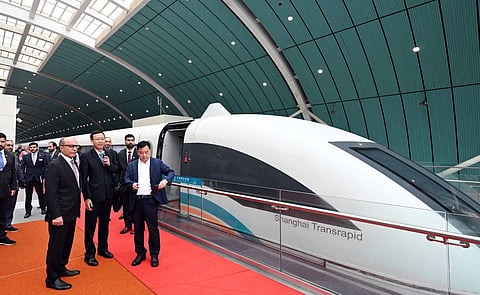
To explore next-generation rail technologies, the delegation experienced the Shanghai Maglev, one of the world’s fastest commercial train services, while also inspecting major bridge, tunnel and multimodal transport hub projects.
The visits provided insights into modern construction techniques, intelligent transport management and integrated mobility planning that could inform Dubai’s future infrastructure projects.
Expanding Chinese participation
RTA said the visit also sought to encourage greater participation by leading Chinese companies in upcoming infrastructure and transport projects planned across Dubai.
According to Mattar Al Tayer, China has become a global benchmark in rail infrastructure, artificial intelligence and digital technologies, making it an ideal partner as Dubai expands its transport network.
He said RTA aims to establish long-term strategic partnerships that enable Dubai to benefit from advanced expertise in delivering major infrastructure projects while adopting innovative technologies that improve efficiency, sustainability and customer service.
Leading city
“The two MoUs underline RTA’s direction towards expanding the use of emerging technologies and artificial intelligence across various areas of work,” Al Tayer said.
He added that strengthening digital infrastructure and accelerating the adoption of smart mobility solutions would support Dubai’s future development agenda while reinforcing its position as one of the world’s leading cities for intelligent and sustainable transport.
As Dubai continues investing heavily in transport infrastructure, Al Tayer noted that the collaboration with Chinese technology leaders signals a shift from simply expanding networks to building metro systems that are increasingly intelligent, connected and capable of using AI to predict demand, optimise operations and enhance the passenger experience.
The agreements also reinforce the growing role of international technology partnerships in shaping the future of mobility across the emirate.