Dubai Metro Blue Line update: How a giant underground 'factory' is carving tunnels beneath International City
Al Wugeisha is a tunnel boring machine (TBM) that is carving out the underground network
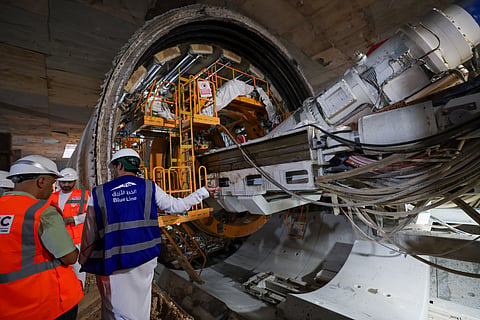
Dubai: Almost 35 metres below the streets of International City, a 2,000-tonne machine is quietly carving out the future of Dubai’s public transport network.
The machine, known as Al Wugeisha, is at the heart of the excavation works for the ambitious Dubai Metro Blue Line project. While progress on the new metro route has already made headlines, few people get the chance to see what is happening deep underground.
Beneath International City, Al Wugeisha is steadily carving out the tunnels that will eventually connect five underground stations on the Blue Line.
Get updated faster and for FREE: Download the Gulf News app now - simply click here.
Al Wugeisha - A bigger, faster and more powerful return
For this project, the RTA has brought back Al Wugeisha, the tunnel boring machine (TBM) named after a small desert rodent and previously used to help build Dubai's Red, Green and Expo 2020 metro lines. This time, however, it has been upgraded: it is larger, taller, faster and more powerful than before, measuring 163 metres in length and weighing in at roughly 2,000 tonnes.
According to RTA engineers on site, who spoke to Gulf News during a visit to the underground construction site, tunnelling works began in May and the machine has already completed approximately 1,200 metres of excavation. On average, it progresses between 13 and 17 metres a day, although at peak performance it can advance as much as 30 metres in a single day.
At the front of the TBM sits a massive rotating cutterhead with a diameter of 9.6 metres, designed to cut through soil and rock as it advances underground.
An underground 'moving factory' on the move
Far from being just a giant drill, Al Wugeisha operates more like a moving underground factory.
The engineering team explained that the machine is controlled from a dedicated operations room, where specialists continuously monitor its alignment, progress and performance. An operator oversees the TBM’s exact position to ensure it follows the planned tunnel route with precision.
As the cutterhead excavates the ground ahead, the machine simultaneously removes excavated material and constructs sections of the tunnel behind it, allowing the excavation and tunnel-building processes to happen at the same time.
Digging beneath International City
The TBM is currently tunnelling from the site of the proposed Dragon Mart Station in International City, one of the key locations on the Blue Line.
The station itself will cover 8,118 square metres, while the overall construction footprint at the site spans 39,480 square metres. On the day of the visit, around 580 workers were operating at the Dragon Mart Station site.
Across the wider International City section of the project, manpower is substantial. The planned International City interchange station employs around 900 workers, while another station in the area has approximately 600 personnel. In total, about 2,080 workers are involved across these sites, operating around the clock through rotating shifts.
The tunnelling works at this location are being carried out at depths of approximately 30 to 35 metres below ground level.
Building a metro tunnel beneath the city with minimal disruption
One of the major advantages of using a tunnel boring machine is that much of the work happens with minimal impact on the city above.
According to the engineering team, TBMs generate very little vibration, meaning nearby residents are unlikely to feel any effects from the excavation. The technology also significantly reduces disruption at street level, helping to minimise impacts on roads, buildings and everyday activities while construction continues underground.
In simple terms, a TBM acts like a giant underground drill. Rather than excavating from the surface, it moves beneath the ground, cutting through soil and rock while simultaneously constructing the tunnel lining behind it. The result is a safer, faster and less disruptive method of building major transport infrastructure.
A hidden network taking shape beneath Dubai
While the underground tunnels may currently resemble a vast construction site, they will eventually form part of one of Dubai’s most significant transport expansions.
Scheduled for completion in 2029, the Dubai Metro Blue Line will stretch 30 kilometres and feature 14 stations, including five underground stations connected by the tunnels now being excavated.
Once operational, the line is expected to serve more than one million residents, further expanding Dubai’s metro network and improving connectivity across some of the city’s fastest-growing communities.
Key facts: Dubai Metro Blue Line tunnel works
The machine
The tunnel boring machine (TBM) is called Al Wugeisha.
It is named after a small desert rodent.
It measures 163 metres long.
It weighs approximately 2,000 tonnes.
Construction progress
Tunnelling works began in May.
Al Wugeisha has already completed approximately 1,200 metres of excavation.
It advances between 13 and 17 metres per day on average. At peak performance, it can excavate up to 30 metres in a single day.
Dragon Mart Station site
The station will cover 8,118 square metres.
The total construction footprint spans 39,480 square metres.
Around 580 workers were operating at the Dragon Mart Station site during the visit.
Workforce
Around 900 workers are employed at the planned International City interchange station.
Another station in the International City area in the area has approximately 600 personnel.
Across these sites, around 2,080 workers are involved in total.


