Dubai Metro Blue Line explained: Routes, stations and construction progress
How Dubai’s Blue Line is reshaping routes, stations and future urban growth
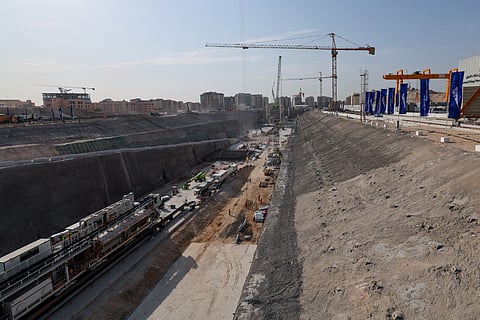
Dubai: The long-awaited Dubai Metro Blue Line is beginning to take shape, with major construction milestones already being reached as work accelerates on one of the city’s most significant transport projects.
Just two months after tunnelling works officially began, the Roads and Transport Authority (RTA) announced the completion of the first phase of excavation in July, a sign of how far construction technology has advanced since Dubai’s original Metro network was built nearly two decades ago.
The Blue Line is a key part of Dubai’s vision for future growth, designed to connect emerging residential communities, economic centres and key destinations while supporting the goals of the Dubai 2040 Urban Master Plan.
Get updated faster and for FREE: Download the Gulf News app now - simply click here.
Faster tunnelling than ever before
The launch of tunnelling works marked a major step in the development of the new line. It also highlighted how dramatically construction capabilities have evolved since the first Dubai Metro tunnels were carved beneath the city in 2007.
Back then, tunnel boring machines represented a major engineering breakthrough. Excavation progressed at an average of around 12 metres per day, with tunnelling works taking approximately seven months to complete.
Today, the Blue Line is being excavated using Al Wugeisha, a next-generation tunnel boring machine equipped with advanced digital guidance and monitoring systems. According to the RTA, the machine can excavate around 30 metres per day, more than double the rate achieved during the construction of the original Metro.
The result is significantly faster progress, with the first phase of tunnelling completed in just two months.
At 163 metres long and weighing around 2,000 tonnes, Al Wugeisha is more than a conventional tunnel boring machine. It operates as a fully integrated underground production system, capable of excavating, removing spoil and automatically installing tunnel lining segments in a continuous process. The technology enables greater precision, efficiency and safety while reducing construction time.
For Dubai, the achievement reflects how rapidly the emirate’s tunnelling expertise has advanced in less than 20 years.
Two key stations
A record-sized interchange - At Dubai International City 1, the Blue Line will connect to what's set to become the largest underground interchange station anywhere in the metro network, over 44,000 square metres, engineered to move an estimated 350,000 people through it daily. Functionally, it's the hinge point of the whole line, linking the Blue Line's two branches and knitting together travel across eastern and northern Dubai.
World’s tallest metro station - then there's Emaar Properties Station, which at 74 metres will be the tallest metro station in the world. It's been designed by Skidmore, Owings & Merrill, the firm behind Burj Khalifa, as well as New York's Olympic Tower and Chicago's Sears Tower and covers around 11,000 square metres. The brief here wasn't just function; the RTA describes it as a symbolic gateway meant to capture openness and modern identity. It'll primarily serve Dubai Creek Harbour, a waterfront community of roughly 40,000 residents, with ridership expected to cross 70,000 a day by 2040 and capacity built in for up to 160,000.
Dubai Metro Blue Line routes
The Blue Line will span 30 kilometres across two routes and is designed to improve links between several rapidly developing districts.
The first route, stretching 21 kilometres and comprising 10 stations, will begin at Creek Interchange Station on the Green Line in Al Jaddaf. It will pass through Dubai Festival City, Dubai Creek Harbour, Ras Al Khor Industrial Area, International City 1, International City 2 and 3, Dubai Silicon Oasis and Dubai Academic City.
The second route will extend nine kilometres from Centrepoint Interchange Station on the Red Line in Al Rashidiya. It will travel through Mirdif and Al Warqa’a before connecting with the International City 1 interchange station. This section will include four stations.
The road ahead
While the Blue Line is still under construction, the pace of progress offers a glimpse into the scale of Dubai’s ambitions. From faster, smarter tunnelling technology to record-breaking stations and new transport links, the project is shaping up to be one of the most transformative additions to the city’s public transport network since the Metro first opened in 2009.


