How Dubai Talabat rider and a woman's mission to feed and rescue 100+ cats in Al Quoz sparked a community effort
From two caregivers to a 21-strong network saving Al Quoz’s street cats
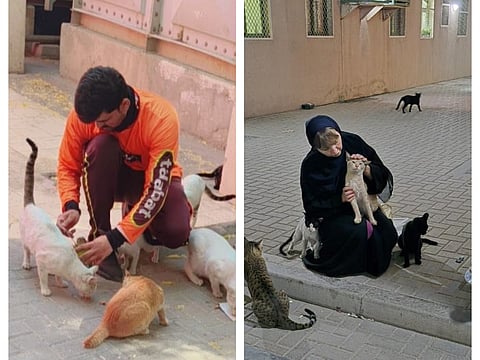
It was April when we last spoke to Kaleem and Fatima.
At the time, Kaleem, a Talabat rider, had described his daily routine caring for more than 70 cats, relying on whatever food he could source through a helpful volunteers' Facebook group.
It was gruelling work, but neither Kaleem nor Fatima, a homemaker, could bring themselves to walk away from the cats. As Fatima told us then, she would spend her evenings after work scouring the streets to feed them, often until 6am. They were both at different corners of Al Qoz: Looking out for the cats. A cat wandering into their midst, knew they would be looked after.
Since then, the task hasn't stayed a solitary one. The number of cats has grown, now crossing 100, but a determinedly optimistic Kaleem is grateful for the network of volunteers who have stepped in to help: The core group being, Sylvia Chandel, Rupsa Mukherjee, Teige, Emma Smith, Janaya and Sandra Stack Al-Madfai.
Between them, there is now a coordinated effort to protect the cats of Al Quoz while easing the burden on Kaleem and Fatima. As Fatima explains, that means staying in close contact with several vets, running TNR (Trap-Neuter-Return) programmes, and providing medical treatment, all in the hope that the cats can eventually be fostered and find homes of their own.
We spoke to several of the volunteers involved, and one thread ran through every conversation: a better life for the cats, and more support for Kaleem and Fatima.
How the volunteer network came together
Explaining how the effort to help Al Quoz's cats began, Al-Madfai walks us through a multi-pronged approach built around food, sterilisation and medical treatment. "I wanted to support Kaleem in any way that I could," she explains. A WhatsApp volunteer group put her in touch with Chandel, and together they began mapping out how to help Kaleem and Fatima properly. "We formed a group that's now 21 members, and we all supply food to Kaleem and Fatima," she says.
It's an overwhelming responsibility, she admits, as the number of stray cats keeps climbing. "I have been trying to get feeding stations near Kaleem and Fatima's area," she says.
As Mukherjee also notes, the group also arranges TNR, with several volunteers personally picking up cats, driving them to the vet, and returning them once the procedure is complete. The costs add up quickly, though, and the group is actively looking for more support to keep pace with the problem.
Currently, as Chandel explains, 50 cats have been vaccinated and sterilised. When it comes to cat food, they have been trying to partner with dedicated food suppliers. “With a couple of more responses, the path does look promising,” she says.
A vet's view: why TNVR matters
For a clinical perspective on what's driving this kind of grassroots effort, and what still needs to change, we spoke to vet Sarah Ramsey, who recently led a dedicated TNVR day focused on Al Quoz's community cats. In a single day, her team neutered 17 cats: 11 males and six females. "For me, that really demonstrates why organised TNVR is so important," she says. "If those six females continued to have litters, and their kittens subsequently reproduced, the numbers can increase extremely quickly. Neutering even a relatively small group therefore has an impact far beyond those individual cats."
TNVR, Trap-Neuter-Vaccinate-Return, is, as Ramsey describes it, a straightforward but carefully managed process: cats are humanely trapped, examined by a veterinary team, neutered and, where appropriate, vaccinated and given any necessary basic treatment, before being returned to the territory they know. Crucially, the goal isn't to clear the streets of every healthy cat. "Many adult community cats are well adapted to outdoor life and would find being confined in a home extremely stressful," Ramsey explains. "The aim is to create a healthy, stable population that is no longer reproducing."
The Al Quoz day also turned up problems beyond reproduction. Some cats had significant dental disease, with rotten or painful teeth that needed to be removed while they were already under anaesthetic for neutering. It's one of the underappreciated upsides of these programmes, Ramsey notes: "Neutering may be the reason the cat comes through the clinic door, but it also gives us an opportunity to identify pain, wounds, infections and other health problems in animals that might otherwise never see a vet."
That clinic door sees a wide range of cases. Community and rescue cats come through with everything from straightforward respiratory and gastrointestinal infections to much more serious disease or trauma, cat flu, severe diarrhoea and parasites, dental disease, wounds and abscesses, eye problems, and infectious diseases such as FIV and FeLV. Road traffic injuries are common too, as are kittens arriving in poor health, a reflection of just how hard street life can be for very young animals.
Dubai's summer heat compounds all of it: With temperatures at their most extreme, access to water, shade and appropriate food becomes critical.
If there's one point Ramsey wants people to take away, it's this: "Feeding community cats is compassionate and important, but feeding alone doesn't control the population." Feeding needs to go hand-in-hand with TNVR, she stresses, because a fed but unneutered colony simply keeps producing kittens, and the person doing the feeding can quickly end up responsible for far more cats than they can realistically manage.
However, sadly, not every cat is destined for a home, and Ramsey is careful to stress that each case is assessed individually. A healthy adult feral or established community cat is, in her experience, often happiest being returned to familiar territory once it has recovered from TNVR, turning every street cat into a house cat isn't necessarily the right welfare call. But some cats are different: Friendly abandoned cats, young kittens, injured animals that can't safely return to the street, and cats that clearly seek out human company. For those, the team tries to find foster or permanent homes wherever possible.
That's easier said than done. Foster homes remain one of the biggest bottlenecks in the whole system, there are simply far more cats needing help than there are foster and adoptive homes available.
It's a gap Ramsey would like to see closed, not least because of the ripple effect a single foster placement can have: "A foster home doesn't just help one cat, by taking that animal out of a veterinary clinic or rescue situation, it creates space and resources for the next emergency."
Looking at the bigger picture, Ramsey argues that community-cat management needs to be treated as a long-term project, not something responded to only when a cat turns up injured or a new litter appears. "Consistent TNVR, responsible feeding, veterinary care when required and adoption of genuinely home-suitable cats all need to work together," she says, alongside a broader shift in pet ownership. "We also need people not to abandon their pets. An unneutered pet that is dumped doesn't just become one more cat on the street, it can contribute to many more kittens being born."
If anyone wishes to help, please contact Amal CSR


