UAE unveils Amal, first AI physician assistant to transform patient care
EHS launches Maitha and Hamda also at World Health Expo in Dubai. Find out how they help
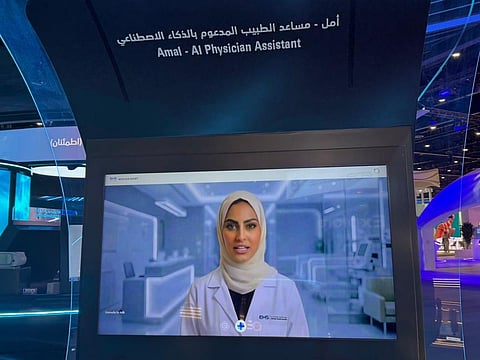
Dubai: The UAE has unveiled Amal, the country's first AI-powered physician assistant that conducts pre-consultation interviews with patients and generates medical summaries to support faster treatment decisions and reduce waiting times.
The system, developed by Boston Health AI, uses artificial intelligence to take a medical-grade history of patients before they meet their doctor, providing physicians with structured insights while enhancing operational efficiency across Emirates Health Services (EHS).
Dr Yousif Mohammed Al Serkal, Director General of EHS, said Amal is one of the three interactive AI-powered initiatives showcased at the World Health Expo (WHX) 2026 in Dubai.
How it works
Dr Al Serkal said Amal conducts interactive pre-consultation interviews with patients, generating accurate and comprehensive medical summaries that support faster treatment decisions and reduce waiting times.
From delivering more personalised patient experience to providing physicians with early, structured insights, the system enhances operational efficiency and expands access to care, advancing the digital transformation agenda, he noted.
Explaining further, Adil Haider, founder of Boston Health AI, told Gulf News that the system interviews patients online before their appointments.
"So that when the patient sees the doctor, the full note and all their history of presenting illness, and why they need to be seen by the doctor and so on, are nicely summarised for the physicians. So that when the doctors see the patient, they are actually well prepared."
Haider said the system provides evidence-based recommendations to doctors about treatments, while ensuring final decisions remain with the physician. "It will not make the decision itself, and it will not try to treat the patient on its own. It will only assist the doctors in doing their job. It also takes away a lot of the documentation burden that doctors might have by preparing the notes and also doing the billing work that doctors need to do."
Proven track record
He said the technology has been deployed with more than 30,000 patients in the US and Pakistan, achieving patient satisfaction rates upwards of 95 per cent. Patients can also access Amal after their appointments to ask follow-up questions about medications or doctor's instructions.
"When they go home, and many times think about how, if you're a patient, you say, 'Oh, what did the doctor say about this? Or the doctor told me to take this medication, should I take it with milk? Should I take it with the water?' You know, patients may have those kinds of questions. You can ask all those questions to Amal again," Haider explained.
Cultural adaptation
The system operates online, with patients receiving a link when they book an appointment. Amal will initially be implemented in EHS's rapid care system, the urgent care service for Emirati nationals, through teleconsultation appointments. It is expected to be expanded to other services later.
Haider said Amal has been culturally adapted for the UAE population, with carefully curated dialect, accent and appearance. "Which is why you've seen how it's been culturally adapted, with the way Amal looks, with the way she speaks, with dialect and accent and everything, specifically curated for the population that she's going to serve."
Maitha and Hamda
EHS also showcased "Maitha", described as the world's first AI-powered system for managing the nursing workforce.
It streamlines recruitment processes, organizes training programs, supports career development pathways, reduces administrative workload, and enables virtual interviews. The system strengthens nursing operations and delivers measurable outcomes that reinforce professional confidence while supporting the healthcare network with greater efficiency.
Also on display is "Hamda", an interactive digital agent that introduces a transformative shift in contact centre operations. Developed as an intelligent digital interface, it explains services, provides real-time guidance, and analyses tone and sentiment to improve engagement quality and accelerate service delivery. EHS said the project has already earned a prestigious regional award.
Ahmed Ali Al Sayegh, Minister of Health and Prevention, who visited the EHS platform noted that the EHS initiatives are designed to expand access to specialised care and improve health outcomes in line with the UAE's long-term national strategies.
Dr Al Serkal said EHS will continue to develop digital healthcare services by adopting solutions to enhance customer experience and expand the use of modern technologies.


