‘We don’t need another war’: UAE pushes for US–Iran dialogue
Pompeo says a lasting Iran deal is ‘unimaginable’ under current regime
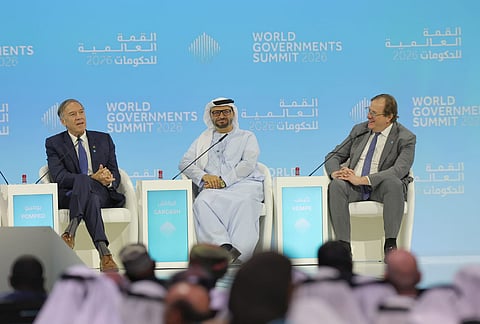
Dubai: The UAE has urged the United States and Iran to enter direct negotiations to avoid another destabilising conflict in the Middle East, warning that the region has already paid a heavy price for repeated confrontations.
Speaking at the World Governments Summit in Dubai, Dr Anwar Gargash, the Diplomatic Advisor to His Highness Sheikh Mohamed bin Zayed Al Nahyan, President of the UAE, said fatigue with conflict is growing and that unresolved tensions with Iran continue to fuel uncertainty.
“I think that the region has gone through various calamitous confrontations,” Gargash said. “I don’t think we need another one.”
Gargash said sustained diplomacy — particularly direct American-Iranian negotiations — was the only way to address long-standing disputes that continue to resurface.
“I would like to see direct Iranian American negotiations leading to understandings that we don’t have these issues every other day,” he said, pointing to Iran’s nuclear programme as a core source of instability.
He argued that Iran today faces mounting pressure to strike a deal, both economically and geopolitically.
“I think Iran today needs to reach a deal,” Gargash said, adding that the country’s economy needs rebuilding and that this would require repairing relations with Washington. He said a broader political and geostrategic agreement could be “beneficial to the area” while also helping Iran meet its own long-term needs.
Million-dollar bounty
Former US Secretary of State Mike Pompeo, who served during Donald Trump’s first administration, struck a far more sceptical tone, warning that past experience with Tehran offered little cause for optimism.
“When I talk about Iran, I always like to do full disclosure; they’re still trying to kill me,” Pompeo said. “For sure, a million-dollar bounty on my head, which my wife thinks is a little low.”
Pompeo said he found it hard to believe that any deal could deliver lasting peace under Iran’s current leadership.
“To think that there’s a long-term solution that actually provides stability and peace to this region while the Ayatollah is still in power is something I pray for, but find unimaginable,” he said.
He also defended the Trump administration’s decision to withdraw from the Obama-era nuclear agreement, saying Tehran had repeatedly violated its commitments. Pompeo suggested that while talks could lead to limited understandings, Washington would not compromise on key red lines, including Iran’s uranium enrichment.
Atlantic Council president and CEO Fred Kempe said Iran’s strategic position has weakened sharply, creating what he described as a pivotal moment. The Atlantic Council was founded with the mission to encourage the continuation of cooperation between North America and Europe that began after World War II.
“The regional spoiler is in deep trouble,” Kempe said, citing Iran’s struggling economy, weakened proxy groups and exposed military vulnerabilities. He argued that President Trump sees this as an opportunity to force change.
“I don’t think he’s going to leave Iran before he has a way to do that, whether it’s through talks, or at least, he’s going to do it through talks or through other means,” Kempe said.
Kempe added that Trump is increasingly focused on foreign policy as his defining legacy, seeing Iran as a potential turning point rather than a short-term political issue.
Despite the contrasting views, the discussion underscored the high stakes surrounding Iran — and the impact that US-Iran engagement, or failure to engage, could have on regional stability.
As Gargash made clear, for the UAE, diplomacy remains the preferred path. “We don’t need another confrontation,” he added.


