UAE official warns against content fuelling fear, anger, outrage: ‘Bermuda Triangle of Media’
Dubai Future Week: UAE media chief urges platforms to stop rewarding inflammatory content
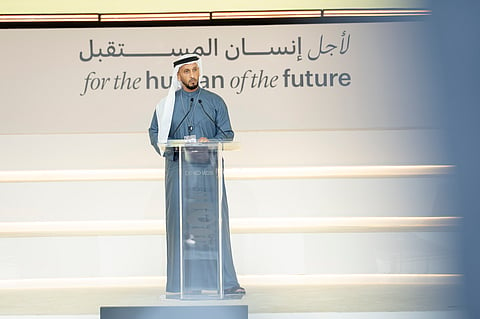
Dubai: The head of the UAE’s National Media Authority has urged digital platforms to stop rewarding content that thrives on fear, anger and outrage, warning that today’s online business models can make misleading information more profitable than the truth.
Abdulla bin Mohammed bin Butti Al Hamed, Chairman of the National Media Authority, said protecting the future of media is a shared responsibility across the entire ecosystem.
Get updated faster and for FREE: Download the Gulf News app now - simply click here.
It demands a fundamental rethink, he said, of the economic incentives behind how content is created and distributed. He called for a shift towards rewarding content that builds trust, advances knowledge and puts human wellbeing first.
He was speaking on Thursday in a keynote titled ‘Bermuda Triangle of Media’ at Dubai Future Week 2026, organised by the Dubai Future Foundation (DFF) under the theme ‘For the Human of the Future’.
Three forces, one trap
Al Hamed named three interconnected challenges reshaping the global media landscape: the ease of producing misleading content, the growing difficulty of telling truth from falsehood, and the commercialisation of public attention. The greatest danger, he said, lies in how the three interact, creating a system that rewards content for its ability to grab attention, regardless of accuracy or consequences.
On the first, he pointed to the transformation brought by artificial intelligence. Tools can now generate highly realistic footage, recreate locations and produce convincing human performances without filming any real event. While this opens new creative possibilities, it has also lowered the barriers to producing fabricated material and sped up its spread. That, he said, places greater responsibility on media organisations to verify information, authenticate sources and uphold professional standards.
The second challenge is the blurring line between truth and misconception, with conflicting narratives often emerging around the same event. The difficulty, he said, is no longer simply accessing information but distinguishing what actually happened from what people have been led to believe happened.
Profit from provocation
The third challenge is the attention economy, which has changed the relationship between content, audiences and revenue. A single piece of content can now cross borders, reach millions and earn its creator substantial returns. But when success is measured mainly by views, clicks and engagement, with little regard for accuracy, quality or social impact, the system can reward content designed to provoke fear, anger and outrage.
Al Hamed stressed that fabricated content is not always driven by political or ideological goals. Amid today’s digital environment, misleading narratives can also be produced purely for commercial gain, with controversy, fear and provocation generating engagement and money.
To illustrate, he cited an investigation by the Institute for Strategic Dialogue (ISD), carried out with the Bureau of Investigative Journalism. It uncovered a network of 128 Facebook accounts and groups reaching a combined audience of more than 1.6 million people.
Shared responsibility
He said the UAE has made a deliberate choice to place responsibility at the centre of media regulation and professional practice, recognising that a trusted media environment can only be built through cooperation among all stakeholders.
“We are discussing the media environment that will shape the human future. Future generations will have unprecedented power to create. Our responsibility is to ensure they also have the ability to distinguish facts from fabrication and have confidence in the information they depend on,” he pointed out.
Concluding his keynote, Al Hamed said the future of media will be determined by the choices made today, and by the values and incentives governing how information is produced, distributed and consumed. “The future of media will be determined by what we choose to reward. We are its architects,” he said.
Running at Emirates Towers and the Museum of the Future from till November 21, Dubai Future Week 2026 features keynote speeches, panel discussions, workshops, debates, challenges and competitions, startup pitches, exhibitions, immersive future experiences, closed-door meetings and offstage activations.


