From Trisha to Anushka Sharma: How women become weapons in battles between powerful politicians and cricketers
Why accomplished women are reduced to weapons in battles they never chose
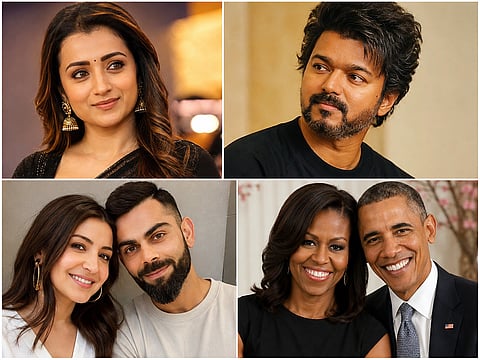
Dubai: Watching the outrage over Udhayanidhi Stalin's controversial remarks involving actor Trisha and his subsequent arrest unfold, I couldn't help but wonder why women continue to be dragged into battles that were never theirs to fight.
The clash was meant to be about the Cauvery water dispute and Chief Minister Vijay's governance. Instead, it veered into familiar territory, with South Indian actor Trisha's name surfacing yet again in a political slugfest that had little to do with the issue at hand.
With one snarky comment in Tamil and a cheap inneundo, a verbose Stalin seems to have reduced Trisha, an accomplished actor with a career spanning more than two decades to little more than a rumoured romantic sidekick to Vijay.
It is a depressingly familiar pattern, one that cuts across politics, sport and popular culture, where women are routinely treated as extensions of the men they are associated with rather than individuals with identities and careers of their own.
Whenever a political rivalry turns ugly, or a sporting icon falls short of expectations, or a celebrity becomes the subject of public debate, it is remarkable how quickly wives, girlfriends and rumoured partners are yanked into the conversation, almost as though humiliating the woman is the most efficient/;effective way of humiliating the man.
Anyone who followed Virat Kohli's career during his lean patches will remember how Anushka Sharma became a convenient punching bag every time India lost an important match or Kohli failed to deliver.
She wasn't selecting the team, deciding field placements or facing the opposition bowlers, yet social media behaved as though the actor somehow bore responsibility for every missed century and every tournament defeat. The criticism became so relentless that both Virat and Anushka were eventually forced to appeal to fans to stop blaming the latter for events over which she had absolutely no control. Looking back, it seems astonishing that a successful Bollywood actor and producer like Anushka was expected to silently absorb the nation's sporting frustrations simply because she happened to be married to one of its greatest cricketers.
The same phenomenon has played out in politics around the world with remarkable consistency. American lawyer, author, and public speaker who served as the First Lady of the United States from 2009 to 2017, Michelle Obama, spent years being scrutinised not merely for her work as First Lady but for her appearance, her clothes, her body and even grotesque conspiracy theories that had nothing to do with governance.
Many of those attacks have been widely interpreted as reflecting racism, misogyny and attempts to undermine Barack Obama by targeting his wife.
Brigitte Macron has endured endless ageist abuse that frequently says more about society's discomfort with older women than it does about French politics, while Melania Trump was routinely mocked for her accent, her modelling career and her personal choices, many of which bore little relevance to Donald Trump's presidency.
Even in the United Kingdom, Carrie Johnson often found herself portrayed as an unelected puppet master every time Boris Johnson's government lurched from one controversy to another, as though reducing complex political decisions to the influence of a wife somehow made for easier public consumption.
Closer home, Trisha has become the latest example of how effortlessly a woman's name can be weaponised in a political contest. Whether the rumours surrounding her closeness to Vijay or not is beside the point because they should never have entered the political arena in the first place.
An actor with a robust career and a fan base that extends far beyond Tamil Nadu continues to find herself defined, at least in moments like these, not by her work but by persistent speculation about the man she is allegedly close to.
Plus, it is difficult to imagine a male actor of similar stature being reduced so casually to gossip whenever political temperatures rise.
What troubles me most is not merely that these incidents happen, but that they barely surprise us anymore. Somewhere along the way, we have accepted the idea that women are fair game in public discourse, particularly if they happen to occupy the orbit of influential men.
We instinctively understand that attacking a wife, girlfriend or rumoured partner will wound the man more personally than a policy critique ever could, and instead of questioning that instinct, we have elevated it into a legitimate political tactic.
There is, of course, an important distinction to be made. If the spouse of a political leader exercises influence over public policy, benefits from public office or occupies an official position, scrutiny is entirely justified because accountability is the cornerstone of any democracy. But that is worlds apart from dragging women into conversations simply because of who they married, who they are dating or who the internet believes they might be romantically linked to. One is public interest; the other is voyeurism masquerading as political commentary.
Perhaps that is why this latest controversy should prompt us to ask a far bigger question than whether one politician crossed the line. Why have we become so comfortable with a political culture that repeatedly treats women as collateral damage? Why do we continue to reduce accomplished women to somebody's wife, somebody's girlfriend or somebody's rumoured partner whenever it suits the narrative of the day? And why do we shrug our shoulders every time another woman is pulled into a fight between powerful men and told, implicitly, that this is simply the price of being associated with influence?
Until we stop treating women as convenient weapons in someone else's battle, we cannot honestly claim that our public discourse has evolved. Criticising politicians is not only fair but necessary in a healthy democracy. Holding governments accountable is a public duty. But dragging women into those fights simply because their names make for better headlines or sharper insults is not politics at all. It is lazy, deeply sexist and, after all these years, something we should have outgrown.


