How to take a real hike in the UAE, according to professional trekkers—beyond reels and views
Hiking in the UAE isn’t a walk in the park—mostly because it isn’t one
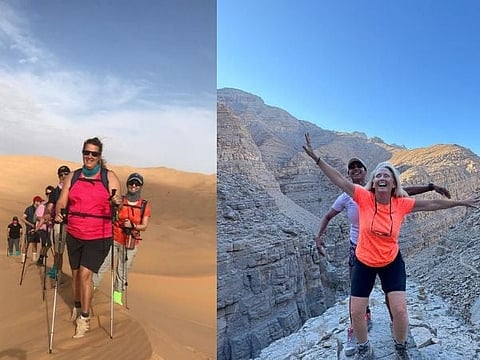
Apart from being a dismissive rebuff, the phrase ‘take a hike’ quite literally means: Go away, but not easily. Go on a long, gruelling journey. Climb a mountain. Follow a trail (or realise there isn’t one). Arrive breathless, slightly humbled, and very aware of your legs.
So yes, take a hike—but be prepared. It won’t look like Instagram. There will be no perfectly framed silhouettes or endlessly sunlit wadis serving cinematic drama on cue. Behind the reels and location tags lies a quieter truth: Hiking in the UAE is not a casual stroll through a picturesque backdrop. It demands discipline. It requires planning. It insists on respect for the terrain. And for those who know it well, it becomes not just a weekend activity, it’s something that just comes as normally to them as breathing.
Myth versus reality
As Amy Subaey, Managing Director of UAE Trekkers LLC, explains the problem of a social-media curated ‘hike’: “If you go on Instagram, you see influencers that tell you great spots to hike. And there's a lot of good ones. They will tell you the best spots, like Wadi Abudala. If you don’t know anything about those places, you will get in a car and drive an hour and a half, walk down to these large parks. It's not really a nice. But it’s not a hike, you walk down to Wadis, and 15 minutes later, you're done. But how, would you know that?"
Subaey’s point isn’t with people wanting to explore nature. It’s with the growing gap between appearance and understanding of what a hike really means. “Influencers will say go visit these places, and everyone has a different idea of hiking. Every culture does," she explains.
The pretty parks you see on Instagram—ends quickly, and that's all there is. "Some other cultures are alright with that. They got out of the city and got fresh air. They walk to the beautiful Wadi and think it’s a hike,” she says. "I think that idea, is a mix of the UAE culture, where they get all these cultures mixed together and we really don't have an agreed understanding of what a hike is."
What a real hike demands
In the UAE, a real hike demands far more than a photogenic trailhead. It involves terrain reading, weather awareness, pace calculation, contingency planning and, often, experience that only comes with time.”For the first time, go with a group or a guide,"adds Subaey. "Or, you just plan to go and see the nice, open space and call it a day. But if you, have an idea, that you do want to spend the day out in the mountains, then you need to have a guide."
This is where the problem lies, as she says. People don't seem to understand, for starters, that their bodies need water. You cannot find it, when you're in the mountains. They also think half a bottle is enough. And they don't really put any planning involved, how long it's going to be, what the weather is going to be like. They just want to go."
That lack of understanding is something Subaey and her team encounter often. When clients approach them for a hike, they frequently don’t grasp what it truly involves. “We say, just come in your sneakers—we’ll give you what you need, so they don’t come unprepared,” she explains.
Adding to the challenge is the fact that many hiking areas don’t have clearly defined trails. Subaey explains that professional guides don’t simply follow paths they happen to find; they build systems around safety. “We make our own trails, we figure out our pace, how long the distance is, people walking faster or slower. If someone is struggling, we would plan for an emergency car. We have to set it all up. Some trails are well-marked, and some aren’t… you can’t actually find where the trail continues, but how would people know that?”
That, she says, is precisely why guides are essential—at least in the beginning. With experience, hikers can eventually go on their own.
Still, Subaey keeps returning to the mountains for one simple reason: peace—and watching others fall in love with it too. “What I’m most passionate about is the feeling of taking other people, and they fall in love with the mountain,” she says, adding that even children join these hikes and learn how to overcome obstacles along the way.
When the Instagram version falls short
The moment of reckoning, when expectation meets reality, is familiar to Sumeet Punjabi, who reveals he is better known in UAE hiking circles as Paparambo. “It has been amazing weather lately, and all I can see my Instagram post full of beautiful views and some of them were unreal,” he recalls.
He started his Instagram journey for this reason: To find where such beautiful places exist in the UAE. Like many beginners, Punjabi headed to Jebel Jais in Ras Al Khaimah with friends, armed with enthusiasm and images saved from social media. “But somehow, we were not able to match the pictures what I had in my feed,” he admits.
That disappointment could have been the end of the story , but instead, it became the beginning. “With great luck, I was able to get in touch with few regular hikers passing by, who had hiking gear. We stopped them and asked them about the pictures, they said these are not easy ones and few of them are in certain routes which not many know about it.”
Those conversations opened a door into a different world, one of route knowledge, elevation math, and lived familiarity with the mountains. “One of them gave us few names, and we now had a list of names who apparently are experienced hikers,” Punjabi says. “Few of them knew multiple routes in the region.”
Today, Punjabi is one of those names. An insurer by profession, he has ‘almost hiked all the routes in the area’ and is known for building a community around disciplined, safe trekking.
Hiking is an extreme sport: Treat it like one
Among experienced hikers, there is one message that comes up repeatedly: do not take it lightly. “Please note engaging with the mountains comes under extreme sports and have to be taken seriously,” Punjabi stresses. “If we follow the rules, we can enjoy and return safely.”
The fundamentals are non-negotiable:
Never go solo
Follow the lead or stick to the map
Take sufficient resources
Hiking shoes are mandatory
Never wander away from the group
Do not litter or harm animals
Even preparation begins the night before. Please eat dinner at 7pm—simple food no experiments
Check your car tyre and petrol.
Hiking gear for beginners:
Before the view, before the victory photo, before the summit selfie — there is the bag. What you carry (and what you forget) often decides whether a hike is memorable for the right reasons, as explained by Punjabi.
Headlamps
2 litres of water
Sunscreen
Sunglasses
Energy bars, fruits
Hiking poles (optional)
Beginner spots
If you’re just starting out, the goal isn’t drama or domination — it’s familiarity. These trails offer a taste of elevation, terrain, and rhythm without demanding everything at once.
Wadi Shawka dam to Shawka Pools hike near Dubai
Al Rabi Tower trail in Khorfakkan
Al Rafisa Dam
Jebel Jais Lower Segment
Al Teen Trails
For the intermediate hikes
Once stamina improves and confidence builds, these routes introduce longer distances, trickier terrain, and the kind of challenge that asks you to listen closely to your body.
Wadi Naqab in Ras Al-Khaimah
Wadi Tayibbah in the Hajar Mountains of Fujairah
Wadi Kub, one of the hidden valleys in RAK
Jebel Hafeet, a mountain in the region of Tawam
For experts and professionals
These are not trails for curiosity or casual exploration. They demand experience, preparation, and often guidance — where the mountain stops forgiving mistakes and starts keeping score.
Jebel Yabana, the 3rd highest peak in United Arab Emirates, located in the Hajar mountains range of Ral Al Khaimah
Jebel Rahabah, a peak in the Hajar Mountains
Jebel Yibir
Nature as strength training for life
For Debbie Nicol, who has been hiking for over 40 years and is the Founder and MD of business en motion, the mountains are more than terrain — they’re a training ground for resilience. “As entrepreneurs, you need to have an outlet,” she says. “Getting out into nature and pushing the limits is how I stay strong, fill up for the next week.”
Her advice for beginners is simple, but firm:
Surround yourself with hikers
Join hiking groups to find your feet
Never venture out alone or without spare water (2–3 litres minimum
Invest in proper hiking boots
But the real lesson, she believes, lies deeper.
“Nature teaches us so many lessons. She also shows the strength we have that perhaps we didn’t know we had,” Nicol reflects. “It always reinforces that ‘what you focus on, think about, you bring about.’”
Focus on fear, and you stumble. Focus on the path forward, and you move.
Beyond the view
In the UAE, hiking is not about chasing views you saw on a screen. It’s about learning patience, respecting limits, and discovering strength — both physical and mental — step by step.
Or, as Subaey puts it simply, “I feel at peace. I don’t think I will ever get enough.”
And that, perhaps, is the real summit.


