"Staycations saved us," says Minor Hotels COO as Anantara parent doubles down on UAE, India growth
Amir Golbarg says local sourcing, resort-led travel will drive the next phase of growth
A pandemic, supply chain disruptions, inflation, geopolitical tensions and shifting travel patterns have forced hotel operators to rethink how they build, staff and run their businesses.
Sitting down with Amir Golbarg, Chief Operating Officer for the Middle East and Africa at Minor Hotels, there’s little sense of an executive rattled by a few difficult years.
What comes through instead is a steady conviction that the group’s model, built on diversification and local sourcing, is exactly what this market needs.
Recovery is already ahead of budget
Golbarg puts Minor's UAE hotels at roughly 60 to 70 per cent of pre-war business levels on paper. But when he looks at total revenue, the picture changes. "We look at it as a total revenue rate — we're above budget, we're above pre-war," he said.
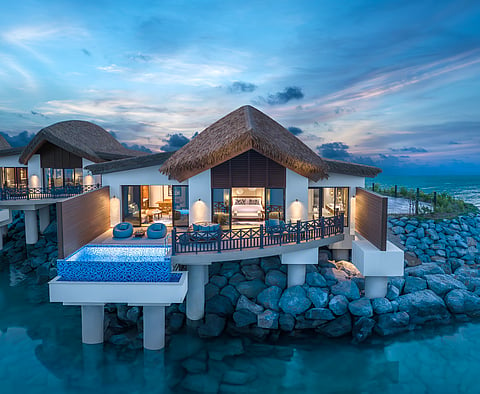
Golbarg credited it to a mix of staycation demand and resort-heavy properties that Minor operates across the UAE, from Anantara Palm to the Santorini-styled retreat in Ghantoot.
"I mean, obviously, staycations have saved us in the last three months. I have to say again, another piece that's really come to our blessing in the last three months has been most of our hotels are resort-driven," he stated.
According to the hotelier, demand has returned not just from the traditionally resilient CIS, African and Asian markets, but from UK, Germany and Northern Europe too — regions analysts had written off as slow to return. "The analysts are so quick at pulling down this region," Golbarg said, "and it's sad because they're proven wrong every time."
He's banking on the final quarter of the year to confirm the trend, pointing to major events being rescheduled into the September-to-December window and a steady pipeline of postponed — rather than cancelled — bookings throughout the conflict.
India moves to the front of the queue
While the Middle East remains central to the group's expansion plans, Golbarg repeatedly returned to another market: India.
Minor currently operates one hotel in the country after closing its Bodh Gaya property for renovation, but the pipeline is expanding rapidly.
Its first Anantara in Jaipur, opened in late 2024, has exceeded expectations, driven partly by India's booming luxury wedding market.
The company has also signed projects across destinations including Visakhapatnam, Coorg and Kolkata, while evaluating opportunities in Lucknow, Jodhpur and other cities.
"India probably is going to be one of our greatest growth markets," Golbarg said.
Villas, staycations, a different kind of guest
Much of Minor’s resilience, in Golbarg’s telling, comes down to portfolio shape. Where big-name competitors lean heavily on city-centre business hotels, he said, "80 or 90 per cent of their portfolio sits in CBD areas... we're the opposite. Most of our hotels are resorts."
That, combined with a guest base willing to pay for villas and pools during periods of uncertainty, has kept rates — and not just occupancy — climbing. Eid this year, he said, outperformed the same period last year, with higher rates achieved on more direct, domestic and regional bookings rather than through discounting.
Growth continues: The Sharjah portfolio
The recovery story hasn’t slowed Minor's expansion plans. Shurooq, the Sharjah Investment and Development Authority and owner of the Sharjah Collection, announced last week that Minor Hotels would take on a portfolio of seven heritage and nature-led properties across the emirate, spanning locations from Kalba to Khor Fakkan.
Golbarg described the deal as one of the more unusual and significant wins in Minor’s regional history. The properties, he said, include converted century-old houses, a mountainside adventure retreat at Khor Fakkan, and Kingfisher Lodge, a tented camp experience — each with its own distinct identity rather than a single branded look.
"They're all very localised," he said, adding that the portfolio will sit under a new collection brand rather than being absorbed into Anantara, with one or two properties potentially converting later. "We're not branding them, we're keeping their brand and identity for each of these," he said.
He called it a rare kind of partnership: "There's some projects when you enter, you enter because they need a commercial engine and they just want a brand. And there are some projects you enter because you are privileged to be part of their journey." All seven properties are expected to open together, on the same timeline — a scale Golbarg says the team is embracing rather than daunted by: "We love this type of challenge."
No job cuts — but plenty of redeployment
Golbarg was direct about the human cost pressures facing the industry, particularly given how expensive staff training has become. But he says Minor avoided formal redundancies tied to the war, instead offering extended paid and unpaid leave, and moving staff to busier properties in Europe, Africa, Muscat and Turkey.
The approach, he said, followed a lesson learned the hard way: asking staff directly rather than deciding on their behalf. At a town hall of more than 700 team members at Anantara Palm, he recalled being surprised by how many volunteered to take leave and return home. "We tend to forget... we are not actually communicating with the people that are affected," he said.
Rising costs, and a workaround
Operating costs have climbed, Golbarg acknowledged plainly, and passing that straight to guests isn't realistic. Minor's answer has been structural rather than price-led: a new global back-office system built with Oracle and Accenture, and a renewed push into renewable energy.
The group has also rolled out Coperama in the UAE, the European procurement platform that Minor inherited through its acquisition of the NH brand, which already serves more than 1,000 hotels across Europe and is now scaling up locally to reduce the cost of goods and services.
A closure and a lesson in energy economics
Not every Minor property in the UAE has escaped the pressure. Anantara World Islands was suspended, Golbarg said, purely on energy economics: an off-grid island resort running entirely on diesel generators, desalination and sewage plants was, in his words, unsustainable to run at scale with only 70 villas.
Around 60 staff were redeployed to other Minor properties, including Anantara Palm and hotels in Zanzibar and Zimbabwe. He didn't rule out a reopening but was clear it would need a serious energy rethink first: "It's going to need to have some level of renewable energy source, because again it goes against our ethos."
The philosophy behind it: build where you are
Running through the conversation is a consistent thread — Minor's preference for sourcing materials, design and even staff locally, rather than importing a fixed global luxury standard.
Golbarg contrasted this with hotel groups that ship in marble and amenities from Europe regardless of location: "I'm in Oman, middle of the mountain, I need Omani stone... In Jaipur, dare I say 99 per cent of the hotel is locally sourced."
It's a model, he argued, that has proven less vulnerable to supply-chain shocks than brands built around imported standards — and one the company arrived at "not by choice", he said, but because sourcing locally "was our DNA" from Anantara's founding in 2001.
Looking ahead
Beyond the UAE, Golbarg pointed to India as one of Minor's biggest growth priorities, with a target of 50 hotels within ten years, alongside expansion plans in Saudi Arabia and Egypt, where the group is working on a joint venture for 50 hotel developments.
Globally, he said 2026 will mark Minor's highest number of new hotel openings in the company's history — a claim he made with characteristic understatement rather than fanfare, in keeping with what he described as the group's low-key, Thai corporate culture: "We're a Thai company, we're humble... we don't scream enough."


