UAE anti-fraud law explained: 24 hours to remove counterfeit goods, penalties, seizure of products
Retailers, online sellers face strict rules on removing fake goods, seizures and penalties
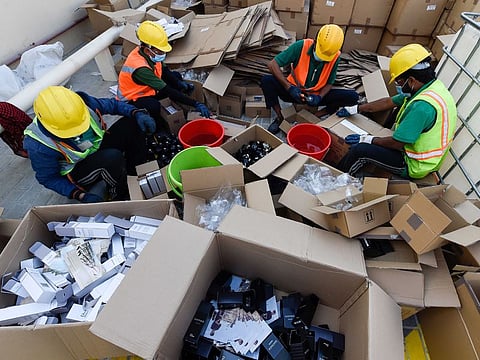
Dubai: Suppliers in the UAE could have just 24 hours to remove counterfeit, adulterated or otherwise unsafe goods from sale once they are officially notified, under new Executive Regulations governing the country’s Anti-Commercial Fraud Law.
Get updated faster and for FREE: Download the Gulf News app now - simply click here.
The rules also allow authorities to seize and hold suspect products at the violator’s expense, require public warnings about withdrawn goods and set out procedures for returning, destroying or safely disposing of products found to be in violation.
The regulations came into force three weeks ago, however, UAE Ministry of Economy officials organised a media briefing on Thursday to discuss key provisions of the Executive Regulations of Federal Law by Decree No. (42) of 2023 concerning Anti-Commercial Fraud, issued pursuant to Cabinet Decision No. (107) of 2026.
Safeya Al Safi, Assistant Undersecretary for the Commercial Control and Governance Sector at the Ministry of Economy and Tourism, said, "Combating commercial fraud represents a fundamental pillar for consolidating a national economy that is efficient and transparent, and that stimulates investment and innovation...."
"The issuance (of the law) is a new milestone in developing market control mechanisms in line with best practices, enhancing consumer protection against counterfeit and fake goods, and regulating seizure and inspection procedures," she explained.
New rules explained
24-hour deadline
Once a supplier is officially notified that goods need to be withdrawn, the supplier must immediately stop selling or offering the products and withdraw them from the market within 24 hours.
The supplier must also notify points of sale and other relevant entities and recover the affected goods, while providing authorities with evidence that the withdrawal has taken place.
This applies to goods that are counterfeit, adulterated or otherwise covered by the commercial-fraud provisions.
Public warning
The rules go beyond simply taking products off shelves.
Suppliers must make a public announcement about the withdrawal within 48 hours, in both Arabic and English.
Where a product poses a risk to health, safety or the environment, authorities can require the announcement to be made sooner.
For consumers, that means a product found to pose a serious risk could trigger a faster public warning rather than waiting for the standard timeframe.
Authorities can seize
If products are subject to enforcement action, authorities can seize and place them in custody, with the costs charged to the violator.
The regulations also establish procedures for the custody, disposal and destruction of seized products, alongside coordination between the relevant authorities.
Safeya Al Safi said the regulations provide clearer directions to retailers and traders on what happens when fraudulent products are discovered.
“They also provide more directions to the retailers and traders if there is any fraud or products, how they will seize it, who will bear the cost, if there is any decision to recirculate this products, or they have also to diminish the products,” she said.
If suppliers fail
The rules do not leave the withdrawal process entirely in the hands of the supplier. If a supplier fails to withdraw the products within the required period, the relevant authority can carry out the withdrawal itself within the following 48 hours, with the costs recovered from the supplier.
If the supplier cannot be reached, authorities can proceed once the supplier's presence in the UAE has been established, with costs again recoverable from the supplier.
Goods can be destroyed
The regulations also set out what happens after fraudulent products have been seized. Where the goods qualify for return to their country of origin or exporting country, they must generally be returned within 30 days of seizure, at the supplier's expense.
If the supplier fails to do so, authorities can take action to return, destroy or otherwise dispose of the goods, with the associated costs charged to the supplier.
Where destruction is ordered, it must generally take place within 15 working days of the relevant court judgment or Supreme Committee decision, unless otherwise specified.
What are the penalties?
The Executive Regulations provide for administrative penalties covering certain commercial-fraud conduct.
These include cases where traders knew, or should reasonably have known through their profession, trade or expertise, that goods or materials were adulterated, spoiled, counterfeit or harmful.
The provisions specifically cover areas including pharmaceuticals, agricultural products and organic foods. They also address the re-circulation of goods that are unfit for use, acquiring products for trade or unlawful profit, and misleading or deceptive promotion and advertising.
The rules also cover false information about a product's nature, quality, origin or components. Al Safi said the penalty system would be gradual and could include different forms of action.
“We are having gradual penalties usually. So in this, it can be taken to the last step,” she said. The detailed penalty list had not yet been issued at the time of the briefing, she said.
All retailers covered
The rules are not limited to a particular retail sector. Al Safi said the requirements apply across retail operations, including supermarkets and pharmacies. “Regular supermarkets, pharmacies... all retailers, all traders,” she said.
That means the framework is intended to cover a broad range of businesses selling goods to consumers.
Online sales included
The rules also extend into the increasingly important e-commerce market.
The Ministry said the regulations keep pace with modern trading patterns, including e-commerce, and involve cooperation with online platforms.
Al Safi said the Ministry can notify platforms when fraudulent products are identified so that action can be taken to withdraw the products or place clear messages before customers.
What if a retailer is fooled?
The regulations distinguish between different circumstances surrounding a retailer's involvement with fraudulent goods.
Al Safi said that if a trader legitimately requests a supply and receives fraudulent or mismatching products, they can report the issue. However, a different situation arises if a trader intentionally requested fraudulent products.
“The retailer or company will be responsible according to the scenario,” she said, adding that cases would be dealt with independently.
Healthcare complaints
For pharmaceutical and healthcare-related concerns, the Ministry said it works with the Emirates Council for Medicine.
Consumers can use Ministry communication channels or approach the council with complaints, with the authorities coordinating where fraudulent products are identified and informing the public where necessary.
Conciliation option
The regulations also provide a route for conciliation in eligible cases.
A conciliation request must generally be submitted within 10 working days. The relevant authority then considers the request, subject to conditions including no previous penalty within the preceding 12 months, the absence of bad faith and the removal of the causes of the violation.
An objection can also be submitted within seven working days under the prescribed procedure.
Importantly, conciliation does not mean that no violation occurred and does not remove civil liability.
10,023 inspections
The new rules come as authorities increase scrutiny of the UAE's retail and commercial markets.
The Ministry said it conducted 10,023 commercial-fraud inspection tours during the first quarter of 2026, resulting in 189 violations.
The Ministry said it is using legislative, supervisory and technological tools, including intelligent systems and price monitoring, alongside cooperation with federal and local authorities, economic departments, e-commerce platforms and retailers.
Zero tolerance
Al Safi said the UAE has a zero-tolerance approach towards commercial fraud and counterfeit and fake goods.
“Combating commercial fraud represents a fundamental pillar for consolidating a national economy that is efficient and transparent, and that stimulates investment and innovation,” she said.
The Ministry said the wider objective is not simply to punish businesses, but to strengthen compliance, improve traceability and accountability and protect consumers while supporting businesses that follow the rules.
For shoppers, the practical takeaway is straightforward: if a product is officially identified as fraudulent or unsafe, it should be pulled from sale quickly, consumers should be warned, and suppliers can face the costs of seizure, withdrawal and disposal.


