Dubai gold rises after two-day drop amid easing war tensions

Prices swing through April as global tensions ease but risks still linger
Last updated:
Nivetha Dayanand, Assistant Business Editor
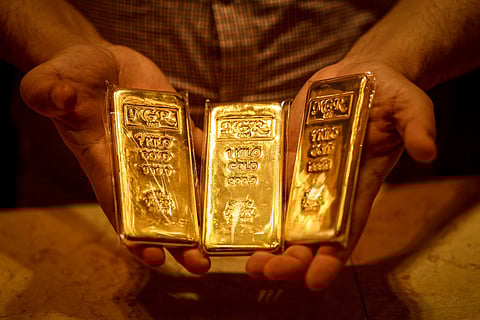
An Emirati gold dealer holds bars of gold in a shop in the Dubai Gold Souk on April 13, 2025.
AFP-FADEL SENNA

Dubai: Gold prices in Dubai moved higher on Tuesday morning, reversing part of the recent slide and reflecting a shift in global sentiment after signs of easing geopolitical tension. (Check latest UAE gold prices here, alongside prices in Saudi Arabia, Oman, Qatar, Bahrain, Kuwait, and India.)

At 8:42 am, 24K gold was priced at Dh573.50 per gram, up from Dh569.75 on Monday. The 22K variant rose to Dh531 from Dh527.75, bringing prices back closer to levels seen earlier in the month.

The move follows a broader rebound in international markets, where bullion gained after two sessions of losses. The shift came as diplomatic signals between the US and Iran raised hopes of a negotiated outcome, easing some of the inflation concerns that had been driving recent volatility.

Get updated faster and for FREE: Download the Gulf News app now - simply click here.

April sees sharp swings

Price action through April shows a market that has struggled to find direction. Gold opened the month near Dh573 per gram before sliding steadily to around Dh561 by April 6, marking one of the sharper early-month declines.

Momentum then reversed quickly. Prices climbed to a peak of around Dh577 by April 9, supported by heightened geopolitical tension and strong safe-haven demand. That rally proved short-lived, with gold pulling back again toward the Dh569 range over the weekend before Monday’s recovery.

Global cues driving local prices

Internationally, bullion rose close to $4,770 an ounce, recovering ground lost over the previous two sessions. The move came even as the US tightened its stance in the Strait of Hormuz, while at the same time signalling openness to negotiations.

President Donald Trump said Iranian officials had approached his administration with the intent “to work a deal.” Iranian President Masoud Pezeshkian also indicated that Tehran remained open to continuing talks within international legal frameworks.

Oil prices dropped below $100 a barrel, easing pressure on inflation expectations. Equity markets moved higher and the dollar weakened slightly, creating a supportive backdrop for gold, which is priced in the US currency.

Lower energy prices have reduced some of the inflation-driven demand that had supported bullion earlier in the conflict. That shift has also influenced expectations around interest rates, with markets still factoring in a limited chance of rate cuts by the US Federal Reserve this year.

What it means for buyers

Despite the latest uptick, gold remains under pressure compared to peak levels seen during the early stages of the conflict. Prices are still roughly 10% lower than where they stood at the height of market stress, when investors rushed into safe-haven assets.

Recent trading suggests that buyers are stepping in during dips, but conviction remains limited. The market continues to balance easing inflation fears against the risk of renewed disruption, particularly with the Strait of Hormuz still under strain.

- With inputs from Bloomberg.

Nivetha Dayanand
Nivetha DayanandAssistant Business Editor
Nivetha Dayanand is Assistant Business Editor at Gulf News, covering aviation, financial markets and commodities. A business and financial journalist with a strong interest in multimedia storytelling, she regularly takes complex financial and economic subjects beyond the written word, producing explainer videos that make them easier for a wider audience to understand. Nivetha has interviewed senior policymakers, business leaders and global financial figures both on and off camera. Her past guests include UAE Minister of Economy and Tourism Abdulla bin Touq Al Marri, Khaled bin Alwaleed Al Saud, a member of the House of Saud and the founder and CEO of KBW Ventures, Jihad Azour, Director of the Middle East and Central Asia Department at the International Monetary Fund and Indian ministers Hardeep Singh Puri and N. Chandrababu Naidu. She has also hosted and moderated panels, conferences and awards shows, bringing her newsroom experience to live conversations on business, finance and the economy. An Erasmus Mundus journalism alum, Nivetha is drawn to stories that affect people directly and to reporting that gives a platform to voices that might otherwise go unheard. She was among the first journalists to speak to Petrofac employees in the UAE about unpaid salaries, broke the news of the planned demolition of Dubai’s well-known “Toyota Building”, and helped set the record straight on widely circulated claims that a giant replica of the Moon was coming to Dubai. More recently, her exclusive interview with EDGE Group CEO Hamad Al Marar revealed how the UAE-based defence group deployed its systems along the country’s shore border and established a geofence around the UAE within 48 hours of the February 28 escalation. Prior to joining Gulf News, Nivetha worked at ITP Media, where she helped launch Finance Middle East, a new publication covering the region’s financial sector. Her role spanned reporting and editing, video production, interviews and events. Across print, digital, and video, she focuses on finding the people behind business stories and explaining why those stories matter to the audience reading or watching them.
Related Topics:

Get Updates on Topics You Choose

By signing up, you agree to our Privacy Policy and Terms of Use.
Up Next