UAE OPEC exit part of wider economic reset, says Al Jaber
Al Jaber says UAE energy move supports industry, AI and long-term economic resilience
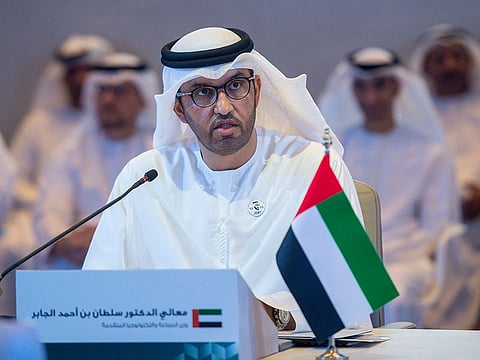
Abu Dhabi: The UAE’s decision to exit OPEC and OPEC+ was not taken as a standalone energy move, but forms part of a wider push to reshape the country’s industrial base, deepen economic resilience and give policymakers more flexibility in global energy markets, Dr Sultan Ahmed Al Jaber said at the opening of the Make it in the Emirates Forum.
Get updated faster and for FREE: Download the Gulf News app now - simply click here.
“The United Arab Emirates’ sovereign decision to reposition itself within the global energy landscape, and to exit OPEC and OPEC+, is not a decision directed against anyone,” said Al Jaber, UAE Minister of Industry and Advanced Technology, ADNOC Managing Director and Group CEO, and Executive Chairman of XRG.
“It is a carefully considered strategic decision that reflects our confidence in our capabilities, and our ambition for a more diversified economy, and a better future,” he stated.
The remarks place the UAE’s energy decision inside a broader national strategy that links industrial output, artificial intelligence, domestic investment and supply chain security at a time when regional disruption has exposed the cost of relying too heavily on external systems.
“This move was not done in isolation,” Al Jaber said. “It is part of a broader effort to reshape our economy and industrial base through a vision that connects energy, technology, and industry, aligning our resources with national priorities to build a stronger, more resilient economy.”
Energy flexibility, market stability
Al Jaber stressed that the UAE would continue to be a reliable player in global energy markets, even while seeking greater room to expand investment and align resources with its national priorities.
“The United Arab Emirates will remain a trusted and responsible partner in global energy markets,” he said, adding that the country would continue “supporting the stability of global markets from a position of greater flexibility.”
Al Jaber said the move was part of a longer economic transition, where resource strength is measured by how effectively it is converted into national value.
“Real strength is not measured by the abundance of resources, but by how they are harnessed to create value and serve the nation,” he said.
Hormuz warning
He also linked industrial sovereignty to the recent strain on trade routes, with Al Jaber warning that the closure of a vital artery such as the Strait of Hormuz carries consequences far beyond the Gulf.
“When a vital artery such as the Strait of Hormuz is closed, it does not only affect one region, it affects the entire global economy,” he said.
He pointed to stopped supplies, higher costs, rising global inflation and disrupted production chains, with the heaviest pressure falling on more vulnerable economies.
“Our position on this issue remains firm and clear,” Al Jaber said. “The Strait of Hormuz must never be held hostage or used as a tool of economic coercion and extortion.”
Freedom of navigation, he added, was “non-negotiable” and the legal status of the Strait as an international waterway “must not be altered.”
Economic security, in Al Jaber’s framing, cannot be bought during a crisis and cannot depend entirely on imported capacity.
“Economic security cannot be imported, it must be built and protected,” he said.
Industry takes centre stage
The UAE’s industrial strategy has already lifted the sector’s national contribution to Dh200 billion, reflecting 70% growth, while industrial exports reached Dh262 billion, including Dh92 billion in advanced industrial exports, Al Jaber said.
“These figures are not merely growth,” he said. “They are proof that our industrial economic model works, produces, and continues to accelerate.”
A major part of that model is the National In-Country Value Programme, which aims to redirect spending into domestic factories, local talent and national supply chains.
The value of industrial procurement opportunities will now rise from Dh168 billion to Dh180 billion over the next 10 years, alongside the localisation of more than 5,000 products across strategic sectors linked to economic, food and healthcare security.
That push is designed to keep vital sectors operating during external shocks, while giving businesses clearer long-term demand from major national buyers.
AI moves into the factory floor
Al Jaber said the next stage of industrial growth would be powered by artificial intelligence, advanced manufacturing and deeper integration between energy and technology.
“Artificial intelligence will no longer be just a tool in our factories,” he said. “It will become an industrial brain and a partner in decision-making, redefining efficiency, productivity, and the decision-making process.”
The UAE wants to position itself as a global platform where investors can build, scale and export, backed by infrastructure, logistics, financial services, regulation and governance.
“The economies of the future will be built on three foundations,” Al Jaber said. “Energy that powers, technology that thinks, and industry that produces.”
Domestic investment push
Ahead of the forum, the UAE also hosted the Make it with ADNOC forum, where projects planned over the next two years with a combined value exceeding Dh200 billion were showcased.
Al Jaber also announced the Local+ initiative, which links engineering, procurement, construction and services contractors with 70 qualified Emirati manufacturers. The initiative requires contractors to prioritise UAE-made products across ADNOC projects and supply chains.
He called on the private industrial sector, chambers of commerce and sovereign wealth funds to treat domestic investment as a strategic priority.
“Investing at home, or Direct Domestic Investment, is no longer an option, it is a priority,” he said. “Because it is an investment in our stability, our economic sovereignty, and the future of generations to come.”