Philippines' top billionaire Ricky Razon joins Manny Pacquiao in bid to solve blackouts, modernise electricity distribution
Ignite Power venture wins key backing to modernise power distribution network
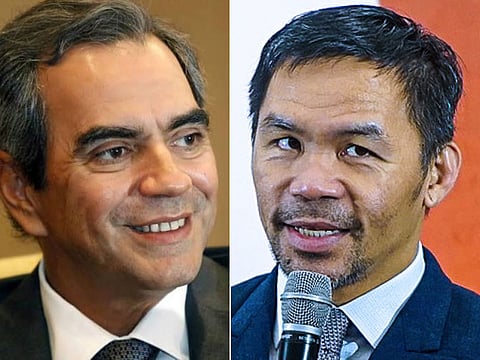
Manila: In an unlikely alliance that brings together the Philippines' richest businessman and one of its most celebrated athletes, Filipino billionaire Enrique K. Razon Jr. and boxing legend Manny Pacquiao are moving closer to taking over the modernisation of an electricity cooperative in the country's south.
Get — updated faster and for FREE: Download the Gulf News app now - simply click here
This project, now awaiting regulatory approval, could help end years of chronic brownouts and inefficiencies affecting hundreds of thousands of consumers, say supporters.
The partnership, operating through IGNITE Power, received a significant boost after more than 32,000 member-consumer-owners of the South Cotabato II Electric Cooperative (known as SOCOTECO II), endorsed a proposed joint venture during the cooperative's annual membership assembly over the weekend.
121 electric cooperatives: There are 121 electric cooperatives operating across the Philippines. The biggest challenges facing these power co-ops are unreliable power service (frequent brownouts), high and uneven electricity rates, and financial or governance mismanagement.
Private-sector investment
While the vote does not finalise the agreement, it marks the strongest sign yet that cooperative members are willing to embrace private-sector investment after years of struggling with an aging distribution network, recurring outages and mounting operational challenges.
The proposed venture would inject new capital into the utility, financing the rehabilitation, expansion and modernization of distribution facilities serving General Santos City, Sarangani Province and neighbouring communities.
For Razon, whose business empire spans ports, infrastructure, property and renewables, the project represents another expansion into the country's power sector.
For Pacquiao, the former world boxing champion turned businessman and politician, it offers an opportunity to help address a persistent problem in his home region of Mindanao, where unreliable electricity has long been viewed as an obstacle to economic growth.
Joint venture
The cooperative's board formally authorised the signing of a Conditional Joint Venture Agreement, which Board President Elenito Senit said would strengthen SOCOTECO II's financial position while improving service reliability through long-overdue infrastructure upgrades, local media reported.
Supporters of the agreement argue that the cooperative cannot modernise its system without substantial outside investment.
Underinvestment
Decades of underinvestment have left portions of the distribution network vulnerable to technical losses, equipment failures and service interruptions, which weigh down on business and rural development in the Philippines.
A high generator adoption rate among commercial enterprises in the Philippines reveals the hidden regulatory and infrastructure "tax" required to do business in the country.
The Philippines portable generator market was valued at approximately $3.8 billion (₱234.6 billion) in 2024 and is projected to grow at an annual rate of 8.1%, reaching an estimated $6.2 billion by 2030, as per research firm Mobility Foresights.
The proposal, however, still faces important regulatory hurdles before it can take effect.
Under Philippine cooperative rules, the partnership must first be approved through a plebiscite of member-consumer-owners. The National Electrification Administration must also issue implementing guidelines governing the process before a vote can be scheduled.
Referendum
To prepare for that referendum, SOCOTECO II officials said they will launch an information campaign explaining the agreement's financial terms, expected investments and long-term implications for cooperative members.
The proposed partnership arrives as electric cooperatives across the Philippines face increasing pressure to improve reliability while meeting rising electricity demand.
Many operate aging infrastructure and require billions of pesos in capital expenditures that are difficult to finance under traditional cooperative structures.
If approved, the Razon-Pacquiao venture could become one of the country's most closely watched public-private partnerships in the electric distribution sector, offering a potential model for other struggling cooperatives seeking private investment without relinquishing member oversight.
For now, the project remains a promise rather than a certainty.
But after securing the backing of tens of thousands of cooperative members, the alliance between the country's wealthiest billionaire and its most famous boxer has taken a decisive step toward reshaping the power landscape of southern Philippines.


What the law says
Under Philippine law, cooperatives are allowed to collaborate and enter into business arrangements with private sector entities and investors under Philippine law.
However, cooperatives maintain their autonomous, member-driven nature.
Direct equity ownership or membership by non-member private investors is strictly restricted under Republic Act No. 9520 (The Philippine Cooperative Code of 2008) and Cooperative Development Authority (CDA) guidelines.
Permitted forms of collaboration
Joint ventures and commercial contracts: Cooperatives can partner with private investors or corporations through joint venture agreements (JVAs), service contracts, or commercial tie-ups to upgrade facilities, bring in outside technology, or scale operations.
Grants and financial assistance: Cooperatives are legally permitted to accept donations, subsidies, grants, and financial or technical assistance from private institutions and foundations, provided these funds are accounted for as donated capital and not converted into individual member shareholdings.
Structural boundaries: In a joint arrangement, the private investor injects capital or expertise into a specific project or enterprise, but the cooperative itself remains independently owned and controlled by its member-consumers or members under the democratic one-man, one-vote principle.
Legal and structural restrictions
Membership + share capital contributions: Membership and share capital contributions are restricted to qualified members.
No open-equity trading: Private investors cannot simply buy equity shares or stock ownership in a primary cooperative the way they would in a standard stock corporation.
Share capital limits: No individual member (other than another cooperative) may own or hold more than 10% of the cooperative's total share capital, and interest on share capital is strictly capped by law.
CDA Regulations: Any external commercial or developmental partnership must comply with cooperative principles and regulatory frameworks issued by the Cooperative Development Authority (CDA) to prevent circumvention of cooperative laws.


