Oil holds near $111 as Hormuz closure keeps fuel cost risks high
Brent gains 12% this week as stalled talks keep supply risks in focus
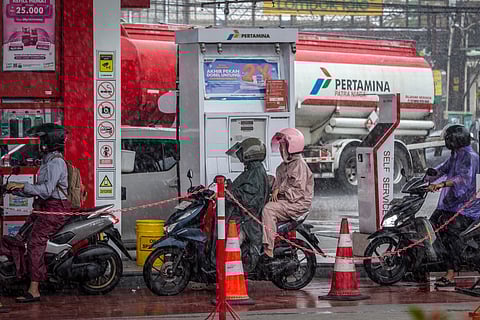
Dubai: Oil headed for a second weekly gain after US President Donald Trump said he would maintain a naval blockade of Iranian ports, keeping markets focused on whether the Strait of Hormuz can reopen soon and how long the pressure on fuel, freight and wider consumer costs may last.
Brent crude for July rose above $111 a barrel, while West Texas Intermediate traded near $106, leaving both benchmarks about 12% higher for the week. The move extends a two-week rally driven by the near-total closure of the Strait of Hormuz, which carried around a fifth of global crude flows before the war. Reuters reported that efforts to resolve the conflict remain at an impasse, while AP reported Brent at around $111 a barrel on Friday amid continuing uncertainty over the conflict and supply routes.
Get updated faster and for FREE: Download the Gulf News app now - simply click here.
The latest rise leaves consumers, airlines and importers facing a market where every signal from Washington and Tehran can feed directly into expectations for petrol, jet fuel, shipping and logistics costs.
Talks stall, supply fears build
Iran’s leadership has cast doubt on a near-term settlement with the US, while Tehran has signalled that it does not intend to give up its nuclear or missile technologies or loosen control over the strait.
Samer Hasn, Senior Market Analyst at XS.com, said oil prices are rising because markets are dealing with the risk of a renewed escalation in the Middle East, with hopes for a diplomatic solution fading as negotiations stall.
“Oil prices rise amid concerns about a renewed severe escalation in the Middle East war, with hopes for a diplomatic solution deemed stalled as negotiations stall,” Hasn said. “As the escalation risk targets more oil infrastructure in the region, crude prices are likely to remain higher for longer than the market could expect.”
Iran has warned it would launch “long and painful strikes” against US regional positions if Washington renews military attacks, while Iranian Foreign Ministry spokesman Esmaeil Baghaei said expecting quick results from negotiations was “not very realistic.”
Market pricing still looks calm
Hasn said futures markets still appear to be treating the crisis as temporary, even after Brent briefly moved above $125 a barrel earlier this week and the strait’s closure removed a major energy corridor from normal trade flows.
“Despite the upward trend in oil futures settlements, they still seem detached from reality, downplaying the scale of the crisis on the ground,” he said.
That disconnect is also visible in the futures curve, where prices still suggest some expectation that supply conditions will normalise later in the year. The risk, according to Hasn, is that traders may be leaning too heavily on the assumption that a political deal will reopen the strait and quickly restore fuel and jet fuel flows.
The Economist, cited in Hasn’s note, described the oil market as being in “La La Land” because traders and speculators continue to underestimate the supply shock caused by the war in Iran.
Physical market tightens
The gap between paper and physical prices is now narrowing, suggesting the disruption is beginning to appear in real supply conditions.
US crude exports surged to a record last week as global buyers turned to American producers for barrels to replace lost supply from the Middle East. That shift points to a market where the paper price may still be pricing in eventual relief, while physical buyers are already looking for alternative barrels.
Hasn said any reopening of the strait may not lead to an immediate return to normal flows, particularly if demining, damaged infrastructure or mothballed refining capacity slow the recovery.
“Even if a deal is reached, demining the strait could take months, and damaged oil wells or mothballed refineries may not immediately return to full capacity,” he said.
Inflation risk returns
The risk for households and businesses is that a prolonged supply shock could feed into a second round of price pressure across fuel, freight, air travel and imported goods.
Higher crude prices raise costs for airlines, shipping companies and logistics operators, with the impact often moving through the economy in stages. Fuel is the first pressure point, followed by freight rates, insurance, delivery costs and consumer prices.
Hasn said the world may soon face “a massive second inflationary shock” if governments are forced to move from supporting demand to managing the effects of reduced supply.
Trading volumes were below normal in Asia on Friday, with several markets closed for Labour Day, including China, Singapore, Germany, France and Brazil.
- With inputs from Agencies.